Ex. 99.2
Solicitation Version
|
§
|
|||
|
In re:
|
§
|
Chapter 11
|
|
|
§
|
|||
|
LUMINAR TECHNOLOGIES, INC.,
|
§
|
Case No. 25-90807 (CML)
|
|
|
et al.,
|
§
|
||
|
Debtors.1
|
§
|
(Jointly Administered)
|
|
|
§
|
|||
|
§
|
DISCLOSURE STATEMENT FOR
THIRD AMENDED CHAPTER 11 PLAN OF LIQUIDATION OF
THIRD AMENDED CHAPTER 11 PLAN OF LIQUIDATION OF
LUMINAR TECHNOLOGIES, INC. AND ITS AFFILIATED DEBTORS
|
WEIL, GOTSHAL & MANGES LLP
Stephanie N. Morrison (24126930) Austin B. Crabtree (24109763)
700 Louisiana Street, Suite 3700
Houston, Texas 77002
Telephone: (713) 546-5000
Facsimile: (713) 224-9511
|
WEIL, GOTSHAL & MANGES LLP
Ronit J. Berkovich (admitted pro hac vice) Jessica Liou (admitted pro hac vice) 767 Fifth Avenue New York, New York 10153 Telephone: (212) 310-8000 Facsimile: (212) 310-8007 |
|
Attorneys for Debtors and Debtors in Possession
|
|
|
Dated: February 18, 2026
Houston, Texas |
|
1
|
The Debtors in these chapter 11 cases, along with the last four digits of each Debtor’s federal tax identification number, are as follows: LAZR Technologies, LLC (8909); Luminar Technologies, Inc. (4317);
Luminar, LLC (7133); Condor Acquisition Sub I, Inc. (0155); and Condor Acquisition Sub II, Inc. (8587). The Debtors’ mailing address is 2603 Discovery Drive, Suite 100, Orlando, Florida 32826.
|
THIS SOLICITATION OF VOTES (THE “SOLICITATION”) IS BEING CONDUCTED TO OBTAIN SUFFICIENT VOTES TO ACCEPT THE PLAN (AS DEFINED HEREIN).
THE DEADLINE TO ACCEPT OR REJECT THE PLAN IS 4:00 P.M. (CENTRAL TIME) ON MARCH 23, 2026 (THE “VOTING DEADLINE”), UNLESS EXTENDED BY THE DEBTORS IN WRITING.
THE RECORD DATE FOR DETERMINING WHICH HOLDERS OF CLAIMS MAY VOTE ON THE PLAN IS FEBRUARY 18, 2026 (THE “RECORD DATE”).
RECOMMENDATION BY THE DEBTORS TO VOTE TO ACCEPT THE PLAN
The board of directors of each of Luminar Technologies, Inc., Condor Acquisition Sub I, Inc., and Condor Acquisition Sub II, Inc. and the sole member of each of LAZR Technologies, LLC and Luminar, LLC have
approved the transactions contemplated by the Plan. The Debtors believe the Plan is in the best interests of all stakeholders and recommend that all creditors whose votes are being solicited submit ballots to accept the Plan.
RECOMMENDATION BY THE CREDITORS’ COMMITTEE
TO VOTE TO ACCEPT THE PLAN
The Creditors’ Committee (i) believes that the Plan is in the best interests of the Debtors’ general unsecured creditors, (ii) supports confirmation of the Plan and (iii) recommends that all general unsecured
creditors in Class 5 submit a ballot to accept the Plan.
THE INFORMATION CONTAINED IN THIS DISCLOSURE STATEMENT (AS MAY BE AMENDED, SUPPLEMENTED, OR MODIFIED FROM TIME TO TIME, THE “DISCLOSURE STATEMENT”) IS INCLUDED HEREIN FOR THE PURPOSES OF
SOLICITING VOTES ON THE THIRD AMENDED CHAPTER 11 PLAN OF LIQUIDATION OF LUMINAR TECHNOLOGIES, INC. AND ITS AFFILIATED DEBTORS, DATED FEBRUARY 18, 2026 (THE “PLAN”),2 AND MAY NOT BE RELIED UPON FOR ANY PURPOSE OTHER THAN TO DETERMINE HOW TO VOTE ON THE PLAN. A COPY OF THE PLAN IS ANNEXED HERETO AS EXHIBIT A. NO SOLICITATION OF VOTES TO ACCEPT OR REJECT THE
PLAN MAY BE MADE EXCEPT PURSUANT TO SECTION 1125 OF CHAPTER 11 OF TITLE 11 OF THE UNITED STATES CODE (THE “BANKRUPTCY CODE”).
| 2 |
Capitalized terms used but not otherwise defined herein shall have the meanings ascribed to such terms in the Plan.
|
ii
ALL HOLDERS OF CLAIMS AND INTERESTS ARE ADVISED AND ENCOURAGED TO READ THE DISCLOSURE STATEMENT AND THE PLAN IN THEIR ENTIRETY BEFORE VOTING TO ACCEPT OR REJECT THE PLAN. IN PARTICULAR, ALL
HOLDERS OF CLAIMS AND INTERESTS SHOULD CAREFULLY READ AND CONSIDER FULLY THE RISK FACTORS SET FORTH IN SECTION VI (CERTAIN RISK FACTORS AFFECTING DEBTORS) OF THIS DISCLOSURE STATEMENT BEFORE VOTING TO ACCEPT OR REJECT THE PLAN. THE PLAN SUMMARIES
AND STATEMENTS MADE IN THIS DISCLOSURE STATEMENT ARE QUALIFIED IN THEIR ENTIRETY BY REFERENCE TO THE PLAN AND THE EXHIBITS ANNEXED TO THE PLAN AND THIS DISCLOSURE STATEMENT. IN THE EVENT OF ANY CONFLICT BETWEEN THE DESCRIPTIONS SET FORTH IN THIS
DISCLOSURE STATEMENT AND THE TERMS OF THE PLAN, THE TERMS OF THE PLAN GOVERN.
THE DISCLOSURE STATEMENT HAS BEEN PREPARED IN ACCORDANCE WITH SECTION 1125 OF THE BANKRUPTCY CODE AND RULE 3016(b) OF THE FEDERAL RULES OF BANKRUPTCY PROCEDURE (THE “BANKRUPTCY RULES”) AND
NOT NECESSARILY IN ACCORDANCE WITH OTHER NON-BANKRUPTCY LAW.
HOLDERS OF CLAIMS AND INTERESTS SHOULD NOT CONSTRUE THE CONTENTS OF THE DISCLOSURE STATEMENT AS PROVIDING ANY LEGAL, BUSINESS, FINANCIAL, OR TAX ADVICE AND SHOULD CONSULT WITH THEIR OWN ADVISORS
BEFORE CASTING A VOTE WITH RESPECT TO THE PLAN.
CERTAIN STATEMENTS CONTAINED IN THE DISCLOSURE STATEMENT, INCLUDING STATEMENTS INCORPORATED BY REFERENCE, PROJECTED FINANCIAL INFORMATION, AND OTHER FORWARD-LOOKING STATEMENTS, ARE BASED ON
ESTIMATES AND ASSUMPTIONS. THERE CAN BE NO ASSURANCE THAT SUCH STATEMENTS WILL BE REFLECTIVE OF ACTUAL OUTCOMES. FORWARD-LOOKING STATEMENTS SHOULD BE EVALUATED IN THE CONTEXT OF THE ESTIMATES, ASSUMPTIONS, UNCERTAINTIES, AND RISKS DESCRIBED
HEREIN.
FURTHERMORE, READERS ARE CAUTIONED THAT ANY FORWARD-LOOKING STATEMENTS HEREIN, INCLUDING ANY PROJECTIONS, ARE SUBJECT TO A NUMBER OF ASSUMPTIONS, RISKS, AND UNCERTAINTIES, MANY OF WHICH ARE BEYOND
THE CONTROL OF THE DEBTORS, INCLUDING THE IMPLEMENTATION OF THE PLAN. IMPORTANT ASSUMPTIONS AND OTHER IMPORTANT FACTORS THAT COULD CAUSE ACTUAL RESULTS TO DIFFER MATERIALLY INCLUDE THOSE FACTORS, RISKS, AND UNCERTAINTIES DESCRIBED IN MORE DETAIL
UNDER THE HEADING “CERTAIN RISK FACTORS AFFECTING DEBTORS” BELOW. PARTIES ARE CAUTIONED THAT THE FORWARD-LOOKING STATEMENTS SPEAK AS OF THE DATE MADE, ARE BASED ON THE DEBTORS’ CURRENT BELIEFS, INTENTIONS, AND EXPECTATIONS, AND ARE NOT GUARANTEES
OF FUTURE PERFORMANCE. ACTUAL RESULTS OR DEVELOPMENTS MAY DIFFER MATERIALLY FROM THE EXPECTATIONS EXPRESSED OR IMPLIED IN THE FORWARD-LOOKING STATEMENTS, AND THE DEBTORS UNDERTAKE NO OBLIGATION TO UPDATE ANY SUCH STATEMENTS. THE DEBTORS DO NOT
INTEND, AND UNDERTAKE NO OBLIGATION, TO UPDATE OR OTHERWISE REVISE ANY FORWARD-LOOKING STATEMENTS, INCLUDING ANY PROJECTIONS CONTAINED HEREIN, TO REFLECT EVENTS OR CIRCUMSTANCES EXISTING OR ARISING AFTER THE DATE HEREOF OR TO REFLECT THE OCCURRENCE
OF UNANTICIPATED EVENTS OR OTHERWISE.
NO INDEPENDENT AUDITOR OR ACCOUNTANT HAS REVIEWED OR APPROVED THE LIQUIDATION ANALYSIS HEREIN. THE STATEMENTS CONTAINED IN THE DISCLOSURE STATEMENT ARE MADE AS OF THE DATE HEREOF UNLESS OTHERWISE
SPECIFIED.
iii
THE DEBTORS HAVE NOT AUTHORIZED ANY PERSON TO GIVE ANY INFORMATION OR ADVICE, OR TO MAKE ANY REPRESENTATION, IN CONNECTION WITH THE PLAN OR THE DISCLOSURE STATEMENT.
THE INFORMATION IN THE DISCLOSURE STATEMENT IS BEING PROVIDED SOLELY FOR PURPOSES OF VOTING TO ACCEPT OR REJECT THE PLAN OR OBJECTING TO CONFIRMATION. NOTHING IN THE DISCLOSURE STATEMENT MAY BE
USED BY ANY PARTY FOR ANY OTHER PURPOSE.
ALL EXHIBITS TO THE DISCLOSURE STATEMENT ARE INCORPORATED INTO AND ARE A PART OF THE DISCLOSURE STATEMENT AS IF SET FORTH IN FULL HEREIN.
THE PLAN PROVIDES THAT THE FOLLOWING PARTIES ARE DEEMED TO GRANT THE RELEASES PROVIDED FOR THEREIN: (A) THE DEBTORS; (B) THE CREDITORS’ COMMITTEE AND EACH OF ITS MEMBERS, SOLELY IN THEIR CAPACITIES AS SUCH; (C) THE AD HOC NOTEHOLDER GROUP; (D) THE FIRST LIEN NOTES AGENT AND
SECOND LIEN NOTES AGENT, SOLELY IN THEIR CAPACITIES AS SUCH; AND (E) WITH RESPECT TO EACH OF THE FOREGOING PERSONS IN CLAUSES (A) THROUGH (D), ALL RELATED PARTIES; (F) THE HOLDERS OF ALL CLAIMS OR INTERESTS WHOSE VOTE TO ACCEPT OR REJECT THE PLAN
IS SOLICITED BUT THAT DO NOT VOTE EITHER TO ACCEPT OR TO REJECT THE PLAN AND DO NOT OPT OUT OF GRANTING THE RELEASES SET FORTH IN ARTICLE XI OF THE PLAN; (G) THE HOLDERS OF ALL CLAIMS OR INTERESTS THAT VOTE TO ACCEPT OR REJECT THE PLAN, ARE
DEEMED TO REJECT THE PLAN, OR ARE PRESUMED TO ACCEPT THE PLAN, BUT IN EACH CASE DO NOT OPT OUT OF GRANTING THE RELEASES SET FORTH IN ARTICLE XI OF THE PLAN; (H) THE HOLDERS OF ALL CLAIMS AND INTERESTS THAT WERE GIVEN NOTICE OF THE OPPORTUNITY TO
OPT OUT OF GRANTING THE RELEASES SET FORTH IN SECTION 11.6 OF THE PLAN BUT DID NOT OPT OUT.
HOLDERS OF CLAIMS OR INTERESTS IN VOTING CLASSES (CLASS 3 (FIRST LIEN NOTEHOLDER SECURED CLAIMS), CLASS 4 (SECOND LIEN NOTEHOLDER SECURED CLAIMS), AND CLASS 5 (GENERAL UNSECURED
CLAIMS)) WILL RECEIVE A BALLOT THAT INCLUDES THE OPTION TO OPT OUT OF THE RELEASES CONTAINED IN SECTION 11.6 OF THE PLAN. HOLDERS OF CLAIMS AND INTERESTS IN CERTAIN
NON-VOTING CLASSES (CLASS 1 (OTHER PRIORITY CLAIMS), CLASS 2 (OTHER SECURED CLAIMS), CLASS 8 (SUBORDINATED CLAIMS), AND CLASS 9 (PARENT INTERESTS)) WILL RECEIVE A NOTICE OF NON-VOTING STATUS THAT (I) NOTIFIES SUCH HOLDERS OF THEIR RIGHT TO OPT
OUT OF THE RELEASES CONTAINED IN SECTION 11.6 OF THE PLAN AND (II) INCLUDES A FORM PURSUANT TO WHICH SUCH HOLDERS CAN OPT OUT OF THE RELEASES CONTAINED IN SECTION 11.6 OF THE PLAN. SEE EXHIBIT D FOR A DESCRIPTION OF THE RELEASES AND
RELATED PROVISIONS.
PLEASE BE ADVISED THAT SECTIONS 11.3, 11.4, 11.5, 11.6, 11.7, 11.8, AND 11.9 OF THE PLAN CONTAIN RELEASE, EXCULPATION, AND INJUNCTION PROVISIONS. YOU SHOULD REVIEW AND CONSIDER THE PLAN CAREFULLY
BECAUSE YOUR RIGHTS MAY BE AFFECTED.
iv
NEITHER (A) THE ISSUANCE NOR THE DISTRIBUTION OF THE PARENT DEBTOR ADDITIONAL STOCK, NOR (B) THE ISSUANCE OF THE LIQUIDATING TRUST INTERSETS HAVE BEEN APPROVED OR DISAPPROVED BY THE SECURITIES AND
EXCHANGE COMMISSION (THE “SEC”) OR BY ANY STATE SECURITIES COMMISSION OR OTHER PUBLIC, GOVERNMENTAL, OR REGULATORY AUTHORITY, AND NEITHER THE SEC NOR ANY SUCH AUTHORITY HAS PASSED UPON THE ACCURACY OR
ADEQUACY OF THE INFORMATION CONTAINED IN THIS DISCLOSURE STATEMENT OR UPON THE MERITS OF THE PLAN OR THE ISSUANCE AND THE DISTRIBUTION OF THE PARENT DEBTOR ADDITIONAL STOCK. ANY REPRESENTATION TO THE CONTRARY IS A CRIMINAL OFFENSE.
An opt-out election form (the “Release Opt-Out Form”) or a Ballot (as defined herein) containing an opt-out election has been or will be mailed to you. The Release
Opt-Out Form or Ballot, as applicable, will provide you with the option to opt out of granting the releases contained in Section 11.6(b) of the Plan. You must complete and timely return the Release Opt-Out Form or Ballot, as applicable, to the
Voting Agent (as defined herein) by the Voting Deadline, March 23, 2026 at 4:00 p.m. (Central Time), in accordance with the instructions set forth in the Release Opt-Out Form or Ballot, as applicable, for your opt-out to be valid. OTHERWISE,
EXCEPT AS EXPRESSLY SET FORTH IN THE PLAN, YOU WILL BE DEEMED TO CONSENT TO AND BE BOUND BY THE RELEASES SET FORTH IN THE PLAN. Please review the additional information set forth in this Disclosure Statement, the Plan, the Release Opt-Out Form,
and the Ballot, as applicable, and any other documents related to these chapter 11 cases that you may receive from time to time. Please be advised that your decision to opt out or not opt out of the releases in Section 11.6(b) of the Plan does
not affect the amount of any distribution you may receive under the Plan.
v
|
I. INTRODUCTION
|
10
|
|||
|
A.
|
OVERVIEW OF PLAN
|
11
|
||
|
B.
|
GLOBAL SETTLEMENT
|
13
|
||
|
C.
|
TREATMENT OF CLAIMS AND INTERESTS
|
15
|
||
|
1.
|
Claims and Interests in Luminar Technologies, Inc.
|
15
|
||
|
2.
|
Key Recovery Table Assumptions and Qualifications
|
17
|
||
|
D.
|
VOTING PROCEDURES
|
18
|
||
|
II. OVERVIEW OF DEBTORS’ OPERATIONS
|
19
|
|||
|
A.
|
COMPANY’S BACKGROUND AND FORMATION
|
19
|
||
|
B.
|
BUSINESS OPERATIONS
|
21
|
||
|
1.
|
LiDARCo
|
21
|
||
|
2.
|
LSICo
|
22
|
||
|
C.
|
CORPORATE STRUCTURE AND GOVERNANCE
|
23
|
||
|
1.
|
Corporate Structure
|
23
|
||
|
2.
|
Capital Structure
|
24
|
||
|
a.
|
First Lien Notes
|
24
|
||
|
b.
|
Second Lien Convertible Notes
|
25
|
||
|
c.
|
Intercreditor Agreement
|
25
|
||
|
d.
|
Unsecured Convertible Notes
|
26
|
||
|
e.
|
Additional Financing Agreements (No Amounts Outstanding)
|
26
|
||
|
f.
|
Common Stock
|
27
|
||
|
3.
|
Prepetition Litigation
|
27
|
||
|
a.
|
Securities Class Action (2023 Action)
|
27
|
||
|
b.
|
Securities Class Action (2025 Action)
|
27
|
||
|
c.
|
Shareholder Derivative Suits (2023)
|
28
|
||
|
d.
|
Shareholder Derivative Suit (2025)
|
28
|
||
|
e.
|
SEC Investigation
|
28
|
||
|
f.
|
Solfice Shareholder Suit (2025)
|
29
|
||
| 4. |
Liquidity
|
29
|
||
| 5. |
Other Assets
|
29
|
||
|
III. KEY EVENTS LEADING TO COMMENCEMENT OF CHAPTER 11 CASES
|
29
|
|||
|
A.
|
CHALLENGES FACING THE DEBTORS’ BUSINESSES
|
30
|
||
vi
|
1.
|
Volvo Relationship Deterioration
|
30
|
|
|
2.
|
Consequences of Partnership Setbacks
|
31
|
|
|
3.
|
Industry Challenges
|
32
|
|
|
B.
|
FINANCIAL PERFORMANCE
|
33
|
|
|
C.
|
LIABILITY MANAGEMENT AND CAPITAL RAISING INITIATIVES
|
33
|
|
|
D.
|
KEY EMPLOYEE RETENTION PROGRAM
|
34
|
|
|
E.
|
OPERATIONAL RESTRUCTURING EFFORTS
|
35
|
|
|
F.
|
PURSUIT OF STRATEGIC AND SALE TRANSACTIONS
|
35
|
|
|
IV. KEY EVENTS DURING CHAPTER 11 CASES
|
37
|
||
|
A.
|
FIRST DAY PLEADINGS
|
37
|
|
|
B.
|
CASH COLLATERAL
|
38
|
|
|
C.
|
COST-SAVING MEASURES
|
39
|
|
|
D.
|
FILING OF CONDOR ENTITIES
|
39
|
|
|
E.
|
ADDITIONAL MOTIONS AND APPLICATIONS
|
39
|
|
|
F.
|
TIMETABLE FOR CHAPTER 11 CASES
|
40
|
|
|
G.
|
GLOBAL BIDDING PROCEDURES AND POSTPETITION SALE PROCESS
|
40
|
|
|
1.
|
LSI Assets Sale Process
|
41
|
|
|
2.
|
LiDAR Assets Sale Process
|
41
|
|
|
3.
|
Asset Sale Offer
|
43
|
|
|
H.
|
STATEMENTS AND SCHEDULES, AND CLAIMS BAR DATES
|
43
|
|
|
I.
|
ADVERSARY PROCEEDINGS
|
44
|
|
|
1.
|
Puttagunta Adversary Proceeding
|
44
|
|
|
2.
|
NEXT Semiconductor Technologies, Inc. Adversary Proceeding
|
45
|
|
|
J.
|
SIC INVESTIGATION
|
45
|
|
|
K.
|
CREDITORS’ COMMITTEE INVESTIGATION
|
46
|
|
|
L.
|
COMMON STOCK
|
46
|
|
|
V. SECURITIES LAWS EXEMPTIONS AND RESTRICTIONS ON TRANSFER
|
47
|
||
|
VI. CERTAIN RISK FACTORS AFFECTING DEBTORS
|
47
|
||
|
A.
|
CERTAIN BANKRUPTCY LAW CONSIDERATIONS
|
47
|
|
|
1.
|
Risk Related to Termination of Consensual Use of Cash Collateral
|
47
|
|
|
2.
|
Risk of Non-Confirmation of Plan
|
48
|
|
|
3.
|
Risk of Non-Consensual Confirmation
|
48
|
|
|
4.
|
Risk of Non-Occurrence of Effective Date
|
48
|
|
|
5.
|
Alternative Transactions
|
48
|
|
|
6.
|
Risks Related to Possible Objections to Plan
|
49
|
|
vii
|
7.
|
Global Settlement May Not Be Approved
|
49
|
|
|
8.
|
Releases, Injunctions, and Exculpation Provisions May Not Be Approved
|
49
|
|
|
9.
|
Claims Could Be More than Projected
|
49
|
|
|
10.
|
Participation in the Asset Sale Offer Could be Less Than Anticipated
|
49
|
|
|
11.
|
Distributions
|
49
|
|
|
12.
|
Administrative Insolvency
|
50
|
|
|
13.
|
Conversion to Chapter 7
|
50
|
|
|
14.
|
The Debtors’ Liquidity May be Exhausted and No Alternative Financing may be Obtained Before the Effective Date
|
50
|
|
|
15.
|
Dismissal of Chapter 11 Cases
|
50
|
|
|
16.
|
Cost of Administering Debtors’ Estates
|
50
|
|
|
B.
|
ADDITIONAL FACTORS TO BE CONSIDERED
|
51
|
|
|
1.
|
Debtors Could Withdraw Plan
|
51
|
|
|
2.
|
Debtors Have No Duty to Update
|
51
|
|
|
3.
|
No Representations Outside This Disclosure Statement Are Authorized
|
51
|
|
|
4.
|
No Legal or Tax Advice Is Provided to You by This Disclosure Statement
|
51
|
|
|
5.
|
No Admission Made
|
51
|
|
|
6.
|
No Waiver of Right to Object or Right to Recover Transfers and Assets
|
51
|
|
|
7.
|
Ongoing Litigation Could Affect the Outcome of the Chapter 11 Cases
|
52
|
|
|
8.
|
Objection to Amount or Classification of Claims
|
52
|
|
|
VII. CERTAIN U.S. FEDERAL INCOME TAX CONSEQUENCES
|
52
|
||
|
A.
|
CONSEQUENCES TO DEBTORS
|
53
|
|
|
1.
|
Transfer of Assets to the Liquidation Trust; Wind Down of the Debtors
|
54
|
|
|
2.
|
Cancellation of Debt
|
54
|
|
|
B.
|
CONSEQUENCES TO HOLDERS OF ALLOWED GENERAL UNSECURED CLAIMS
|
55
|
|
|
1.
|
Treatment to U.S. Holders of Allowed First Lien Noteholder Secured Claims or Allowed Second Lien Secured Claims
|
55
|
|
|
2.
|
Treatment to U.S. Holders of Allowed General Unsecured Claims
|
56
|
|
|
3.
|
Distributions in Respect of Accrued But Unpaid Interest or OID
|
57
|
|
|
4.
|
Character of Gain or Loss
|
58
|
|
|
C.
|
TAX TREATMENT OF LIQUIDATION TRUST AND ITS BENEFICIARIES
|
58
|
|
|
1.
|
General “Liquidating Trust” Tax Reporting by the Liquidation Trust and their Beneficiaries
|
59
|
|
viii
|
2.
|
Tax Reporting for Assets Allocable to a Disputed Ownership Fund (including the GUC Reserve)
|
60
|
||
|
D.
|
WITHHOLDING ON DISTRIBUTIONS AND INFORMATION REPORTING
|
60
|
||
|
VIII. CONFIRMATION OF PLAN
|
61
|
|||
|
A.
|
CONFIRMATION HEARING
|
61
|
||
|
B.
|
OBJECTIONS
|
61
|
||
|
C.
|
REQUIREMENTS FOR CONFIRMATION OF PLAN
|
62
|
||
|
1.
|
Requirements of Section 1129(a) of Bankruptcy Code
|
62
|
||
|
2.
|
Acceptance of Plan
|
63
|
||
|
3.
|
Cramdown
|
63
|
||
|
a.
|
No Unfair Discrimination
|
64
|
||
|
b.
|
Fair and Equitable Test
|
64
|
||
|
4.
|
Best Interests Test
|
65
|
||
|
5.
|
Feasibility
|
65
|
||
|
IX. RELEASES
|
65
|
|||
|
X. ALTERNATIVES TO CONFIRMATION AND CONSUMMATION OF PLAN
|
66
|
|||
|
1.
|
Alternative Plan of Liquidation
|
67
|
||
|
2.
|
Liquidation under Chapter 7 of Bankruptcy Code
|
67
|
||
|
XI. CONCLUSION
|
67
|
|||
|
EXHIBIT A
|
Plan [filed separately]
|
|
EXHIBIT B
|
Debtors’ Organizational Structure
|
|
EXHIBIT C
|
Liquidation Analysis
|
|
EXHIBIT D
|
Release, Injunction and Exculpation Provisions
|
|
EXHIBIT E
|
Solicitation and Voting Procedures
|
ix
On December 15, 2025, and December 31, 2025, as applicable (the “Petition Date”), Luminar Technologies, Inc. (“Luminar”
or “Luminar Parent”), LAZR Technologies, LLC, Luminar, LLC, Condor Acquisition Sub I, Inc., and Condor Acquisition Sub II, Inc. (together with Luminar, the “Debtors”,
and, the Debtors collectively with the Debtors’ direct and indirect non-debtor subsidiaries, the “Company”) commenced voluntary cases in the United States Bankruptcy Court for the Southern District of Texas
(the “Bankruptcy Court”) pursuant to chapter 11 of the Bankruptcy Code. The Debtors’ chapter 11 cases are being jointly administered for procedural purposes only pursuant to Bankruptcy Rule 1015(b).
On December 30, 2025, the United States Trustee for Region 7 (the “U.S. Trustee”) appointed the Creditors’ Committee pursuant to section 1102 of the
Bankruptcy Code to represent the interests of unsecured creditors in the chapter 11 cases (Docket No. 115). The members of the Creditors’ Committee are (i) U.S. Bank Trust Company, National Association, (ii) Fujian Hitronics Technologies, Inc.,
(iii) Applied Intuition, Inc., (iv) Optera TPK Holding Pte., Ltd. and TPK Precision Hong Kong Co., Ltd., (v) Workday, Inc., (vi) STEER Tech LLC, and (vii) Alidade Discovery Lakes, II, LLC. The Creditors’ Committee retained Paul Hastings LLP (“Paul Hastings”) as counsel and Alvarez & Marsal Holdings, LLC (A&M) as financial advisor.
The purpose of this Disclosure Statement is to provide information of a kind, and in sufficient detail, to enable creditors of the Debtors that are entitled to vote on the Plan to make an informed
decision on whether to vote to accept or reject the Plan. The Disclosure Statement contains, among other things, a summary of (i) the treatment of Claims against and Interests in the Debtors under the Plan, (ii) the Debtors’ business and certain
historical events, (iii) anticipated events during these chapter 11 cases, (iv) risk factors affecting the Debtors and the Plan, and (v) the standard for seeking confirmation of the Plan.
As described in more detail below, the Debtors faced certain financial difficulties prior to the Petition Date and commenced these chapter 11 cases to facilitate value-maximizing sale processes for
its LiDAR business and for the equity of Luminar Semiconductors Inc. (“LSI”) and certain of its subsidiaries (collectively, “LSICo”).
On December 15, 2025, the Debtors entered into a Stock Purchase Agreement with Quantum Computing, Inc. (“QCi”), the stalking horse bidder for the LSICo
equity. On December 18, 2025, the Debtors filed a motion seeking approval of bidding procedures, designation of QCi as the stalking horse bidder for the LSICo equity, and authorization to designate one or more stalking horse bidders for the
LiDARCo (as defined herein) equity (Docket No. 86) (the “Bidding Procedures Motion”), which was entered by the Bankruptcy Court on December 30, 2025 (Docket No. 119) (the “Bidding
Procedures Order”). The Debtors received no additional qualified bids, and the Bankruptcy Court approved the sale of the LSICo equity to QCi at a hearing held on January 27, 2026 (Docket No. 320). The LSI Sale Transaction closed on
February 2, 2026.
On January 11, 2026, the Debtors entered into a purchase agreement with QCi for the LiDARCo assets and filed a notice designating QCi as the stalking horse bidder for
the LiDARCo assets (Docket No. 202). The Debtors qualified an additional bid and held an auction for the LiDARCo assets on January 26, 2026. At the conclusion of the auction, the Debtors named MicroVision, Inc. (“MicroVision”)
as the successful bidder and QCi as the back-up bidder. At a hearing held on January 27, 2026, the Bankruptcy Court approved the sale of the LiDARCo assets to MicroVision (Docket No. 329). The LiDARCo Sale Transaction closed on February 3, 2026.
10
In the last several weeks, the Debtors have engaged in extensive negotiations with the Creditors’ Committee and Ad Hoc Noteholder Group, culminating in the entry into a global compromise and
settlement to resolve all of the Creditors’ Committee’s issues with the Plan, including the allocation of consideration to be distributed to holders of unsecured claims (the “Global Settlement”). The terms
of the Global Settlement are incorporated into the Plan and described in Section I.B herein.
| A. |
OVERVIEW OF PLAN
|
The Plan contemplates the distribution of the proceeds from the completed sales of substantially all the Debtors’ assets pursuant to section 363 of the Bankruptcy Code to QCi for LSICo and to
MicroVision for LiDARCo and the efficient and orderly wind-down of the Debtors’ estates in accordance with the Global Settlement.
To implement the provisions of the Plan, including making distributions to holders of Claims and Interests, the Plan contemplates the creation of a Liquidation Trust, as well as the appointment of
a Liquidation Trustee, the identity of which shall be included in the Plan Supplement. The selection of the Liquidation Trustee shall be mutually agreeable between the Ad Hoc Noteholder Group and the Creditors’ Committee, and reasonably acceptable
to the Debtors. The Liquidation Trustee shall carry out and implement all provisions of the Plan after the Effective Date, including the reconciliation of Claims, the monetization of the Liquidation Trust Assets, including the GUC Reserve Assets,
and the winding down of the Debtors’ estates. A Liquidation Trust Oversight Board shall be established to supervise the Liquidation Trustee’s reconciliation of General Unsecured Claims and its pursuit, abandonment, or liquidation of the GUC
Reserve Assets. The Liquidation Trust Oversight Board will be comprised of three (3) members, each of which will be selected by the Creditors’ Committee.
On or before the Effective Date, the Debtors and the Liquidation Trustee shall take all necessary steps to establish the Liquidation Trust for the benefit of Holders of Claims against the Debtors,
including executing the Liquidation Trust Agreement and the Liquidation Trust Transfer Agreement, each of which shall be in form and substance reasonably acceptable to the Debtors, the Required Senior Secured Holders, and the Creditors’ Committee,
and all of the Assets of the Debtors as of the Effective Date will vest with the Liquidation Trust.
The Plan further provides for, on the Effective Date, certain distributions to be made and reserves to be established, including (i) initial funding of the Senior Claims Reserve on account of
Allowed Administrative Expense Claims, Allowed Priority Tax Claims, and Allowed Priority Non-Tax Claims, (ii) funding of the Wind Down Reserve with the Wind Down Amount ($3,000,000) in accordance with the Wind Down Budget, (iii) funding of the
First Lien Reserve, (iv) funding of the GUC Reserve, and (v) funding of the Professional Fee Escrow Account and payment of Professional Fee Claims therefrom. In addition to the Professional Fee Escrow Account, the Liquidation Trustee will
establish a separate account for each of the Senior Claims Reserve, Wind Down Reserve, GUC Reserve, First Lien Reserve, and Second Lien Reserve, each to be maintained by the Liquidation Trustee in accordance with the Plan.
The Liquidation Trustee shall make Plan Distributions, as applicable, in the frequency determined in the Liquidation Trustee’s discretion, in accordance with the Plan:
Holders of Other Secured Claims will either receive (i) payment in full in Cash of their Allowed Claims, (ii) other treatment to render them unimpaired, or (iii) such other recovery to satisfy
section 1129 of the Bankruptcy Code.
11
Holders of First Lien Noteholder Secured Claims will receive their pro rata share of First Lien Liquidation Trust Interests, which beneficial interests will entitle them to the Excess Cash to be
allocated pursuant to the Waterfall, until they receive the allowed amount of their Claims.
Holders of Second Lien Noteholder Secured Claims will receive their pro rata share of Second Lien Liquidation Trust Interests, which beneficial interests will entitle them to the Excess Cash
remaining after all First Lien Noteholder Secured Claims are satisfied in full pursuant to the Waterfall.
Holders of General Unsecured Claims, including any deficiency claims of the First Lien Noteholders and the Second Lien Noteholders, as well as the claims of the Unsecured Noteholders, will receive
their pro rata share of the GUC Liquidation Trust Interests, which beneficial interests will entitle them to share in a GUC Reserve that consists of (i) the GUC Residual Amount,1 if any, (ii) the GUC Reserve Funding Amount of $1,500,000.00, (iii) the Retained Causes of Action belonging to each of the Debtors and the Debtors’ Estates and the proceeds thereof (including any D&O Policy proceeds payable
to the Estate on account of settlements or judgments from Commercial Tort Claims and other non-released claims and Causes of Action), and (iv) the Unencumbered Assets, and (v) the proceeds of each of the foregoing clauses (i)-(iv), which in the case of clauses (ii), (iii), and (iv) shall be transferred to the Liquidation Trust on the Effective Date, and in the case of clauses (i) and (v) shall be transferred to the Liquidation Trust on the Effective Date
or as soon as reasonably practicable thereafter in accordance with the Plan, free and clear of all Claims, Liens, and encumbrances.
For purposes of making distributions under the Plan to Holders of General Unsecured Claims, the Debtors’ assets and liabilities will be substantively consolidated, and as such, treated as if they
belonged to a single combined entity. As a result, a General Unsecured Claim against any one Debtor will be treated as a single General Unsecured Claim against the combined Debtors, rather than as separate claims against each individual Debtor.
After the Effective Date, pursuant to the Plan, the Liquidation Trustee shall, in an expeditious but orderly manner, wind down, sell, and otherwise liquidate and convert to Cash the
remaining assets of the Debtors, with no objective to continue or conduct a trade or business except to the extent reasonably necessary to, and consistent with, the liquidation and orderly wind down of the Debtors and shall not unduly prolong the
duration of the liquidation and the wind down.
To the extent the Liquidation Trustee generates Excess Cash after the Effective Date from monetizing the Liquidation Trust Assets, including the receipt of any Surplus Reserved
Cash, Surplus Senior Claims Reserve Cash, and Surplus Professional Fee Escrow Account, such proceeds shall be allocated pursuant to the Waterfall as set forth below.
For cash remaining after the initial funding of reserves on the Effective Date, derived from the monetization of non-GUC Reserve Assets of the Liquidation Trust, or received from
surplus reserve amounts, such proceeds shall be distributed through the Waterfall in the following order:
| 1. |
to fund any deficits in the Senior Claims Reserve;
|
| 2. |
to fund the First Lien Reserve for the benefit of First Lien Noteholders;
|
| 1 |
The “GUC Residual Amount” means any Excess Cash remaining after (i) any deficits in the Senior Claims Reserve are satisfied in accordance with the Plan, (ii) Holders of First Lien Liquidation Trust Interests receive an amount equal to
their Allowed First Lien Noteholder Secured Claims, and (iii) Holders of Second Lien Liquidation Trust Interests receive an amount equal to their Allowed Second Lien Noteholder Secured Claims.
|
12
| 3. |
to fund the Second Lien Reserve for the benefit of Second Lien Noteholders; and
|
| 4. |
as the GUC Residual Amount, if any, to be distributed to Holders of General Unsecured Claims.
|
For cash (i) derived from the monetization of GUC Reserve Assets of the Liquidation Trust or (ii) remaining as GUC Residual Amount, such proceeds shall be
applied in the following order:
| 1. |
to fund up to $200,000.00 of the Creditors’ Committee Fees in excess of the Creditors’ Committee Fee Cap;
|
| 2. |
to fund the GUC Reserve for the benefit of Holders of General Unsecured Claims.
|
Furthermore, the Office of Foreign Assets Control (“OFAC”) has issued a blocking order for 5% of Luminar Parent shares (the “Blocked
Parent Interests”). As a result, pursuant to OFAC regulations, the Debtors are prohibited from dealing in, or otherwise affecting, the Blocked Parent Interests prior to obtaining an OFAC License. The Debtors are preparing to apply for
such an OFAC License, but the timing of obtaining such license is to be determined. Therefore, the Debtors’ Plan provides that on the Effective Date, to the extent the Debtors have not secured an OFAC License, (i) all Parent Interests, other than
the Blocked Parent Interests, will be cancelled and (ii) substantially contemporaneously, new common stock in the Parent Debtor of the same number, class, and series as the Unblocked Parent Interests that are cancelled pursuant to section 4.9 of
the Plan will be issued to the Liquidation Trust. The Parent Debtor Additional Stock shall be held only (and not transferred by) the Liquidation Trust and, once the Debtors have secured the OFAC License and can cancel the Blocked Parent Interests,
the Liquidation Trust will be entitled to subsequently cancel all remaining Interests (including the Blocked Parent Interests) and wind down Luminar Technologies, Inc.
Any right to receive a Distribution from the Liquidation Trust will not, and is not intended to, constitute “securities” and, accordingly, will not be
registered pursuant to the Securities Act or any applicable state or local securities law. However, if it should be determined that any such right to receive such Distributions constitute “securities,” the exemption provisions of section 1145 of
the Bankruptcy Code will be satisfied and the offer and sale under the Plan of such right will be exempt from registration under the Securities Act, all rules and regulations promulgated thereunder, and all applicable state and local securities
laws and regulations. Any such right to receive such Distributions (and the underlying Claim giving rise thereto) shall not: (a) be voluntarily or involuntarily, directly or indirectly, assigned, conveyed, hypothecated, pledged, or otherwise
transferred or traded; (b) be evidenced by a certificate or other instrument; and (c) possess any voting rights with respect to the Liquidation Trust or otherwise, except as otherwise provided in the governing documents thereof.
The Debtors believe the Plan maximizes value for all stakeholders.
| B. |
GLOBAL SETTLEMENT
|
The Debtors, the Ad Hoc Noteholder Group, and the Creditors’ Committee have engaged in good faith and arm’s length negotiations, culminating in the parties’ entry into the Global Settlement. The
Global Settlement is incorporated into the Plan and provides for the resolution of all disputes, claims, and controversies between the parties, including those related to the Plan and treatment of general unsecured claims, among other issues.
The Global Settlement includes, among others, the following material terms and conditions (each as set forth in the Plan):
13
| • |
Holders of General Unsecured Claims (including First Lien Noteholder Deficiency Claims, if any, and Second Lien Noteholder Deficiency Claims) shall receive GUC Liquidation Trust Interests entitling them to their Pro Rata Share of Cash
consisting of the GUC Reserve Assets and any proceeds thereof, net of any costs and expenses incurred by the Liquidation Trust (including fees of the Liquidation Trustee and any taxes incurred by the Liquidation Trustee, whether such taxes
are incurred directly by the Liquidation Trustee in his or her role as such, or on account of those taxes attributed proportionately to each Holders’ share of GUC Liquidation Trust Interests) in connection with the pursuit, abandonment, or
liquidation of all GUC Reserve Assets;
|
| • |
GUC Reserve Assets shall include (i) the GUC Residual Amount, if any, (ii) the GUC Reserve Funding Amount of $1,500,000.00, (iii) the Retained Causes of Action belonging to each of the Debtors and the Debtors’ Estates and the proceeds
thereof (including any D&O Policy proceeds payable to the Estate on account of settlements or judgments from Commercial Tort Claims and other non-released claims and Causes of Action), and (iv) the Unencumbered Assets, and (v) the
proceeds of each of the foregoing clauses (i)-(iv);
|
| • |
The appointment of the Liquidation Trustee shall be mutually agreeable between the Ad Hoc Noteholder Group and the Creditors’ Committee and reasonably acceptable to the Debtors; the Creditors’ Committee shall select each of the three
members of the Liquidation Trust Oversight Board;
|
| • |
The Debtors shall be deemed substantively consolidated for purposes of distributions to Holders of General Unsecured Claims;
|
| • |
All Preference Actions against the Debtors’ trade vendors shall be deemed released on the Effective Date;
|
| • |
The Ad Hoc Noteholder Group consents to permit the Debtors to use Cash Collateral through the Effective Date;
|
| • |
The sum of the Allowed Professional Fee Claims of the Creditors’ Committee Advisors and the Restructuring Fees and Expenses due to the Unsecured Notes Trustee shall be capped at $4.225 million; provided
that any amounts up to $200,000 incurred in excess of $4.025 million shall be payable from the first dollars to be distributed as Post Effective Date Available Cash (GUC Reserve Assets); and
|
| • |
Only if the Effective Date of the Plan occurs on or before April 14, 2026, the aggregate Allowed Professional Fee Claims of the Debtors’ Advisors (excluding any amounts paid pursuant to the Ordinary Course Professionals Retention Order)
shall not exceed $26.471 million.
|
The Debtors, the Ad Hoc Noteholder Group, and the Creditors’ Committee believe that the Global Settlement avoids potentially costly, time-consuming, and wasteful litigation and any related delays
in distributions to creditors. The Debtors, the Ad Hoc Noteholder Group, and the Creditors’ Committee likewise believe the Global Settlement balances the desires of the key constituents in these cases and provides an equitable solution that is
reasonable, fair and efficient. For these and other reasons described above, the Creditors’ Committee recommends that creditors in class 5 vote to ACCEPT the Plan.
14
| C. |
TREATMENT OF CLAIMS AND INTERESTS
|
The following table summarizes (i) the type of Claims and Interests under the Plan, (ii) which Classes are impaired by the Plan, and (iii) which Classes are entitled to vote on the Plan. The table
is qualified in its entirety by reference to the full text of the Plan.
| 1. |
Claims and Interests in Luminar Technologies, Inc.
|
|
Designation
|
Total Est. Claims3
|
||||||
|
Class 1: Other Priority Claims
|
Except to the extent that a Holder of an Allowed Other Priority Claim agrees to a less favorable treatment of such Claim, each such Holder shall receive, in full and final satisfaction, settlement, release,
and discharge of such Claim, on or as soon as reasonably practicable after the later of the Effective Date and the date that is thirty (30) calendar days after the date such Other Priority Claim becomes an Allowed Claim, at the option of
the Debtors or Liquidation Trustee (as applicable), either (i) payment in full in Cash or (ii) other treatment consistent with the provisions of section 1129(a)(9) of the Bankruptcy Code.
|
Unimpaired
|
No (Presumed to Accept)
|
$0.8M
|
100%
|
||
|
Class 2: Other Secured Claims
|
Except to the extent that a Holder of an Allowed Other Secured Claim agrees to less favorable treatment of such Claim, each Holder of an Allowed Other Secured Claim shall receive, at the option of the Debtors
or the Liquidation Trustee, as applicable, in full and final satisfaction, settlement, release, and discharge of such Claim, on the Effective Date or as soon as reasonably practicable thereafter: (i) payment in full in Cash in an amount
equal to the Allowed amount of such Other Secured Claim; (ii) such other treatment sufficient to render such Holder’s Allowed Other Secured Claim Unimpaired pursuant to section 1124 of the Bankruptcy Code; or (iii such other recovery
necessary to satisfy section 1129 of the Bankruptcy Code.
|
Unimpaired
|
No
|
$8.0M
|
100%
|
|
2
|
Nothing in the Plan or Confirmation Order shall grant the Debtors a discharge pursuant to section 1141(d) of the Bankruptcy Code.
|
|
3
|
The total estimated claim amounts are based on preliminary claims estimates and are subject to material change, including on account of any additional claims that may be Filed and Allowed, such as rejection
damages claims. Additional information regarding the assumptions and qualifications regarding this recovery table is set forth in Section I.C.2.
|
15
|
Class
Designation
|
Plan Treatment2 | Impairment | Entitlement to Vote | Total Est. Claims3 | Approx. Percentage Recovery | ||
|
Class 3: First Lien Noteholder Secured Claims
|
Except to the extent that a Holder of a First Lien Noteholder Secured Claim agrees to a less favorable treatment of such Claim, each such Holder shall receive, in full and final satisfaction, settlement,
release, and discharge of such Claim, on the Effective Date or as soon as reasonably practicable thereafter, such Holder’s Pro Rata Share of the First Lien Liquidation Trust Interests.
|
Impaired
|
Yes
|
$24.0M
|
100%
|
||
|
Class 4: Second Lien Noteholder Secured Claims
|
Except to the extent that a Holder of a Second Lien Noteholder Secured Claim agrees to a less favorable treatment of such Claim, each such Holder shall receive, in full and final satisfaction, settlement,
release, and discharge of such Claim, on the Effective Date or as soon as reasonably practicable thereafter, such Holder’s Pro Rata Share of the Second Lien Liquidation Trust Interests.
|
Impaired
|
Yes
|
$14.0M
|
48–100%
|
||
|
Class 5: General Unsecured Claims
|
Except to the extent that a Holder of an Allowed General Unsecured Claim agrees to a less favorable treatment of such Claim, each such Holder shall receive, in full and final satisfaction, settlement,
release, and discharge of such Claim, on the Effective Date or as soon as reasonably practicable thereafter, such Holder’s Pro Rata Share of the GUC Liquidation Trust Interests.
|
Impaired
|
Yes
|
$518.8M
|
0–1%
|
||
|
Class 6: Intercompany Claims
|
On or before the Effective Date or as soon as reasonably practicable thereafter, all Intercompany Claims shall be adjusted, Reinstated, or discharged (each without any distribution) to the extent reasonably
determined to be appropriate by the Debtors or Liquidation Trustee (as applicable).
|
Impaired
|
No (Deemed to Reject)
|
$6.8M
|
None.
|
||
|
Class 7: Intercompany Interests
|
On the Effective Date, and without the need for any further corporate or limited liability company action or approval of any member, board of directors, board of managers, managers, management, or Security
Holders of any Debtor, all Intercompany Interests shall be cancelled, released, and extinguished, by distribution, contribution or otherwise, as determined by the Debtors or the Liquidation Trustee (as applicable); provided that no Plan Distributions shall be made to Holders of an Intercompany Interest on account of such Intercompany Interest under the Plan.
|
Unimpaired / Impaired
|
No (Deemed to Reject)
|
N/A
|
None.
|
16
|
Class
Designation
|
Plan Treatment2 | Impairment | Entitlement to Vote | Total Est. Claims3 | Approx. Percentage Recovery | ||
|
Class 8: Subordinated Claims
|
All Subordinated Claims, if any, shall be discharged, cancelled, released, and extinguished as of the Effective Date, and will be of no further force or effect, and Holders of Allowed Subordinated Claims will
not receive any distribution on account of such Claims.
|
Impaired
|
No (Deemed to Reject)
|
N/A
|
None.
|
||
|
Class 9: Parent Interests
|
Without the need for any further corporate or limited liability company action or approval of any board of directors, management, or Security Holders of any Debtor, as applicable, all Parent Interests shall
be cancelled (i) on the Effective Date, with respect to all Unblocked Parent Interests and (ii) after OFAC issues the OFAC License, with respect to all Blocked Parent Interests, and the Holders of Parent Interests will not receive or retain
any property on account of such Parent Interests under the Plan.
|
Impaired
|
No (Deemed to Reject)
|
N/A
|
None.
|
| 2. |
Key Recovery Table Assumptions and Qualifications
|
The recovery table above estimates ~$32.2 to $39.4 million of net proceeds are available for recovery to creditors, after the Asset Sale Offer (as defined and described below), and the funding of
the Wind Down Trust ($3.0 million) and Liquidation Trust, and include (i) estimated cash and cash equivalents based on the Approved Budget under the Final Cash Collateral Order and includes estimated proceeds from the LiDAR Sale Transaction, (ii)
estimated recoveries on accounts receivables, (iii) a 50–100% recovery of the $11.0 million LSI Post Closing Indemnity Escrow; and (iv) other assets and PP&E, including estimated recoveries on the NEXT Note and SAFE Note, proceeds from the sale
of real property in Florida, and any remaining value distributed from or liquidated at the international or other non-debtor subsidiaries.
The calculations in the recovery table assume (i) that $89.35 million of proceeds from the LSI Sale Transaction are used to redeem at least 80% of the First Lien
Noteholders Secured Claims at 103% plus accrued interest on or about March 11, 2026 pursuant to an Asset Sale Offer made in accordance with section 3.12 of, and as defined in, the 1L Notes Indenture (as defined below) (ii) the remaining First Lien
Noteholder Secured Claims (estimated at $24.0 million) are paid in full pursuant to the distributions made pursuant to the Plan at a redemption price of 111% plus accrued interest through the payment date. Additional information regarding the
Asset Sale Offer is set forth in Section IV.G.3. hereof.
17
Based on the estimated proceeds available for distribution and estimated participation in the Asset Sale Offer, the Debtors have estimated the Second Lien Noteholder Secured Claims at
$14.0 million, which amount is the highest expected recovery for such Holders after the First Lien Noteholder Secured Claims are satisfied under the Plan. The estimated unpaid portion of the Second Lien Noteholder Claim Amount4 after payment on account of the Second Lien Noteholder Secured Claims is approximately $259 million, which is considered a Second Lien Deficiency Claim under the Plan
and classified as General Unsecured Claims.
The Debtors have estimated approximately $519 million of General Unsecured Claims consisting of estimated Second Lien Deficiency Claims (~50%), Unsecured Notes (26%), and estimated trade accounts
payable and potential rejection damages (~24%).
| D. |
VOTING PROCEDURES
|
For each holder of a Claim or Interest entitled to vote on the Plan, the Debtors will provide each party with, among other things, a copy of the Disclosure Statement, the Plan, a Ballot, and voting
instructions regarding how to properly complete the Ballot and submit a vote with respect to the Plan. For detailed voting instructions, please refer to the voting instructions and the Ballot enclosed with this Disclosure Statement.
All completed Ballots must be actually received by Omni Agent Solutions, Inc. (“Omni”), the Debtors’ claims, noticing, and balloting agent (the “Voting Agent”), at the below address no later than the Voting Deadline.
If you are holder of a Claim or Interest that is entitled to vote on the Plan and you did not receive a Ballot, received a damaged Ballot, or lost your Ballot, or if you have any questions
concerning the Disclosure Statement, the Plan, or the procedures for voting with respect to the Plan, please contact Omni at (888) 901-3403 (for holders of Claims or Interests in the U.S. and Canada; toll-free) or +1 (747) 293-0190 (for holders of
Claims or Interests located outside of the U.S. and Canada) or via e-mail message (with “Luminar Solicitation” in the subject line) to LuminarInquiries@OmniAgnt.com.
Sections 11.3, 11.4, 11.5, 11.6, 11.7, 11.8 and 11.9 of the Plan also contain certain release, injunction, and exculpation provisions, each of which are reproduced on Exhibit D hereto. If you hold a Claim or Interest and do not timely, properly, and affirmatively elect to opt-out of the releases contained in Section 11.6(b) of the Plan, then you shall be deemed to consent to the releases
contained in Section 11.6(b) and elect to release claims against the “Released Parties”.
| 4 |
“Second Lien Noteholder Claim Amount” means, for each Second Lien Noteholder, the remaining outstanding principal owed, after taking into account any payments made pursuant to an Asset Sale Offer (as defined in the Second Lien Notes
Indenture) before the Effective Date in accordance with section 3.12 of the Second Lien Notes Indenture, plus, without duplication, any interest (including, if applicable, Default Interest (as defined in the Second Lien Notes Indenture),
unpaid fees, expenses, and indemnities of the Second Lien Notes Agent, in each case accrued and unpaid through the Petition Date, to the extent provided under the Second Lien Notes Indenture and the Bankruptcy Code, plus 50% of the
Make-Whole Premium (as defined in the Second Lien Notes Indenture) that would have otherwise been included in the calculation of the Redemption Price (as defined in the Second Lien Notes Indenture) of the Second Lien Notes. For the
avoidance of doubt, the Second Lien Noteholder Claim Amount shall be calculated based on the remaining balance outstanding on the Second Lien Noteholder Claims following any payments made pursuant to an Asset Sale Offer.
|
18
|
THE VOTING AGENT WILL NOT COUNT ANY BALLOTS RECEIVED AFTER THE VOTING DEADLINE, UNLESS THE DEBTORS, SHALL HAVE GRANTED AN EXTENSION OF THE VOTING DEADLINE IN WRITING WITH RESPECT TO SUCH BALLOT OR WAIVE THE
LATE SUBMISSION.
|
| A. |
COMPANY’S BACKGROUND AND FORMATION
|
Headquartered in Orlando, Florida, the Debtors are a technology company specializing in advanced Light Detection and Ranging (“LiDAR”) hardware and software
solutions to enable the world’s safest and smartest vehicles. In the last decade, the Company has been developing proprietary LiDAR hardware, core semiconductor components, and software – in-house – to meet the demanding performance, safety,
reliability and cost requirements to enable next-generation safety and autonomous (self-driving) capabilities for passenger and commercial vehicles, as well as other adjacent markets.
Austin Russell founded the Company on December 12, 2012, with the goal of developing preeminent LiDAR technology that could be used in passenger and commercial vehicles (including to facilitate the
autonomous operation of cars, trucks, and robotaxis), among other applications, and ultimately save lives by significantly reducing vehicle collisions. As described below in more detail, LiDAR technology is the most advanced sensor technology
available for autonomous driving and significantly improves safety functions in vehicles by providing increased situational awareness in a broad range of driving environments through improved and higher confidence detection and planning at all
vehicle speeds. Yet, prior to the Company’s founding, LiDAR technology was primarily used in defense and aerospace applications and was virtually absent from the civilian automotive market. Given the complexities attendant to integrating LiDAR
technology into the multifaceted automotive systems embedded in autonomous cars, no company had successfully integrated LiDAR into consumer vehicles at the time the Company was founded.
The Company distinguished itself in the industry by (i) focusing its business primarily on applying LiDAR technology in the automotive industry through partnerships with major original equipment
manufacturers (“OEMs”) (as opposed to other smaller, at the time, markets like robotics and drones), (ii) using a higher wavelength laser, which provides superior performance, and (iii) building its LiDAR
technology in-house (as opposed to a product composed of unaffiliated off-the-shelf parts), facilitated through a series of strategic acquisitions. In so doing, the Company offered its customers best-in-class LiDAR systems. These efforts required
significant investment to develop groundbreaking LiDAR technology while simultaneously integrating multiple businesses and their associated products into the Company’s business model.
In its first few years, the Company generally operated out of the public eye to protect its intellectual property and develop its business. Over time, the Company made several acquisitions,
entered into multiple partnerships to grow its business while continuing to develop its technology, and went public to raise more capital for these initiatives.
19
BFE Acquisition. The Company’s first strategic acquisition was its 2018 acquisition of BFE Acquisition Sub II, LLC d/b/a Black Forest Engineering (“BFE”),
a provider of advanced photonic hardware and firmware solutions. This transaction was the Company’s initial step in executing on its growth strategy of being able to develop the chip technology necessary to build LiDAR units wholly in-house and
scale its business to meet growing customer demand.
LSI Acquisitions. In August 2021, the Company acquired OptoGration, Inc. (“OptoGration”), a manufacturer of photodetectors (i.e., electronic devices that convert light into an electrical signal, such as a current or voltage), including photodiodes, quadrant detectors, focal plane arrays, and short-wave infrared single-photon avalanche diodes. In April
2022, the Company acquired Freedom Photonics LLC (“Freedom Photonics”), a designer and manufacturer of high-performance lasers and related photonic products exclusively for external customers. In 2023, the
Company began to refer to OptoGration and Freedom Photonics as the LSI side of the business, or LSICo. On March 18, 2024, the Company further augmented LSICo by acquiring EM4, LLC (“EM4”), a designer,
manufacturer, and seller of packaged photonic components and sub-systems for aerospace and industrial markets.
Public Listing. In December 2020, the Company went public in a de-SPAC transaction, and its Class A common stock of the Company began trading on the Nasdaq Global Select Market under the
ticker symbol “LAZR”.5 The de-SPAC transaction enabled the Company to raise over $500 million cash.
Key Partnerships. The Company entered into several key partnerships over the years, as described below:
| • |
Volvo Partnership. In March 2020, the Company signed the automotive industry’s first deal for LiDAR production for autonomous consumer vehicles through a contract with Volvo. At the time
of the agreement, Volvo was expected to make the Company’s LiDAR technology part of the standard safety package on its next generation electric SUV, the EX90. After several years of development under the contract, Volvo required the
Company to demonstrate that it could make enough LiDAR components to represent a full year’s production. To meet these demands, the Company continued to expand and invest in its business and demonstrated it could produce the required
100,000+ LiDAR components in 2024. This investment did not yield the intended results, as Volvo only purchased less than 10,000 LiDAR components over the next eighteen (18) months.
|
| • |
Polestar Partnership. In September 2021, Polestar Automotive Holding UK PLC (“Polestar”) disclosed that it would integrate the Company’s technology
into certain of its future production vehicles. In October 2022, Polestar unveiled the Polestar 3 electric performance SUV and announced that Luminar LiDAR would be an optional feature available for customers in the second quarter of
2023. However, after repeated project delays, Polestar discontinued the offering because the vehicle’s software ultimately could not use the LiDAR features, and the contract terminated.
|
| 5 |
Specifically, the Company’s predecessor, Gores Metropoulos, Inc. (“Gores Metropoulos”), a special purpose acquisition company, and Dawn Merger Sub, Inc. (“Merger
Sub I”) and Dawn Merger Sub II, LLC (“Merger Sub II”), each a wholly-owned direct subsidiary of Gores Metropoulos, consummated a merger with pre business-consummation Luminar Technologies, Inc. (“Legacy Luminar” and, such transaction the “Merger”) whereby Gores Metropoulos, Merger Sub I, and Merger Sub II
merged with and into Legacy Luminar, with Gores Metropoulos being the surviving corporation. Upon the closing of the Merger, Gores Metropoulos changed its name to Luminar Technologies, Inc.
|
20
| • |
Mercedes Partnership. In January 2022, the Company announced a partnership with Mercedes-Benz (“Mercedes”) to accelerate the development of future
automated driving technologies for Mercedes passenger cars. In the first quarter of 2023, Mercedes indicated it planned to integrate the Company’s LiDAR across a broad range of its next-generation production vehicle lines, as optional
equipment, by mid-decade. However, after the Company failed to meet ambitious requirements, Mercedes terminated the development and supply agreement for breach in November of 2024. The Company and Mercedes entered into a non-exclusive
development agreement for Halo in March of 2025, however, at this time, the Company has no go-forward projects with Mercedes.
|
| B. |
BUSINESS OPERATIONS
|
The Company operated two distinct, but interconnected, business segments, each under a separate vertical of the Company’s organizational structure: (i) autonomy solutions, which is housed at
Luminar Parent, Luminar, LLC, and certain of their subsidiaries (collectively, “LiDARCo”); and (ii) advanced technologies and services (“ATS”), which is housed in
LSICo. Together, LiDARCo and LSICo developed proprietary LiDAR hardware, core semiconductor components, and software to meet demanding performance, safety, reliability, and cost requirements to enable next-generation safety and autonomous
capabilities for passenger and commercial vehicles and other adjacent markets. The LSICo entities are not Debtors in these chapter 11 cases. Instead, as described below, the Debtors prosecuted these cases, in part, to sell their equity interests
in LSICo pursuant to section 363 of the Bankruptcy Code.
| 1. |
LiDARCo
|
Luminar Parent oversees the Company’s LiDARCo autonomy solutions business and, together with certain of its subsidiaries, houses, develops, and markets the Company’s LiDAR sensors. Specifically,
LiDARCo manufactures and sells LiDAR sensors, with a focus on OEMs in the automotive industry, robotaxis, and adjacent industries. Additional supporting functions within this segment include (i) non-recurring engineering (“NRE”) services related to the Company’s LiDAR products, (ii) the development of related software products, packaged as SentinelTM (an autonomous driving and safety software, which combines the Company’s LiDAR,
perception software, and HD mapping), and (iii) the licensing of certain data and information.
The Company pioneered the use of LiDAR technology in vehicles. It was the first company to build a LiDAR sensor for use in the roofline of vehicles—a practice that has now become the global
standard. Moreover, the Company’s LiDAR technology enables higher speed highway autonomy as compared to its competitors because it operates with a higher wavelength laser that detects critical objects further away. The Company’s LiDAR sensors
measure distance using pulsed laser light to generate a 3D model of the surrounding environment. Unlike cameras and radar, the Company’s LiDAR sensors provide precise, three-dimensional sight in all lighting conditions, even in blinding light or
of dark objects at night up to 300 meters away.
The first LiDAR model the Company successfully brought to the consumer vehicle market, Iris LiDAR (“Iris”), is a high performance, long-range sensor, built
from the chip-up, that unlocks safety and autonomy for vehicles. Iris and its variants feature the Company’s vertically integrated receiver, detector, and application-specific integrated circuit (ASIC) solutions developed by LSICo. The Company
announced Iris’s launch shortly after partnering with Volvo in 2020, and it achieved start of production (“SOP”) in April 2024.
21
Luminar Halo (“Halo”), which the Company unveiled in 2024, is the Company’s next-generation and most technologically-advanced model of LiDAR technology.
Halo is designed to combine unmatched performance in a pocket-sized package for high-volume production vehicles. Halo offers step-function improvements in performance, integration, and cost, as compared to Iris. Despite its smaller size, Halo can
see faster, farther, and more precisely than any of today’s LiDAR solutions, and its advancements are expected to enable a 2x improvement in performance, a 3x reduction in size, and a more than 2x improvement in cost. The Company is currently
targeting SOP of Halo by 2027.
A key differentiator of the Company’s LiDAR technology, as compared to its competitors, is its use of a 1550nm laser, as opposed to the 905nm laser. The 1550nm laser allows for the detection of
objects from longer distances, at higher speeds, and in more challenging conditions compared to the 905nm laser. In addition, the Company’s technology is the only LiDAR product on the market that (i) meets OEM specifications to enable highway
autonomy for consumer series production and (ii) was made standard on a global production vehicle (the Volvo EX90).
| 2. |
LSICo
|
LSI and its subsidiaries oversee the Company’s ATS businesses, developing components that can be used in the Company’s LiDAR sensors, as well as other applications. Specifically, LSICo is a
vertically integrated photonics company that supplies critical components, subsystems (including semiconductor lasers and photodetectors), and systems to Luminar and third parties. The operations of OptoGration, Freedom Photonics, and EM4 fall
within the LSICo segment and together provide advanced hardware and custom developed components to power the Company’s LiDAR technology, as well as design, testing, and consulting services to LiDARCo and third-party customers. In particular,
OptoGration is a critical supplier to LiDARCo as well as to external customers in other industries, including energy, military, and space.
Photonics is the science and technology of generating, manipulating, and detecting photons (or light). LSICo offers the full vertical stack of photonics solutions enabling the Company to utilize
its own supply chain to build best-in-class LiDAR technology. LSICo’s products and capabilities (which span photon generation, interaction, and detection) are also applicable to a wide range of rapidly growing industries, including aerospace and
defense, quantum sensing and networking, and telecommunications. Third parties to which LSICo’s diverse range of photonics solutions are deployed include government agencies and contractors in a range of applications, including missile defense,
quantum sensing and networking, directed energy, and autonomous systems, among others.
LSICo operates four (4) facilities across the United States: Boston, Massachusetts (two (2) facilities); Princeton, New Jersey; and Santa Barbara, California. In those facilities, LSICo performs
end-to-end capabilities from wafer fabrication to subsystem integration; in-house research and development and low-volume wafer production; space-grade and other advanced packaging functions; optical component qualification and reliability testing;
and design and assembly functions for their subsystems; optical component qualification and reliability testing; and design and assembly of complex micro-optic subsystems.
Because LSICo’s capabilities span photon generation, interaction, and detection, LSICo provides a unified photonics architecture, delivering full-stack photonics solutions for defense and
enterprise applications. In addition, LSICo’s advanced packaging expertise allows it to produce integrated systems that meet U.S. Department of Defense and enterprise specifications. Moreover, LSICo’s photonics solutions address significant
capability gaps critical to technologies of the Department of Defense. LSI is a secure 100% domestic supplier for national security purposes.
22
| C. |
CORPORATE STRUCTURE AND GOVERNANCE
|
| 1. |
Corporate Structure
|
A chart summarizing the Debtors’ corporate organization structure, as of the date hereof, is annexed hereto as Exhibit B. The Company consists of nineteen (19) legal entities organized in multiple jurisdictions, of which five (5) are Debtors. Luminar Parent directly or indirectly owns the other Debtors.6
On May 14, 2025, following a code of business conduct and ethics inquiry by the Board’s audit committee, Mr. Russell, who had been the Company’s Chief Executive Officer (“CEO”) since its founding, resigned as the Company’s President and CEO and as Chairperson of the Board. That day, the Board appointed Paul Ricci as the Company’s CEO, effective on or about May 21, 2025, and to the Board. The
Company chose Mr. Ricci, a seasoned executive with decades of experience leading technology companies, to help navigate institutional challenges and guide the business in a positive direction.
On October 31, 2025, the Company announced that Thomas J. Fennimore would step down as the Company’s Chief Financial Officer (the “CFO”), effective November
13, 2025, to pursue other career opportunities. On November 7, 2025, the Company appointed Thomas Beaudoin as its CFO, effective November 13, 2025.
As of the Petition Date, Luminar Parent’s board of directors (the “Board”) consisted of eleven (11) directors: Elizabeth Abrams, Patricia Ferrari, Alec E.
Gores, Dr. Mary Lou Jepsen, Dr. Shaun Maguire, Katharine A. Martin, Paul Ricci, Austin Russell, Dominick Schiano, Matthew J. Simoncini, and Daniel D. Tempesta. Ms. Abrams and Ms. Ferrari, who both have substantial restructuring experience, were
appointed to the Board as independent directors on November 12, 2025.
The Company’s senior management team consists of the following individuals: Paul Ricci, Thomas Beaudoin, and Alexander Fishkin.
On November 12, 2025, the Board established a special investigation committee comprised of Ms. Abrams and Ms. Ferrari (the “Special
Investigation Committee” or “SIC”). The Special Investigation Committee is authorized to, among other things, review, evaluate, pursue, negotiate, approve, and authorize any disposition of any
potential claims or causes of action against any of the Board’s current, former, or future director, officer, insider, affiliate, or other related party. Before the Petition Date, the SIC retained King & Spalding LLP (“K&S”) to assist the SIC and Weil with an investigation of certain acts, omissions, transactions and potential claims and causes of action involving or related to
certain current and former directors and officers of Luminar Technologies, Inc. and its affiliates.
| 6 |
On February 2, 2026, Luminar Technologies, Inc. sold its equity interests in Luminar Semiconductor, Inc. and indirectly in certain of its subsidiaries (OptoGration, Inc., Freedom Photonics, LLC, EMFOUR Acquisition Co., LLC, and EM4,
LLC). In connection with the LSI Sale Transaction, BFE Acquisition Sub II, LLC became owned directly by Luminar Technologies, Inc.
|
23
On November 24, 2025, the Board (i) renamed a pre-existing special committee7 the Special Transactions Committee (“STC”), (ii) changed the composition of the STC, including to add Ms. Abrams and Ms. Ferrari, and (iii) updated the STC’s mandate. The STC is authorized to, among other things, evaluate potential transactions
that may involve Luminar Parent and one or more of its subsidiaries, on the one hand, and Mr. Russell, on the other hand (each, a “Covered Transaction”), recommend that the Board authorize the Company to
enter into a Covered Transaction, oversee Company management and its advisors with respect to discussions and negotiations concerning a Covered Transaction, and oversee the implementation and execution of a Covered Transaction. On December 8, 2025, the Board further expanded the STC’s mandate to include the evaluation of and ability to make a recommendation on certain other transactions. The current members of the STC are Ms. Abrams, Ms.
Ferrari, Dr. Jepsen, Ms. Martin, Mr. Simoncini, and Mr. Tempesta.
| 2. |
Capital Structure
|
As of the Petition Date, the Debtors had approximately $488 million in funded debt obligations comprised of the Company’s obligations under the (i) 1L Notes Indenture (as defined below), (ii) 2L
Notes Indenture (as defined below), and (iii) Unsecured Notes Indenture (as defined below). A summary of the Debtors’ outstanding funded debt obligations as of the Petition Date is set forth below:
|
Approximate Amount Outstanding as of Petition Date(1)
|
|
|
Secured Funded Debt
|
|
|
Floating Rate Senior Secured Notes due 2028
|
$104.4 million
|
|
9.0% Convertible Second Lien Senior Secured Notes due 2030
|
$57.3 million
|
|
11.5% Convertible Second Lien Senior Secured Notes due 2030
|
$189.7 million
|
|
Unsecured Funded Debt
|
|
|
1.25% Convertible Senior Notes due 2026
|
$135.7 million
|
|
Total Funded Debt
|
$487.1 million
|
|
(1) Includes estimated accrued interest through December 15, 2025.
|
|
| a. |
First Lien Notes
|
On August 8, 2024, certain of the Debtors entered into that certain first lien indenture (the “1L Notes Indenture”), by and among Luminar, as issuer, certain
subsidiaries of the Company, as guarantors (in such capacity, the “Notes Guarantors”), and GLAS Trust Company LLC, as trustee and collateral agent (in such capacity, the “1L
Collateral Agent”), pursuant to which the Company issued $100.0 million in aggregate principal amount of Floating Rate Senior Secured Notes due 2028 (the “1L Notes”). The 1L Notes bear interest at a
floating rate equal to Term secured overnight financing rate (“SOFR”) plus 9.0%, subject to a Term SOFR floor of 3.0%, resulting in an effective interest rate of 14.8% as of September 30, 2025. Interest is
payable quarterly in arrears on February 15, May 15, August 15, and November 15 of each year. The 1L Notes mature on the earlier of (i) August 15, 2028 or (ii) September 15, 2026 if, as of June 30, 2026, more than $100.0 million of Unsecured
Convertible Notes remain outstanding. As of the Petition Date, the aggregate principal amount of 1L Notes outstanding was approximately $104.4 million including accrued and unpaid interest. As described in Section IV.G.3. herein, the Debtors
launched an Asset Sale Offer, in compliance with the 1L Notes Indenture, on February 6, 2026.
The obligations under the 1L Notes Indenture are secured pursuant to that certain First Lien Security Agreement, dated as of August 8, 2024 (the “1L Security
Agreement” and, together with any other collateral documents purporting to secure the obligations under the 1L Notes Indenture, the “1L Collateral Agreements”), by and among Luminar, the Notes
Guarantors and the 1L Collateral Agent. Pursuant to such 1L Collateral Agreements, the 1L Notes are secured by a first lien security interest in substantially all of the Company’s and the Notes Guarantors’ assets.8 Additional information regarding the liability management and capital raising initiatives that resulted in the entry to the 1L Notes Indenture and 1L Collateral Agreements is set forth in
Section III.C.
| 7 |
On October 2, 2024, the Board approved the formation of a special committee to consider a potential acquisition of the Company as well as certain other transactions.
|
| 8 |
This includes accounts, equipment, goods, inventory, fixtures, documents, instruments, chattel paper, letter-of-credit rights, securities collateral, investment property and deposit accounts, intellectual property collateral, commercial
tort claims, general intangibles, money, supporting obligations, all books and records pertaining to any and/or all of the foregoing, all proceeds and products of each of the foregoing and all accessions to, substitutions and replacements
for, and rents, profits and products of, each of the foregoing, and any and all proceeds of any insurance, indemnity, warranty or guaranty payable from time to time with respect to any of the foregoing, other than “Excluded Assets” (as
defined under the applicable security agreement) (the “Notes Collateral”).
|
24
| b. |
Second Lien Convertible Notes
|
On August 8, 2024, certain of the Debtors entered into that certain second lien indenture (the “2L Notes Indenture”), by and among Luminar, as issuer, the
Notes Guarantors, as guarantors, and GLAS Trust Company LLC, as trustee and collateral agent (in such capacity, the “2L Collateral Agent”), pursuant to which the Company issued (i) $82.3 million in aggregate
principal amount of 9.0% Convertible Second Lien Senior Secured Notes due 2030 (the “Series 1 Notes”) and (ii) $192.0 million in aggregate principal amount of 11.5% Convertible Second Lien Senior Secured
Notes due 2030 (the “Series 2 Notes” and, together with the Series 1 Notes, the “2L Notes”). The Series 1 Notes bear interest at a rate of 9.0% per annum and the
Series 2 Notes bear interest at a rate of 11.5% per annum. Interest is payable on the 2L Notes quarterly in arrears on January 15, April 15, July 15, and October 15 of each year. The 2L Notes mature on the earlier of (i) January 15, 2030, or
(ii) September 15, 2026 if, as of June 30, 2026, more than $100.0 million of Unsecured Convertible Notes remain outstanding. As of the Petition Date, approximately $247.1 million in aggregate principal amount of 2L Notes were outstanding,
comprised of (x) $57.3 million of outstanding Series 1 Notes and (y) $189.7 million of outstanding Series 2 Notes, in each case including accrued and unpaid interest.
The obligations under the 2L Notes Indenture are secured pursuant to that certain Second Lien Security Agreement, dated as of August 8, 2024 (the “2L Security
Agreement” and, together with any other collateral documents purporting to secure the obligations under the 2L Notes Indenture, the “2L Collateral Agreements”), by and among Luminar, the Notes
Guarantors and the 2L Collateral Agent. Pursuant to the 2L Collateral Documents, the 2L Notes are secured by a second lien security interest in the Notes Collateral. Additional information regarding the liability
management and capital raising initiatives that resulted in the entry to the 2L Notes Indenture and 2L Collateral Agreements is set forth in Section III.C.
| c. |
Intercreditor Agreement
|
The relative priorities of the 1L Collateral Agent and the 2L Collateral Agent with respect to the Notes Collateral are set forth in that certain First Lien/Second Lien
Intercreditor Agreement, dated as of August 8, 2024 (as amended, restated, amended and restated, supplemented, or otherwise modified from time to time, the “Intercreditor Agreement”), by and between the 1L
Collateral Agent and the 2L Collateral Agent and acknowledged and agreed to by Luminar and the Notes Guarantors.
25
| d. |
Unsecured Convertible Notes
|
On December 17, 2021, the Company entered into that certain indenture (the “Unsecured Notes Indenture”), by and between the Company, as issuer, and U.S. Bank
National Association, as trustee (in such capacity, the “Unsecured Notes Trustee”), pursuant to which the Company issued $625.0 million in aggregate principal amount of 1.25% Convertible Senior Notes due 2026
(the “Unsecured Notes”). The Unsecured Notes bear interest at a rate of 1.25% per annum. Interest is payable on the Unsecured Notes semi-annually in arrears on June 15 and December 15 of each year. The
Unsecured Notes mature on December 15, 2026. As of the Petition Date, the aggregate principal amount of Unsecured Notes outstanding was approximately $135.7 million, including accrued and unpaid interest. A portion of the Unsecured Notes was refinanced by the issuance and exchange of 2L Notes in 2024 as described above.
| e. |
Additional Financing Agreements (No Amounts Outstanding)
|
In addition to the foregoing, which comprise the Debtors’ capital structure, the Debtors were parties to different financing agreements which were available to them at various times, but under
which no amounts remain outstanding as of the Petition Date.
(i) ATM Facility
On February 28, 2023, the Company entered into an agreement (the “2023 Sales Agreement”) with Virtu Americas LLC (“Virtu”),
under which the Company could offer and sell, from time to time in its sole discretion, shares of the Company’s Class A common stock with aggregate gross sales proceeds of up to $75.0 million through an equity offering program under which Virtu
will act as sales agent (the “Equity Financing Program”). The Company completed sales of common stock under the 2023 Sales Agreement in March 2024. On May 3, 2024, the Company entered into an agreement (the
“2024 Sales Agreement”), which extended the Equity Financing Program under the 2023 Sales Agreement and increased the size of the Equity Financing Program by an additional $150.0 million. In August 2024, the
Company increased the size of the Equity Financing Program by an additional $50.0 million. In March 2025, the Company increased the size of the Equity Financing Program by an additional $75.0 million which brought the total aggregate amount the
Company could issue and sell to $350 million of Class A common stock (the “ATM Facility”). In total, the Company issued $177.5 million under the ATM Facility.
(ii) St. James Bank Facilities
On February 23, 2024, certain of the Debtors entered into two facilities by and among Luminar, as the borrower, and The St. James Bank & Trust Company Ltd. (“St.
James Bank”), as lender: (i) that certain Non-Recourse Loan and Securities Pledge Agreement (as may be amended, restated, amended and restated, supplemented or otherwise modified from time to time, the “LAZR Non-Recourse Loan Agreement”), and (ii) that certain Non-Recourse Loan and Securities Pledge Agreement (as may be amended, restated,
amended and restated, supplemented or otherwise modified from time to time, the “ECX Non-Recourse Loan Agreement” and together with the LAZR Non-Recourse Loan
Agreement, the “St. James Bank Facilities”). The St. James Bank Facilities provide for loans to Luminar in the principal amount of (i) up to $45.0 million (the “LAZR Loan”) and (ii) up to $5.0 million (the “ECX Loan”), each at an interest rate of 8.0% per annum. The obligations under each of the
St. James Bank Facilities are secured by a security interest, to and in favor of St. James Bank, in a certain amount of the securities which Luminar delivers into a securities account at St.
James Bank – Luminar securities for the LAZR Loan and ECARX Holding Inc. securities for the ECX Loan. As of the Petition Date, no amounts are outstanding under the LAZR Loan or the ECX Loan and no securities are in the St. James Bank securities
accounts.
26
(iii) Yorkville Facility
On May 19, 2025, the Company entered into a securities purchase agreement (the “Preferred SPA”) with certain institutional accredited investors, pursuant to
which the Company may, at its option, issue and sell in a series of registered direct offerings up to an aggregate of 200,000 shares of Series A Convertible Preferred Stock, par value $0.0001 per share, with a stated value of $1,000 per share
(the “Series A Preferred Stock”), to the investors at a purchase price of $960.00 per share. Each closing under the Preferred SPA is at the option of the Company upon notice to the investors and subject to
the satisfaction or waiver of certain closing conditions set forth in the Preferred SPA. The initial offering for 35,000 shares of Series A Preferred Stock was closed on May 22, 2025, and resulted in net proceeds to the Company of $33.6 million,
before deducting placement agent fees and other offering expenses. The Company is under no obligation to sell any securities to the investors under the Preferred SPA.
| f. |
Common Stock
|
As of January 23, 2026, Luminar Parent had approximately 75,153,311 shares of Class A common stock and 4,872,578 shares of Class B common stock outstanding.
| 3. |
Prepetition Litigation
|
The Debtors are subject to several pending class-action claims and shareholder complaints, as well as an Securities and Exchange Commission (“SEC”)
investigation.
| a. |
Securities Class Action (2023 Action)
|
In May 2023, a putative class action complaint was filed against Luminar and an employee in the United States District Court for the Middle District of Florida. The suit asserts purported claims
on behalf of purchasers of the Company’s securities between February 28, 2023 and March 17, 2023 under Sections 10(b) and 20(a) of the Securities Exchange Act of 1934 (the “Exchange Act”) for allegedly
misleading statements regarding the Company’s photonic integrated circuit (“PIC”) technology. The court appointed a lead plaintiff on August 29, 2023. On October 30, 2023, the plaintiff filed an amended complaint against Luminar and certain of its
employees. Luminar and certain of its employees, as defendants, filed their motion to dismiss the amended complaint, which the court granted on May 31, 2024. On July 8, 2024, the plaintiff filed a second amended complaint against Luminar and its
employee. The defendants filed their motion to dismiss the second amended complaint, which the court granted on December 12, 2024. On January 10, 2025, the plaintiff filed a third amended complaint, which alleges that Luminar had misappropriated
an image of another company’s PIC chip during an investor presentation. On February 24, 2025, the defendants filed their motion to dismiss the third amended complaint, which the court denied on September 10, 2025. The defendants filed their
answer and affirmative defenses on October 24, 2025. On December 30, 2025, the Court issued an order staying the claims against Luminar and requiring the parties to file a joint status report indicating whether the case should be stayed in its
entirety. On January 16, 2026, the parties filed a joint status report and stipulation requesting the Court enter an order staying the action as it pertains to the individual defendant to allow the parties to pursue private mediation of the claims
against that individual, which the Court granted on January 22, 2026.
| b. |
Securities Class Action (2025 Action)
|
In July 2025, a plaintiff, an acquirer of Luminar securities, filed a putative class action complaint against Luminar and certain current and former employees in the United States District Court
for the Middle District of Florida. The suit asserts purported claims on behalf of purchasers of Luminar’s securities between March 20, 2025 and May 14, 2025 under Sections 10(b) and 20(a) of the Exchange Act for allegedly misleading statements
regarding the former CEO’s conduct and seeks compensatory damages. The court appointed two co-lead plaintiffs on November 12, 2025. On January 26, 2026, the plaintiffs filed an amended complaint, which extended the putative class period to March
1, 2022 through October 31, 2025, and removed Luminar Technologies, Inc. as a named defendant. The purported claims are predicated on alleged misstatements regarding (a) the Company’s “Iris” LiDAR technology and (b) the defendants’ ethics
commitments and the perquisites given to the former CEO. The defendants’ answer or response to the amended complaint is due March 27, 2026.
27
| c. |
Shareholder Derivative Suits (2023)
|
On October 21, 2023, a shareholder derivative suit was filed in the United States District Court for the Middle District of Florida against certain directors of Luminar and an employee (the “Florida 2023 Derivative Action”). The Florida 2023 Derivative Action avers claims for purported breaches of fiduciary duty, unjust enrichment, abuse of control, gross mismanagement, waste, aiding and abetting,
and contribution under Sections 10(b) and 21D of the Exchange Act on the basis of the same purported wrongdoing alleged in the 2023 Securities Action described above. On February 8, 2024, the court stayed the Florida 2023 Derivative Action pending
the resolution of a motion to dismiss in the 2023 Securities Action. The court lifted the stay on December 19, 2025 in light of the parties’ notice that a ruling on the motion to dismiss had been issued in the 2023 Securities Action.
In November 2023, three additional shareholder derivative suits asserting claims similar to the Florida 2023 Derivative Action were filed in the United States District Court for the District of
Delaware (the “Delaware Derivative Actions”). On February 8, 2024, the Delaware Derivative Actions were consolidated, and on March 5, 2024, the court administratively closed the Delaware Derivative Actions
pending the resolution of the motion to dismiss in the 2023 Securities Action and instructed the parties to promptly notify the court when that motion has been resolved. The Delaware Derivative Actions remain administratively closed.
| d. |
Shareholder Derivative Suit (2025)
|
In August 2025, a shareholder derivative suit was filed in the United States District Court for the Middle District of Florida against the Board and current and former employees alleging claims for
breach of fiduciary duties, and for violations of Sections 10(b), 20(a), and 21D of the Exchange Act based on the same alleged facts and circumstances in the first complaint in the 2025 Securities Action described above. In September 2025, two
other shareholder derivative lawsuits averring similar claims were filed in the United States District Court for the Middle District of Florida. On October 3, 2025, the plaintiffs in these three shareholder derivative suits filed a motion to
consolidate the three actions. On November 5, 2025, the magistrate judge recommended that the actions be consolidated and stayed pending resolution of the expected motion to dismiss in the 2025 Securities Action.
| e. |
SEC Investigation
|
As disclosed in recent public filings, the Company received two subpoenas in September 2025 from the SEC for documents in connection with an investigation the SEC is conducting to determine whether
there has been a violation of federal securities laws. The Company is cooperating with the investigation. The SEC informed the Company that its investigation does not mean that it has concluded that anyone has violated the law and that receipt of
the subpoena does not mean that the SEC has a negative opinion of any person, entity, or security.
28
| f. |
Solfice Shareholder Suit (2025)
|
In November 2025, a shareholder of Solfice Research, Inc. (“Solfice”) filed a complaint in the Delaware Court of Chancery
against Solfice, Condor Acquisition Sub I, Inc. (“Condor I”), Condor Acquisition Sub II, Inc. (“Condor II” and, together with Condor I, the “Condor Subsidiaries”), Luminar Technologies, Inc., and certain directors and officers of Solfice regarding the 2022 asset sale of Solfice to Luminar Technologies, Inc. (the “Solfice Transaction”).
The Condor Subsidiaries are wholly-owned subsidiaries of Luminar Technologies, Inc. that were established in connection with the Solfice Transaction. Plaintiff seeks a finding that the Solfice Transaction (including the transfer of assets to the
Debtors or its subsidiaries thereunder) was void ab initio. The complaint further asserts Luminar Technologies, Inc. and the Condor Subsidiaries aided and abetted in the breach of fiduciary duties. The Debtors dispute the assertions in the
complaint. The Condor Subsidiaries filed voluntary chapter 11 petitions on December 31, 2025. As described in Section IV.I.1. hereof, Plaintiff commenced an adversary proceeding with the Bankruptcy Court on January 13, 2026. The Bankruptcy Court
dismissed the adversary proceeding on January 27, 2026. As of the date hereof, the matter is stayed in the Delaware Court of Chancery.
| 4. |
Liquidity
|
The Company’s principal sources of liquidity have been proceeds received from issuances of debt and equity. As of September 30, 2025, the Company had cash and cash equivalents totaling $54.5
million and marketable securities of $19.5 million, totaling $74 million of total liquidity. For the nine months ending September 30, 2025, $173.2 million of cash was used in operations. As of the Petition Date, the Company had cash and
marketable securities on hand equal to approximately $25 million.
| 5. |
Other Assets
|
In August 2023, the Debtors made an investment in a Simple Agreement for Future Equity (“SAFE”) of Plus Automation, Inc. (“Plus
Automation”), pursuant to which the Debtors are entitled to redeem their investment for cash or, under certain conditions, for equity in Plus Automation (the “SAFE Note”). The Debtors exercised
their redemption right under the SAFE Note on December 19, 2025. Under the terms of the SAFE Note, Plus Automation was required to pay $10 million in cash (the “Redemption Payment”) no later than Friday,
February 6, 2026. After discussions between the parties, Plus Automation notified the Debtors on January 20, 2026 that it intends to comply with its obligations under the terms of the SAFE Note. However, on February 4, 2026, Plus Automation
informed the Debtors that there would be a delay in paying the Redemption Payment.
As described further in Section IV.I.2. herein, the Debtors filed an adversary proceeding against NEXT (as defined therein), requesting payment of amounts owed pursuant to a note, including $2.2
million in principal and additional amounts owed as a result of accrued interest and accrued default interest on the note.
The Debtors held equity interests of ECARX Holdings, Inc (“ECARX”), which the Debtors sold in compliance with the Cash Management Motion and Order (Docket
Nos. 5 and 284). The proceeds were approximately $2.5 million.
The Debtors commenced these chapter 11 cases with the support of a substantial majority of their senior secured creditors (the Ad Hoc Noteholder Group) for the sale of LSICo with QCi as the
stalking horse bidder, as well as through those creditors’ consent to the Debtors’ use of cash collateral. Moreover, the Debtors entered chapter 11 with the intention to continue marketing LiDARCo and identify a buyer during the chapter 11 cases.
29
| A. |
CHALLENGES FACING THE DEBTORS’ BUSINESSES
|
The Company has faced serious challenges stemming from (i) lower than anticipated demand for LiDAR-enabled autonomous cars from OEMs, including fewer LiDAR technology purchases from Volvo,
Polestar, and Mercedes, (ii) various partnership setbacks, including with Volvo, which led to a recurring loss from the development and sale of products, and (iii) various market obstacles, including growing price pressure from Chinese LiDAR
development companies, which are able to produce LiDAR more cost effectively. Each of these challenges significantly strained the Company’s businesses, operations, and liquidity, as described in more detail below.
| 1. |
Volvo Relationship Deterioration
|
In March 2020, the Company entered into a Framework Purchase Agreement (the “FPA”) with Volvo to equip Luminar products into Volvo’s next-generation vehicle
platform (“SPA2”), with the SPA2 program intended to serve as a model for future Volvo and Polestar vehicle lines. SPA2’s primary aim was to enable highway autonomous drive capability as an option on
consumer vehicles, with series production expected to start in 2022. In addition, the program presented a simultaneous opportunity to enable next-generation proactive safety systems in a more widespread capacity at lower cost than autonomous drive
upgrades.
Volvo and the Company each agreed in the FPA to make certain investments to ensure the greatest possible success of the program. Pursuant to the FPA, the Company and Volvo’s teams worked
collaboratively to produce high quality products on faster-paced timelines than traditionally associated with automotive companies. Indeed, as described below, Volvo’s demanded pace required (i) more rapid employee ramp-up, (ii) significant
capital expenditures, and (iii) the use of costly external contractors and service vendors.
The FPA contained minimum volume targets for several geographic locations for specified periods and specific vehicle models. When the parties signed the FPA in March 2020, the FPA estimated that
Volvo would purchase 39,500 lifetime units of Iris LiDAR. In March of 2021, Volvo increased the expected volumes significantly—by over 1,700%—to approximately 673,000 lifetime units. Eleven (11) months later, in February of 2022, Volvo again
increased its expected volumes, this time to 1.1 million units.
To ensure it could meet Volvo’s requested volumes and performance requirements, the Company incurred significant capital expenditures to make substantial up-front investments in equipment,
facilities, and workforce. These included NRE costs essential to customizing and industrializing the Company’s products for Volvo’s platforms, as well as capital expenditures for site construction, tooling, and production equipment. In
particular, the Company needed to expand its manufacturing footprint and did so, most notably through the launch of a high-volume production facility in Monterrey, Mexico, which was built to support Volvo’s EX90 production ramp.
The Company made these investments and expansions anticipating that the Volvo EX90 relationship would serve as a steppingstone for it to introduce Iris to the broader automotive industry, paving
the path for the Company to develop the product further and start producing it in mass for other OEMs. As part of the Company’s broader strategy to support Volvo’s safety vision and accelerate mass adoption of its technology, the Company also
invested in the development of its next-generation LiDAR system, Halo.
These sizable investments allowed the Company to increase its production capacity quickly. Specifically, from the March 2020 FPA signing through early 2024, the Company increased production
capacity by almost 2,833% from approximately 4,800 units per annum to approximately 136,000 units per annum, costing the Company approximately $52 million.
30
The Company’s problems with Volvo began in 2022. The SOP (start of production), initially targeted for 2022, was delayed until 2024 due to complex software development and testing issues as Volvo
worked to integrate a variety of complex technologies, including the Company’s LiDAR, into its vehicle systems. In the interim period, the Company’s operating expenses continued to grow.
Compounding the problem, in early 2024, without any prior notice, Volvo informed the Company it was reducing its expected volume of Iris LiDAR units for 2024 by approximately 75%. At the time,
Volvo reassured the Company that despite the substantial reduction in estimated 2024 units, it still expected to meet its lifetime volume estimates under the FPA by increasing its purchases of Iris and Halo in the future. Based on these
representations, the Company continued producing Iris and developing Halo to ensure it could meet Volvo’s estimated lifetime volumes.
In September 2025, Volvo informed the Company that beginning in April 2026, it would offer the Company’s Iris only as a vehicle option, as opposed to it
being standard on vehicles, as Volvo had previously represented. This change reduced Volvo’s estimated lifetime volumes by approximately 90%. Volvo also informed the Company that it would not be using any LiDAR, including Halo, in Volvo’s next
generation of vehicles as it was shelving the initiative as a cost-cutting measure due to Volvo’s own financial challenges.
On October 3, 2025, the Company notified Volvo that Volvo had breached the FPA by failing to purchase anywhere near the estimated volumes it provided the Company and by
failing to comply with its obligations to negotiate in good faith. On October 31, 2025, the Company disclosed in a public filing that it was suspending further Iris product shipments to Volvo pending resolution of the dispute.
On November 14, 2025, Volvo sent the Company a notice purporting to terminate the FPA, including the supply of Iris for Volvo’s SPA2 program, alleging breach of contract. Notwithstanding the
termination, Volvo’s engineering division requested that the Company provide additional software and firmware releases (under a new, NRE funded agreement) to complete the validation and certification of functional safety. The future of the
Company’s collaboration with Volvo remains uncertain.
Volvo’s abrupt 90% reduction in lifetime volumes and complete reversal regarding the standardization of LiDAR in its vehicles have significantly impacted the Company’s projected revenue. Indeed,
the Company’s total expected revenue from the Volvo contract has cratered to $53 million, only approximately 27% of the almost $200 million in costs (inclusive of NRE costs and capital expenditures) the Company incurred based on Volvo’s initial
representations. In addition, the Company lost over $10 billion in market capitalization, much of which is directly attributable to the decrease in expected revenue from Volvo compared to projections based on Volvo’s representations.
| 2. |
Consequences of Partnership Setbacks
|
When the Company was in growth mode, it secured key partnerships with Volvo, as well as other major OEMs. During that time, the Company continued developing its LiDAR technology while tailoring it
to meet the specifications and needs of particular customer mandates, a task that required significant resources and funding. The Company secured the required funding and dedicated enormous resources to these OEM partnerships because they were
significant, promising projects that the Company believed would revolutionize autonomous driving capabilities and ultimately yield profits. With Volvo in particular, the Company was willing to take on debt and lose money with the sale of each Iris
LiDAR unit, because it believed that once this life-saving technology became standard in the Volvo EX90 and the automotive industry saw its impact, the market demand would follow and the Company would eventually make money on its products. But
when these partnerships did not succeed, the Company suffered serious consequences.
31
For example, as described above, the Volvo relationship did not result in significant sales or lead the automotive market to witness the successful, large-scale deployment of the Company’s LiDAR
units in a series of consumer cars as the Company had expected. In fact, although installed and activated on the EX90, Volvo never allowed the consumers to experience the benefits of the Company’s LiDAR. In addition, because the Company’s LiDAR
technology had not been adopted more broadly in the automotive market, allowing economies of scale and/or more economically favorable contracts, the Company incurred a loss with each sale of the Iris product to Volvo as, among other reasons, the
price point of Iris did not account for the millions of dollars of developed, but unpurchased, product. Once Volvo reduced its expected volume, the Company produced more Iris units than it had the ability to sell to other customers. The Company
began selling the LiDAR sensors it had produced to sell to Volvo to adjacent markets in an effort to recover its sunk costs.
Other significant OEM partners with which the Company went into development cancelled their agreements as well, due to their inability to integrate LiDAR technology into their vehicle platforms
successfully, resulting in additional losses. While the Company presently has other customers for which it is in development or production, the setbacks from the loss of these major OEMs have had a detrimental impact on the trajectory of the
Company’s business.
As its relationship with Volvo deteriorated, the Company worked tirelessly to identify new customers, but was ultimately unable to enter into production with any new customers in a timely fashion.
The public Volvo dispute also resulted in a decline in sales due to broader market concerns over Luminar’s financial future. Without substantial customer demand and the broader market adoption that was anticipated, the investments the Company made
into its top-of-the-line product are currently left with no foreseeable means of generating a return sufficient to meet the Company’s existing debt repayment terms.
In the months leading up to the filing, the Company struggled to access additional liquidity to fund its losses. While the Company’s stock began declining in early 2025, public disclosures in late
October that the Volvo relationship was deteriorating resulted in an additional steep decline. The declining stock prices, particularly the drop after the Company issued its August 2025 10-Q, made it harder for the Company to access its ATM and
Yorkville facilities.
| 3. |
Industry Challenges
|
As a general matter, the LiDAR market has been subject to several industry-wide challenges, including (i) the complexity inherent in integrating LiDAR into a vehicle’s technology system, (ii)
pressure to reduce costs due to lower price points of China-based competitors, and (iii) a fluctuating domestic market demand for the technology.
LiDAR technology is particularly difficult for OEMs to integrate into autonomous vehicles, as the technology is still new and the automotive industry generally takes significant time to integrate
new features. To facilitate successful implementation of LiDAR, new hardware and software architectures need to be identified, created, tested, and then validated. The process is iterative and takes significant time and resources. Each time the
Company partners with a new OEM, it must adjust its LiDAR technology to ensure it is compatible with the OEM’s vehicles (and to ensure it meets any other specifications the OEM may require, such as size or capabilities) and the OEM must put in
significant work to integrate the LiDAR technology successfully into its systems. As the technology systems in place in many vehicles produced today are already complicated, incorporating LiDAR technology is a complex endeavor. Few attempts to
introduce LiDAR into the domestic automotive market have gained traction, which is what made the Company’s initial relationship with Volvo, the industry’s first global standard equipment series production win for self-driving vehicles on highways,
groundbreaking.
32
While the majority of OEMs have expressed (and continue to express) interest in integrating LiDAR into their vehicles, as demonstrated by the development contracts the Company has successfully
secured with major OEMs (described above), OEMs have been unwilling to make the effort required to implement the Company’s technology into their vehicle lines, in part because the cost to produce consumer vehicles has continued to increase,
interfering with OEM profitability. Indeed, on several occasions, the Company’s OEM partners have effectively or explicitly terminated projects at the transition to production phase because the OEMs could not deliver vehicles with LiDAR at a
reasonable price point due to the added cost and complexity of integrating the technology. Without substantial consumer demand for LiDAR technology, once an OEM understands the amount of work, time, and testing required to integrate the LiDAR
technology into its vehicle systems for the first time, there is little incentive to follow through on development or production requests.
As with any complex, life-saving technology, LiDAR is costly to develop and implement, and will remain so until it is produced at scale. LiDAR companies based in China have changed the market
landscape as they benefit from significant government subsidies that mitigate the sale, production, and software integration costs of LiDAR technology. Consequently, China-based LiDAR companies have been able to implement the technology into
substantially more vehicles at lower price points as compared to LiDAR companies based in the United States or Europe. Indeed, millions of cars are sold in China with LiDAR-enabled features while OEMs in the United States are waiting for the cost
of LiDAR technology to decrease or may consider purchasing the technology directly from China in the future.
The macroeconomic condition of the automative market has also proved challenging, as OEMs are pushing new contracts out to the end of the decade. The advent of U.S. tariff policies in 2025
introduced additional volatility into the market generally. Finally, the domestic stock market’s demand for companies focused on LiDAR technology and autonomous vehicles remains in flux.
| B. |
FINANCIAL PERFORMANCE
|
The Company has incurred net losses on an annual basis since inception. For the years ended December 31, 2024, 2023, and 2022, the Company incurred net losses of $273.1 million, $571.3 million,
and $445.9 million, respectively. As of December 31, 2025, the Company had an accumulated deficit of $2.4 billion. The Company expects to incur operating losses for the foreseeable future due to low expected sale
volumes of LiDAR technology,9 continued investments in product and software development, efforts to build customer relations, expansion into additional markets, and
investments in developing advanced manufacturing capabilities, including contract manufacturing partners.
| C. |
LIABILITY MANAGEMENT AND CAPITAL RAISING INITIATIVES
|
In the face of dwindling liquidity, looming debt maturities, and an insufficient revenue model, the Company executed multiple transactions to address its balance sheet and enhance liquidity.
| 9 |
While all sales of LiDAR products outside of sales to Volvo are profitable on a gross margin basis, sale volumes are not high enough to achieve net profitability.
|
33
As of mid-2024, the Company faced over $600 million in Unsecured Notes maturing in December 2026. As of Q2 2024, the Company had $211.3 million of available cash and liquidity (collectively, “Cash & Liquidity”), including cash and cash equivalents, marketable securities and up to $50 million of borrowings available under the St. James Bank Facilities that was not drawn upon. To extend its
maturity runway and raise more capital, the Company entered into discussions with certain holders of Unsecured Notes. On August 6, 2024, Luminar, the Notes Guarantors, and certain holders of the Unsecured Notes entered into an exchange agreement
(the “Exchange Transaction”), pursuant to which Luminar exchanged $421.9 million in aggregate principal amount of Unsecured Notes for $274.3 million in aggregate principal amount of 2L Notes, specifically
(i) $82.3 million in aggregate principal amount of Series 1 Notes and (ii) $192.0 million in aggregate principal amount of Series 2 Notes. Concurrently with the Exchange Transaction, the Company issued $100 million in aggregate principal amount of
1L Notes for $97 million of cash consideration. The Company’s costs related to the Exchange Transaction included, but were not limited to, accrued interest payable to holders of Unsecured Notes who participated in the Exchange Transaction. The
Exchange Transaction and the 1L Notes financing together lowered the Company’s total debt amount, pushed out near-term maturities, and raised additional capital. Following the completion of the Exchange Transaction and the 1L Notes financing, the
Company increased its guidance for year-end 2024 Cash & Liquidity from greater than $150 million to greater than $240 million. More information on the Exchange Transaction is publicly available in the Company’s 8-K filed on August 6, 2024.
To address its maturity and liquidity needs further, the Company entered into a series of private transactions with individual noteholders to address a portion of the remaining outstanding
Unsecured Notes in advance of the relevant maturity date. To that end, on March 23, 2025, Luminar entered into separate, individually negotiated private exchange agreements with certain holders of Unsecured Notes, pursuant to which the holders
exchanged $18.2 million in aggregate principal amount of Unsecured Notes for shares of Luminar’s Class A common stock, plus, in certain circumstances, cash in respect of accrued and unpaid interest on the exchanged Unsecured Notes. Then on May 22,
2025, Luminar entered into separate, individually negotiated private exchange agreements and private repurchase agreements with certain holders of Unsecured Notes, pursuant to which (i) the holders exchanged $6.2 million in aggregate principal
amount of Unsecured Notes for shares of Luminar’s Class A common stock and (ii) Luminar repurchased $43.8 million in aggregate principal amount of Unsecured Notes for an aggregate of $30.2 million in cash consideration.
As a result of these transactions, the Company was able to reduce the principal on its Unsecured Notes maturing in 2026 by hundreds of millions of dollars. The Company also raised significant
equity capital under its Yorkville and ATM facilities. However, these efforts proved insufficient in the long term to fix the Company’s balance sheet issues and overcome the industry and operational challenges it faced.
| D. |
KEY EMPLOYEE RETENTION PROGRAM
|
Prior to the Petition Date, the Company faced concerns about key employee attrition and alignment of incentives given the enormous additional burdens on Company’s senior management team and other
key employees in connection with the comprehensive exploration of out-of-court options, the ongoing sale and marketing process, and the preparation for a chapter 11 filing, and the likely continued demand on such key employees during these chapter
11 cases. In response, the Company implemented a key employee retention program (“KERP”) for fifteen (15) key employees (the “KERP Participants”), to ensure that such
employees remain with the Company and align their interests with the Company to facilitate value maximization in these chapter 11 cases. The KERP collectively provided for the payment of approximately $4.0 million in the aggregate, which amount
was paid in full on December 5, 2025 to the KERP Participants. The payments to the KERP Participants are subject to claw-back, should a KERP Participant (i) voluntarily terminate their employment (as described in each KERP agreement) prior to the
earlier of (a) twelve (12) months following the effective date of the applicable KERP agreement and (b) the date of consummation of a sale of all or substantially all of the assets or a recapitalization or restructuring of all or substantially all
of the equity and/or debt of the Company and its subsidiaries, including under chapter 11, or (ii) be terminated by the Company for cause.
34
| E. |
OPERATIONAL RESTRUCTURING EFFORTS
|
In addition to these balance sheet initiatives, the Company took active steps throughout 2024 to decrease operating costs, including implementing an internal restructuring and cost reduction plan
that, among other things, reduced the Company’s workforce and sub-leased certain facilities. On October 29, 2025, the Company implemented another plan to decrease its workforce by approximately 25% to reduce operating costs further. In addition,
as liquidity became tighter, the Company made the difficult decision to stop payments to some suppliers, leading some to terminate contracts and assert claims, including Celestica, as described herein.
In parallel to these chapter 11 cases, the Debtors and their Advisors have been evaluating and planning for the ultimate wind down of their non-Debtor subsidiaries, including certain foreign
subsidiaries. As part of the Debtors’ $3.0 million Wind Down Budget, the Debtors have allocated an estimated $450,000 to costs associated with winding down non-Debtor subsidiaries. Any residual value at these entities is assumed to be distributed
to Luminar and made available for distribution under the Plan. In addition to the wind down costs for the non-Debtor subsidiaries, the Debtors’ Wind Down Budget contemplates costs for counsel, the liquidating agent, claims agent, tax preparation,
U.S. Trustee fees, and other costs.
| F. |
In January 2025, the Company retained Jefferies LLC (“Jefferies”) to respond to an unsolicited acquisition proposal and assist the Company as it considered
various strategic alternatives. As additional unsolicited inbounds expressing interest in acquiring the Company surfaced over the spring and summer of 2025, the Company and Jefferies worked with the various counterparties to advance a potential
transaction, including management meetings and the facilitation of diligence. No actionable transaction arose from these efforts.
In September 2025, Jefferies initiated a process to explore a potential business combination for the Company or LiDARCo. That same month, the Company began to explore options for a comprehensive
restructuring solution and engaged Weil, Gotshal and Manges (“Weil”) and Triple P TRS, LLC (“Portage Point”) to assist with those efforts
along with Jefferies. In October 2025, the Company expanded the scope of Jefferies’ engagement to include the exploration of various restructuring alternatives, including a divestiture of LSICo.
Facing the likely need to restructure the Company’s balance sheet, in the months leading up to these cases, the Company and its Advisors approached certain of its secured noteholders to form a
group and retain advisors to engage in discussions with the Company regarding potential solutions to the Company’s balance sheet and liquidity issues. This outreach resulted in the formation of an ad hoc group of secured noteholders (the “Ad Hoc Noteholder Group”), which currently consists of holders of approximately 91.3% of the Company’s 1L Notes and approximately 85.9% of the Company’s 2L Notes. The Ad Hoc
Noteholder Group engaged Ropes & Gray LLP and Ducera Partners LLC as its legal and financial advisors (the “Ad Hoc Noteholder Group Advisors”). Since then, the Company and its Advisors have coordinated
closely with the Ad Hoc Noteholder Group and the Ad Hoc Noteholder Group Advisors regarding potential in-court and out-of-court options.
35
In October 2025, the Company began engaging with the newly formed Ad Hoc Noteholder Group through the Ad Hoc Noteholder Group Advisors, providing them with extensive diligence concerning the
Company, its operations, and the strategic alternatives it was exploring. Subsequently, the members of the Ad Hoc Noteholder Group executed non-disclosure agreements and became restricted to negotiate a restructuring transaction.
Early in these discussions, the Company presented the Ad Hoc Noteholder Group Advisors with a “liquidity maximization forecast” to demonstrate the potential liquidity savings that could be realized
from an early November chapter 11 filing. In response, the Ad Hoc Noteholder Group Advisors encouraged the Company to continue exploring out-of-court solutions, while also seeking a stalking horse purchaser for a potential chapter 11 sale
process. The Company likewise recognized that an out-of-court transaction, if a viable one could be found, could provide the greatest benefit to its stakeholders and that filing chapter 11 with a stalking horse bidder was preferable to filing
without one.
To preserve liquidity while providing additional time to negotiate a restructuring transaction and explore other strategic transactions, the Board authorized the Company to elect not to make
interest payments due on its 1L and 2L Notes in October and November. To avoid the exercise of remedies upon the occurrence of events of default for failing to make such interest payments when due after the respective applicable grace periods, the
Company entered into a series of forbearance agreements with the Ad Hoc Noteholder Group. The negotiations with respect to one of the forbearance extensions resulted in the appointment of Ms. Robin Chiu from Portage Point as Chief Restructuring
Officer.
In its efforts to find buyers or partners, Jefferies contacted over 100 strategic and financial prospective buyers and received a number of proposals. One such proposal was an October 14, 2025,
non-binding proposal from Russell AI Labs (“Russell AI”) to acquire the Company and combine it with a larger global automotive technology company (the “Russell Proposal”).
On October 16, 2025, Mr. Russell filed a Schedule 13D with the SEC, disclosing high level details of the Russell Proposal. The Company and its Advisors carefully considered the Russell Proposal, provided feedback to Mr. Russell and his advisors,
and continued to engage with them until just a few days before the Petition Date. In its various iterations, the Russell AI proposals involved substantial execution risk, including requiring near unanimous consent of all noteholders, a shareholder
vote, and capital to bridge the Company to a closing, as well as regulatory risk.
In early October 2025, Jefferies contacted Quantum Computing Inc. (“QCi) to discuss LSICo as part of its marketing process. On October 31, 2025, QCi
submitted an indication of interest to acquire the equity of LSICo on an out-of-court basis for $100 million and expressed that, with focused dedication from QCi and LSICo, the deal could be signed within two weeks.
On November 2, 2025, in exchange for QCi raising its purchase price to $110 million, the Company and QCi entered into an exclusivity agreement with a November 14, 2025 deadline. While the Company,
QCi, and their Advisors worked to resolve issues and finalize documentation, they were unable to enter into a binding agreement by the deadline. As a result, the Company terminated the exclusivity agreement and continued marketing LSICo while
still negotiating and trying to execute a binding definitive agreement with QCi.
QCi initially indicated it would be willing to consummate the transaction out of-court, and later clarified that it was unwilling to do so without the Company (the seller) demonstrating a
comprehensive solution for its over-levered balance sheet.
36
Over the month and a half leading up to the Petition Date, the Company, the Ad Hoc Noteholder Group, and their respective advisors dedicated their efforts to signing the QCi deal, as well as
pursuing a solution for LiDARCo that would enable the Company to avoid chapter 11. In consultation with the Ad Hoc Noteholder Group, the Company and its Advisors engaged multiple interested parties regarding alternative paths in the months leading
up to the Petition Date. During this time, the Company received several proposals to acquire the Company’s assets or invest in its capital structure and the Company and its Advisors exchanged non-binding term sheets with various parties in an
attempt to reach a feasible out-of-court transaction. Each of those transactions would have required nearly unanimous creditor consent, including significant debt reduction or equitization of its 2L Notes and Unsecured Notes, and several of those
proposals would have required shareholder consent and/or regulatory approvals. The processes to achieve those consents would have been time-consuming and the results uncertain. Moreover, those transactions would not have provided a solution for
the Company’s significant unsecured trade and litigation debt.
Ultimately, the Company and QCi agreed the parties would consummate the transaction through a chapter 11 filing (with the stock of LSICo being sold as a Luminar Parent asset in a section 363
sale). QCi expressed that keeping LSICo itself out of chapter 11 was an important consideration, without which QCi would potentially not be interested in the transaction or offer a substantially lower purchase price.
To keep the economics of the QCi deal, the Ad Hoc Noteholder Group entered into a Forbearance and Transaction Support Agreement, dated December 15, 2025 (the “LSICo Transaction Support and Forbearance Agreements”),
pursuant to which the Ad Hoc Noteholder Group agreed, in their capacities as holders of the 1L Notes and 2L Notes, to forbear from exercising remedies against the non-Debtor LSI entities prior to the sale and to take the necessary actions to ensure
that the 1L Notes’ and 2L Notes’ liens and claims against the LSI entities would be released upon consummation of the sale. Such arrangement requires using the net proceeds of the QCi deal to make an offer to pay down the 1L Notes. In
conversations with the Company’s Advisors, the Ad Hoc Noteholder Group Advisors also confirmed that the Ad Hoc Noteholder Group understood that to gain the benefit of maximizing the value of its collateral through a chapter 11 case, it would have
to fund the costs of chapter 11 through cash collateral, the LSI proceeds, or otherwise.
The Company’s arm’s length negotiations with QCI successfully culminated in the signed Stock Purchase Agreement, dated December 15, 2025, pursuant to which QCi served as a stalking horse for LSICo
in the Debtors’ chapter 11 process.
| A. |
FIRST DAY PLEADINGS
|
On or around the Petition Date, the Debtors filed motions seeking various relief from the Bankruptcy Court to enable the Debtors to facilitate a smooth transition into chapter 11, minimize any
disruptions to the Debtors’ operations, and aid in the ongoing sale and marketing efforts (collectively, the “First Day Pleadings”). A description of the First Day Pleadings is set forth in the Declaration of Robin Chiu in Support of the Debtors’ Chapter 11 Petitions and First Day Relief (Docket No. 20).
On an interim basis, the Bankruptcy Court authorized the Debtors to continue to use the Prepetition Secured Parties’ (as defined herein) cash collateral; use their existing cash management system,
maintain existing business forms and intercompany arrangements, continue intercompany transactions, continue utilizing employee credit cards, and monetize or redeem investment assets; pay critical vendor claims, non-U.S. vendor claims, lien claims,
and 503(b)(9) claims; and honor certain prepetition obligations to customers and continue customer programs in the ordinary course of business (Docket Nos. 42, 44, 47, and 48).
37
The Bankruptcy Court entered various orders authorizing the Debtors to, among other things:
| • |
pay certain prepetition taxes, fees, and assessments (Docket No. 46);
|
| • |
continue insurance programs and customs bonds, pay all obligations with respect thereto, and continue the processing of workers’ compensation claims (Docket No. 45);
|
| • |
pay prepetition wages, salaries, employee benefits, other compensation, and employee expenses and maintain employee benefits programs (Docket No. 43); and
|
| • |
establish notification procedures and approve restrictions on certain transfers of interest in and claims against the Debtors and certain worthless stock deduction claims (Docket No. 52).
|
On January 20, 2026, the Bankruptcy Court entered an order approving the relief requested with respect to
existing customer programs on a final basis (Docket No. 247). On that same date, the Bankruptcy Court also entered an order approving the relief requested with respect to payment of certain prepetition vendor claims on a final basis (Docket No.
248) (the “Final Vendor Order”). As January 30, 2026, the Debtors have made approximately $71,800 in payments to vendors pursuant to the Final Vendor Order. On January 26, 2026, the Bankruptcy Court entered
an additional order granting the Debtors authority to maintain the existing cash management system and the ability to monetize or redeem investment assets on a final basis (Docket No. 284).
| B. |
CASH COLLATERAL
|
On the Petition Date, the Debtors filed the Emergency Motion of Debtors for Interim and Final Orders (I) Authorizing the Debtors’ Use
of Cash Collateral, (II) Granting Adequate Protection to the Prepetition Secured Parties, (III) Modifying The Automatic Stay, (IV) Scheduling a Final Hearing Pursuant to Bankruptcy Rule 4001(B), and (V) Granting Related Relief (the “Cash Collateral Motion”) (Docket No. 21), which was approved by the Bankruptcy Court on an interim basis on December 16, 2025 (Docket No. 42). Following a hearing on January 27, 2026, the Bankruptcy Court
approved the Cash Collateral Motion on a final basis (Docket No. 319) (the “Final Cash Collateral Order”), overruling the Creditors’ Committee’s objection to the budget. The budget approved in connection
with the Final Cash Collateral Order was negotiated and agreed to by and between the Debtors and the Ad Hoc Noteholder Group. The Final Cash Collateral Order includes, as Exhibit 1 thereto, the current approved budget.
As set forth more fully in the Cash Collateral Motion, to support the sale process, the Debtors and Ad Hoc Noteholder Group, including the requisite Senior Secured Holders under the Senior Secured
Notes Indentures (as defined in the Cash Collateral Motion), agreed to the terms under which the Debtors could continue to use cash on hand, substantially all of which constitutes the holders’ Cash Collateral, to operate in the ordinary course of
business while marketing their businesses to obtain the highest and best bid and the most value-maximizing outcome possible for the Debtors and their stakeholders. The use of Cash Collateral provided the Debtors with the necessary liquidity to
maintain their operations, pursue a sale of all or substantially all of their assets under section 363 of the Bankruptcy Code, and seek confirmation of a chapter 11 plan that provides an orderly wind down. In connection with the Global Settlement,
the Ad Hoc Noteholder Group has consented to the Debtors’ continued use of Cash Collateral through the Effective Date.
38
| C. |
COST-SAVING MEASURES
|
Since the commencement of these chapter 11 cases, the Debtors have continued to evaluate opportunities to minimize their operating costs and expenses, and right size their selling, general, and
administrative expenses. This includes (i) a significant reduction in workforce to reduce operating costs, (ii) initial steps to wind down foreign operations, and (iii) other operational cost-cutting measures.
| D. |
FILING OF CONDOR ENTITIES
|
On December 31, 2025, Condor Subsidiaries each commenced voluntary cases under chapter 11 of the Bankruptcy Code. On January 7, 2026, the Debtors filed the Emergency
Motion of Debtors Requesting (I) Joint Administration of Additional Chapter 11 Cases and (II) That Certain Orders in the Chapter 11 Cases of Luminar Technologies, Inc., et al. Be Made Applicable to New Debtors (Docket No. 158) and
simultaneously submitted the Declaration of Robin Chiu in Support of the Emergency Motion of Debtors Requesting (I) Joint Administration of Additional Chapter 11 Cases and (II) That Certain Orders in the Chapter
11 Cases of Luminar Technologies, Inc., et al. Be Made Applicable to New Debtors (Docket No. 159), requesting that the Bankruptcy Court (i) jointly administer the chapter 11 cases of the Condor Subsidiaries with those chapter 11 cases
filed on December 15, 2025 (the “Initial Debtors’ Cases”) and (ii) direct all generally applicable (a) orders previously entered by the Court in the Initial Debtors’
Cases and (b) proposed orders sought in the Initial Debtors’ Cases, including any final orders with respect to preexisting orders that were currently pending before the Bankruptcy Court in the Initial Debtors’ Cases. Following a hearing on January
9, 2026 on the relief requested, the Bankruptcy Court entered an order directing joint administration and making certain orders applicable to the Condor Subsidiaries (Docket No. 176) (the “Condor Joint
Administration Order”).
| E. |
ADDITIONAL MOTIONS AND APPLICATIONS
|
On the Petition Date, the Debtors filed an application to retain Omni as claims, noticing, and solicitation agent (Docket No. 4). On December 16, 2025, the Bankruptcy Court approved the Debtors’
retention of Omni as claims, noticing and solicitation agent (Docket No. 36).
The Debtors filed various other motions to further facilitate the smooth and efficient administration of the chapter 11 cases and reduce the administrative burdens associated therewith, including:
| • |
SOFAs and Schedules Extension Motion. The Debtors filed a motion and obtained authority from the Bankruptcy Court to extend the deadline to file (i) the statement of financial affairs (“SOFAs”)
and schedule of assets and liabilities (“Schedules”) for each of the Debtors to January 12, 2026, and (ii) the 2015.3 Reports until February 7, 2026 (Docket Nos. 16, 54). The Debtors filed their
SOFAs and Schedules on January 9, 2026 (Docket Nos. 181–190).
|
| • |
Ordinary Course Professionals Motion. The Debtors filed a motion and obtained authority to establish procedures for the retention and compensation of certain professionals utilized by the Debtors in the ordinary course of their
business (Docket Nos. 201, 381).
|
39
| • |
Retention Applications and Interim Compensation. The Debtors filed several applications and received authority to retain various professionals to assist the Debtors in carrying out their duties under the Bankruptcy Code during
these chapter 11 cases. These professionals include: (i) Weil, as restructuring counsel to the Debtors (Docket Nos. 197, 392), (ii) Portage Point, as restructuring advisor to the Debtors (Docket Nos. 198, 372), (iii) Jefferies, as
investment banker to the Debtors (Docket Nos. 199, 383), and (iv) K&S, as special investigation co-counsel to the SIC (Docket Nos. 200, 380). In connection with such retentions, the Debtors filed a motion and received authority to
establish procedures for the interim compensation and reimbursement of expenses of chapter 11 professionals (Docket Nos. 196, 373).
|
| F. |
TIMETABLE FOR CHAPTER 11 CASES
|
In light of the Debtors’ severely constrained liquidity and as a condition to their ability to use the Prepetition Secured Parties’ cash collateral, the Debtors have agreed to proceed on an
expedited timeline to market their assets for sale and to confirm a Plan. The Final Cash Collateral Order established certain outside deadlines for certain key events to occur (the “Milestones”). On February 5, 2026 and February 13, 2026, the Ad Hoc Noteholder Group extended certain Milestone dates pursuant to the Final Cash Collateral Order in furtherance of the Global Settlement negotiations. The extended
Milestones are as follows:
|
Event
|
Governing Milestone
|
|
Approval of Disclosure Statement
|
February 19, 2026
|
|
Commencement of Plan Solicitation
|
February 24, 2026
|
|
Voting Deadline
|
March 24, 2026
|
|
Entry of Confirmation Order
|
April 3, 2026
|
| G. |
GLOBAL BIDDING PROCEDURES AND POSTPETITION SALE PROCESS
|
The Debtors have marketed for the sale of substantially all of their assets, including:
(i) Assets related to the Debtors’ Light Detector and Ranging-related business segment (collectively, the “LiDAR Assets”);
(ii) Equity interests in Luminar Semiconductor, Inc., the Debtors’ Advanced Technologies and Services business segment, which includes LSI’s chip design subsidiary companies, including
OptoGration, Inc., Freedom Photonics LLC, and EM4, LLC (collectively the “LSI Assets”); and
(iii) Certain other assets of the Debtors as determined by the Debtors in their sole discretion.
Under the Bidding Procedures Order, parties were permitted to submit bids for any individual asset (or combination of assets), in accordance with the terms and provisions of the Global Bidding
Procedures (as defined herein).
On December 18, 2025, the Debtors filed their proposed global bidding procedures (Docket No. 86-1) for the Debtors’ assets, including the equity of LSICo. On December 18, 2025, the Debtors filed
the Bidding Procedures Motion (Docket No. 86), seeking (i) approval of (a) the Debtors’ global bidding procedures, (b) designation of stalking horse bid and stalking horse bidder, (c) form and manner of notice of sale, auction, and sale hearing,
and (d) assumption and assignment procedures; (ii) authorization of the entry into the stalking horse agreement with QCi; (iii) authorization of the sale of the Debtors’ assets free and clear of liens, claims, interests, and encumbrances;
(v) approval of compliance with indenture in connection with sale including the use of net sale proceeds to pay down prepetition relief; and (vi) related relief. A hearing on the Bidding Procedures Motion was held on December 30, 2025, and the
Bankruptcy Court entered the Bidding Procedures Order on the same date, approving the global bidding procedures contained therein (the “Global Bidding Procedures”).
40
The Bidding Procedures Order set forth key dates and deadlines for the sale process, which the Debtors adjusted from time to time, in accordance with the Global Bidding Procedures, to maximize
value.
| 1. |
LSI Assets Sale Process
|
Prior to the Petition Date, QCi submitted a binding stalking horse bid (the “LSI Stalking Horse Bid”). The Company, in consultation with the Ad Hoc
Noteholder Group, determined that the LSI Stalking Horse Bid presented the most value-maximizing transaction available for LSICo. On December 15, 2025, after a month and a half of negotiations, the Debtors executed the Stock Purchase Agreement
with QCi (the “LSI Stalking Horse Agreement”) for the purchase of the LSI Assets. On the Petition Date, the Debtors filed the Notice of Filing of Stock Purchase Agreement,
Bidding Procedures, and Related Documents (Docket No. 23), which attached, among other things, the signed Stock Purchase Agreement, pursuant to which QCi served as the stalking horse bidder for the purchase of the LSI Assets. As set
forth in the LSI Stalking Horse Agreement, QCi’s bid provides for the going-concern sale of the equity of LSICo for an aggregate purchase price of $110 million in cash, subject to adjustments. The LSI Stalking Horse Bid was subject to higher or
otherwise better offers submitted in accordance with the terms and provisions of the Global Bidding Procedures (as defined herein).
The bid deadline for the LSI Assets was January 9, 2026, and no other bids were submitted for the LSI Assets. On January 14, 2026, following the bid deadline, the Debtors filed their Notice of (I) Quantum Computing, Inc. as Successful Bidder for LSI Assets and (II) Cancellation of Auction with Respect to LSI Assets (Docket No. 216). The LSI Stalking
Horse Bid is expected to result in significant cash proceeds that the Debtors intend to use to pay down first lien debt.
On January 14, 2026, pursuant to the Global Bidding Procedures, the Debtors announced that QCi’s LSI Stalking Horse Agreement was the successful bid for the LSI Assets and would be presented for
approval at the January 27, 2026 sale hearing. The Debtors received no formal or informal objections by the January 20, 2026 sale objection deadline. At the January 27, 2026 sale hearing, the Bankruptcy Court approved the Debtors’ entry into the
LSI Stalking Horse Agreement with QCi (the “LSI Sale Transaction”).
In furtherance of the closing of the LSI Sale Transaction, on February 2, 2026, Luminar and LSI entered into that certain Transition Services Agreement (the “TSA”),
pursuant to which Luminar, as service provider, agreed to provide or cause to be provided certain services and other assistance to LSI, as service recipient, on a transitional basis and in accordance with the terms thereof. Notwithstanding the
occurrence of the Effective Date or any provisions of the Plan or Confirmation Order, any obligations of LTI under the TSA shall remain in full force and effect in accordance with its terms and the LSI Sale Order. For the avoidance of doubt, the
TSA shall not be deemed rejected as of the Effective Date.
| 2. |
LiDAR Assets Sale Process
|
Shortly before the initial bid deadline, the Debtors received a bid from QCi for the LiDAR Assets, which bid was separate from QCi’s LSI Stalking Horse Bid. The Debtors and their advisors began
negotiating the terms of a qualified bid for the LiDAR Assets with QCi, but were unable to reach an executed agreement by the initial bid deadline. On January 8, 2026, the Debtors extended the bid deadline for the LiDAR Assets from January 9, 2026
to January 12, 2026 at 5:00 p.m. (Central Time) (the “LiDAR Assets Bid Deadline”).
41
On January 11, 2026, the Debtors designated QCi as the stalking horse bidder (the “LiDAR Stalking Horse Bidder,” and the bid submitted by QCi, the “LiDAR Stalking Horse Bid”) for the LiDAR Assets pursuant to and as set forth in that certain Purchase Agreement (the “LiDAR Stalking
Horse Agreement”) by and between Luminar Technologies, Inc. and QCi, dated January 11, 2026. The LiDAR Stalking Horse Agreement provided for cash consideration in the amount of $22 million, adjusted
in accordance with the terms of the LiDAR Stalking Horse Agreement. The LiDAR Stalking Horse Bid was subject to higher or better offers in accordance with the Bidding Procedures Order and the Global Bidding Procedures. Additionally, the LiDAR
Stalking Horse Agreement further obligated the LiDAR Seller to pay QCi a break-up fee in an amount equal to (i) three percent (3%) of the Closing Cash Consideration plus (ii) the amount of the reasonable, out-of-pocket and documented expenses of
QCi incurred in connection with the transaction contemplated by the LiDAR Stalking Horse Agreement for the LiDAR Assets up to an aggregate amount of $500,000 in the event that the LiDAR Stalking Horse Agreement was validly terminated by the LiDAR
Seller and the LiDAR Seller consummates an alternative transaction. The Debtors received two additional bids for the LiDAR Assets by the LiDAR Assets Bid Deadline. Following the submission of these bids, the Debtors and their advisors worked with
the bidders to improve the bids such that they would become “Qualified Bids”. At the same time, the Debtors received communications from other parties that expressed an interest in the LiDAR Assets. As a result, the Debtors extended the Bid
Deadline to Friday, January 23, 2026 at 5:00 p.m. (Central Time) and moved the auction to January 26, 2026.
The Debtors held an auction for the LiDAR Assets on January 26, 2026. At the auction, the Debtors determined that the highest or best offer was submitted by MicroVision for the purchase of all or
substantially all of the Debtors’ LiDAR Assets for an aggregate cash purchase price of $33 million plus certain assumed liabilities (subject to certain purchase price adjustments (the “Successful Bid”), and
the second highest or best offer was submitted by QCi for the sale of all of the Debtors’ LiDAR Assets for an aggregate cash purchase price of $28.78 million plus assumption of certain liabilities (subject to certain purchase price adjustments)
(the “Back-Up Bid”). The Debtors and MicroVision subsequently entered into that certain Purchase Agreement By and Between MicroVision, Inc. and Luminar Technologies, Inc.,
dated January 26, 2026 (the “MicroVision Purchase Agreement”). The Debtors filed their Notice of Designation of Successful Bid and Back-Up Bid for LiDAR Assets
(Docket No. 286) on January 27, 2026.
At the January 27, 2026 sale hearing, the Bankruptcy Court approved the Debtors’ entry into the MicroVision Purchase Agreement with MicroVision (the “LiDAR Sale
Transaction”, and, together with the LSI Sale Transaction, the “Sale Transactions”). On January 29, 2026, the Bankruptcy Court entered the Order (I) Approving the
Sale of the LSI Assets Free and Clear of Liens, Claims, Interests and Encumbrances; (II) Approving Compliance with Indenture in Connection with Sale Including Use of Net Sale Proceeds to Offer to Purchase Certain Prepetition Secured Debt from
Holders Thereof in Accordance with the Asset Sale Offers; and (III) Granting Related Relief (Docket No. 320). On January 30, 2026, the Bankruptcy Court entered the Order (I) Approving the Sale of the
LiDAR Assets Free and Clear of Liens, Claims, Interests and Encumbrances; and (II) Granting Related Relief (Docket No. 329).
In addition, in furtherance of the closing of the LiDAR Sale Transaction, on February 3, 2026, Luminar and MicroVision entered into that certain Amendment #1 to the Purchase Agreement (the “LiDAR Sale Amendment”), pursuant to which the parties agreed to provide or cause to be provided certain services and other assistance to the other parties and its affiliates, on a transitional basis and in
accordance with the terms thereof. Notwithstanding the occurrence of the Effective Date or any provisions of the Plan or Confirmation Order, any obligations of the parties under the LiDAR Sale Amendment shall remain in full force and effect in
accordance with its terms and the LiDAR Sale Order. For the avoidance of doubt, the LiDAR Sale Amendment shall not be deemed rejected as of the Effective Date.
42
| 3. |
Asset Sale Offer10
|
The closing of the LSI Sale Transaction on February 2, 2026 constituted an “Asset Sale” as defined in the 1L Notes Indenture and, as a result, the LSI Sale Transaction is subject to, and must
comply with, Section 3.12 of the 1L Notes Indenture (the “Asset Sale Covenant”), which governs the application of the net proceeds from any Asset Sale. Under the Asset Sale Covenant, to the extent net
proceeds exceed the specified de minimis threshold following the applicable reinvestment period, Luminar Parent is required to use such net proceeds to offer to purchase outstanding 1L Notes in an amount in
cash equal to 103% of the principal amount so purchased, prepaid or redeemed, plus accrued and unpaid interest on such principal amount to the date of purchase (the “Asset Sale Offer”). Unlike the LSI Sale
Transaction, the LiDAR Sale Transaction involved a sale of the Debtors’ assets pursuant to section 363 of the Bankruptcy Code. Accordingly, while the LiDAR Sale Transaction would ordinarily constitute an “Asset Sale” that gives rise to an asset
sale offer under both the 1L Notes Indenture and the 2L Notes Indenture, any such requirement was superseded by the applicable provisions of the Bankruptcy Code.
In accordance with the terms of the 1L Notes Indenture and the LSICo Transaction Support and Forbearance Agreements, which provides that the Asset Sale Offer must be made within ten (10) business
days following the closing of the LSI Sale Transaction, the Debtors launched the Asset Sale Offer on February 6, 2026. The Asset Sale Offer must be conducted in compliance with applicable federal and state securities laws, including the tender
offer rules under the Securities Exchange Act of 1934, which require that the Asset Sale Offer remain open for a specified period and that tendering holders be paid promptly following expiration of the Asset Sale Offer. The Debtors expect to close
the Asset Sale Offer on or about March 11, 2026.
| H. |
STATEMENTS AND SCHEDULES, AND CLAIMS BAR DATES
|
Pursuant to section 521 of the Bankruptcy Code and Rule 1007 of the Bankruptcy Rules, on December 15, 2025, the Debtors filed the Motion of Debtors for Entry of
an Order Extending Time to File (I) Schedules of Assets and Liabilities, (II) Statements of Financial Affairs, and (III) Rule 2015.3 Reports (Docket No. 16). On December 16, 2024, the Bankruptcy Court entered the Extending Time to File (I) Schedules of Assets and Liabilities, (II) Statements of Financial Affairs, and (III) Rule 2015.3 Reports (Docket No. 54). The Debtors filed their (i) schedules of assets and liabilities and
(ii) statements of financial affairs on January 9, 2026 (Docket Nos. 181–190).
Pursuant to sections 105(a), 501, 502, 503, and 1111(a) of the Bankruptcy Code and Bankruptcy Rules 2002, 3003(c)(3), and 5005(a), on the Petition Date, the Debtors filed the Emergency Motion of Debtors for Order (I) Establishing Deadlines to File Proofs of Claim, and (II) Approving Form and Manner of Notice Thereof (Docket No. 15) (the “Bar Date
Motion”) setting forth proposed deadlines for filing certain proofs of claim, which was served on all known parties-in-interest in these chapter 11 cases. A hearing on the Bar Date Motion was held
on December 30, 2025. On the same date, the Bankruptcy Court entered the Order (I) Establishing Deadlines to File Proofs of Claim and (II) Approving Form and Manner of Notice Thereof (Docket No. 118)
(the “Bar Date Order”). The Bar Date Order sets forth the following deadlines in these chapter 11 cases:
| 10 |
Capitalized terms in this section IV.G.3. that are not otherwise defined herein shall have the meaning ascribed to such terms in the Bidding Procedures Motion.
|
43
| • |
February 4, 2026 at 5:00 p.m. (Central Time) as the deadline for all persons and entities (excluding Governmental Units) holding potential claims against the Debtors or their estates that arose or are deemed to have arisen prior to the
Petition Date, including secured claims, unsecured priority claims, unsecured non-priority claims, and claims arising under section 503(b)(9) of the Bankruptcy Code (the “General Bar Date”);
|
| • |
June 15, 2026 at 5:00 p.m. (Central Time) as the deadline for all Governmental Units (as defined in section 101(27) of the Bankruptcy Code) holding potential claims against the Debtors or their estate (the “Governmental Bar Date”). The Governmental Bar Date applies to all Governmental Units holding claims against the Debtors (whether secured, unsecured priority, or unsecured non-priority) that arose prior to the Petition Date,
including Governmental Units with claims against the Debtors for unpaid taxes, whether such claims arise from prepetition tax years or periods or prepetition transactions to which the Debtors were a party;
|
| • |
the later of (i) the General Bar Date or the Governmental Bar Date, as applicable, or (ii) as applicable, (y) the date that is thirty (30) days following the filing of the Schedules or (z) the date that is thirty (30) days after service
of a notice of the applicable amendment or supplement to the Schedules on such affected claimant (the “Amended Schedule Bar Date”); and
|
| • |
the later of (i) the General Bar Date or the Governmental Bar Date, as applicable, or (ii) thirty (30) days after entry of an order of the Court authorizing the Debtors’ rejection of the applicable executory contract or unexpired lease,
as the deadline by which Proofs of Claim in connection with the Rejection Damages Claims shall be filed so that they are received by Omni (the “Rejection Bar Date”).
|
Pursuant to the Condor Joint Administration Order, the dates set forth in the Bar Date Order are also applicable to the Condor Subsidiaries.
The General Bar Date passed on February 4, 2026. As of the date hereof, approximately 203 Proofs of Claim have been Filed against the Debtors. The Debtors continue to review and refine its
analysis of the filed Proofs of Claim.
| I. |
ADVERSARY PROCEEDINGS
|
| 1. |
Puttagunta Adversary Proceeding
|
In early January, Shanmukha Sravan Puttagunta, a former stockholder of Solfice commenced an adversary proceeding against Debtors Luminar, Condor I, and Condor II, captioned Adv. Proc. No. 26-03008
(the “Puttagunta Adversary Proceeding”). In his adversary complaint (the “Complaint”), Mr. Puttagunta challenged the validity of the June 2022 asset sale of the Civil
Maps assets to Luminar under Delaware statutory law. Mr. Puttagunta’s papers were docketed, thereby commencing the adversary proceeding, on January 13, 2026. On the same date, the Clerk of Court docketed three (3) additional filings from Mr.
Puttagunta seeking emergency relief (i) from the automatic stay, (ii) for a temporary restraining order, (iii) for interim status-quo relief (Adv. Proc. Docket Nos. 2–4) (collectively, the “Emergency Motions”).
On January 13, 2026, the Debtors filed a motion to dismiss (Adv. Proc. Docket No. 7) (the “Motion to Dismiss”), requesting that the Bankruptcy Court dismiss
the Complaint in its entirety with prejudice. Additionally, the Debtors filed an objection to the Emergency Motions on January 18, 2026 (Adv. Proc. Docket No. 9).
44
The Bankruptcy Court held a hearing on January 21, 2026 to consider the relief requested in the Emergency Motions and the Motion to Dismiss. At the conclusion of the hearing, the Bankruptcy Court
denied Mr. Puttagunta’s request for relief from the automatic stay. On January 27, 2026, in an oral ruling, the Bankruptcy Court granted the Debtors’ Motion to Dismiss (Adv. Proc. Docket No. 48), dismissing the Puttagunta Adversary Proceeding
immediately.
| 2. |
NEXT Semiconductor Technologies, Inc. Adversary Proceeding
|
On June 20, 2025, Luminar, as lender, and NEXT Semiconductor Technologies, Inc. (“NEXT”), as borrower, entered into a Senior Secured Promissory Note (the “NEXT Note”). Pursuant to the NEXT Note, Luminar and NEXT agreed to a fixed-term loan (the “Loan”) to NEXT in an initial aggregate principal amount of $2,200,000 with a
maturity date of December 19, 2025 (the “Maturity Date”). The NEXT Note further provided Luminar a continuing first-priority security interest in collateral, which includes substantially all of NEXT’s
personal property.
On the Maturity Date, the Loan matured, triggering an obligation by NEXT to return the currently outstanding Principal Amount and accrued but uncapitalized interest to Luminar. NEXT acknowledged
the occurrence of the Maturity Date and admitted that it did not remit payment as the NEXT Note required due to other disputes between the parties and the Company’s bankruptcy filing. On January 7, 2026, Luminar notified NEXT that it was in
default on the NEXT Note. NEXT stated it was in the process of raising funds and expected and committed to paying off the NEXT Note within 90 days. Although NEXT has repeatedly told Luminar it hopes to raise funds, Luminar has no real assurances
that NEXT actually intends to pay its debt.
As a result, the Debtors commenced an adversary proceeding against NEXT, captioned Adv. Proc. No. 26-03019 (the “NEXT Adversary Proceeding”) on January 28,
2026. In the adversary complaint, the Debtors requested turnover of the undisputed overdue and presently owing amounts under the NEXT Note, including the principal amount of the NEXT Note, accrued interest on the NEXT Note, and accrued default
interest, each as pursuant to the NEXT Note.
| J. |
SIC INVESTIGATION
|
As described herein, the Board established the SIC on November 12, 2025. The SIC is authorized to, among other things, review, evaluate, pursue, negotiate, approve, and authorize any disposition
of any potential claims or causes of action against any of the Board’s current, former, or future director, officer, insider, affiliate, or other related party (collectively, the “Related Parties”). The SIC,
as advised by Weil and K&S, conducted an investigation of certain acts, omissions, transactions and potential claims and causes of action involving or related to certain Related Parties of Luminar Technologies, Inc. and its affiliates (the “Investigation”). Specifically, the SIC investigated any and all potential claims and causes of action the Debtors may have against any of its current directors, officers, insiders, affiliates and certain Related
Parties, including claims and causes of action for breaches of fiduciary duty, corporate waste, voidable transfers and preferential transfers that the Debtors might have against the Debtors’ current directors
and officers.
As of the date hereof, the SIC has concluded its Investigation. The SIC and its counsel obtained nearly three million documents and reviewed nearly one million documents, including, among other
things, emails and text messages, relevant public filings, Board materials and minutes (including Board committee materials and minutes), employment agreements for certain officers, and complaints filed against current and former directors and
officers of the Debtors, from the Debtors and certain current and former directors and officers. The SIC also filed a motion under Bankruptcy Rule 2004 and served a subpoena on Austin Russell in connection with the Investigation (Docket No. 132).
The SIC’s counsel also interviewed more than a dozen Related Parties, including the current outside directors, current officers, current and certain former advisors to the Debtors.
45
As a result of the Investigation, the SIC has determined that there are not colorable causes of action that the Debtors may have against their current directors and officers except for Austin
Russell.
As a result of the Investigation, the SIC has further determined that the Non-Released Parties shall include (i) Austin Russell and (ii) any director or officer who was a former director or officer
of a Debtor as of the Petition Date. For the avoidance of doubt, the Non-Released Parties do not include the individuals identified as the Current Directors and Officers.11
Counsel to the SIC shared the results of its Investigation with the Ad Hoc Noteholder Group and the Creditors’ Committee. In addition, the Ad Hoc Noteholder Group and the Creditors’ Committee consent to the releases set forth in the Plan,
including specifically the releases of the Current Directors and Officers. The Non-Released Parties Schedule is attached to the Plan at Exhibit A.
| K. |
CREDITORS’ COMMITTEE INVESTIGATION
|
The Creditors’ Committee is conducting an ongoing investigation into certain of the Debtors’ prepetition transactions, as well as the liens and claims asserted by the First Lien Noteholders and
Second Lien Noteholders. The Creditors’ Committee’s investigation is ongoing and, as a result, may identify additional unencumbered property. Under the Global Settlement, the Creditors’ Committee’s challenge period is tolled until the Effective
Date of the Plan. The Debtors, Creditors’ Committee, and the Ad Hoc Noteholder Group agreed under the Final Cash Collateral Order that (i) commercial tort claims; (ii) the Debtors’ Citibank investment account number ending in x04259 and the
proceeds thereof; and (iii) all assets and property that constitute “Excluded Collateral” (as defined in the Prepetition SSN Documents) are carved out of the definition of “Collateral” and are thus unencumbered.
| L. |
COMMON STOCK
|
Luminar Technologies, Inc. was publicly traded on the NASDAQ Stock Market (“Nasdaq”) under the symbol “LAZR.” Following the Petition Date, on December 17, 2025, Luminar Technologies, Inc. received written notice from the staff of Nasdaq notifying Luminar Technologies, Inc. that, as a result of the Chapter 11 Cases, Nasdaq determined that Luminar Technologies, Inc.’s Class A common stock would be delisted from Nasdaq and that trading of Luminar Technologies, Inc.’s Class A common stock would be suspended at the opening of business on
December 24, 2025. Luminar Technologies, Inc.’s Class A common stock was subsequently delisted from Nasdaq. Nasdaq filed a Form 25-NSE with the SEC on January 23, 2026.
As of December 24, 2025, Luminar Technologies, Inc.’s Class A common stock trades on the OTC Market under the symbol “LAZRQ”. As of January 23, 2026, Luminar Technologies, Inc. had approximately 75,153,311 shares of Class A common stock and approximately 4,872,578 shares of Class B common stock outstanding.
| 11 |
As defined in the Plan, “Current Directors and Officers” means Elizabeth Abrams, Yarden Amsalem, Thomas Beaudoin, Robin Chiu, Patricia Ferrari, Alexander Fishkin, Alec Gores, Mary Lou Jepsen, Shaun Maguire, Katharine A. Martin, Paul
Ricci, Dominick Schiano, Matthew Simoncini, and Daniel Tempesta.
|
46
The offer, issuance, and distribution of the Parent Debtor Additional Stock pursuant to Section 5.4(c) of the Plan will be exempt from registration under the Securities Act pursuant
to Section 4(a)(2) thereof. Section 4(a)(2) of the Securities Act provides that the issuance of securities by an issuer in transactions not involving a public offering are exempt from registration under the Securities Act. Such securities shall be
subject to the injunction set forth in Article XI of the Plan and shall not be transferrable.
Any beneficial interest in the Liquidation Trust (including, for the avoidance of doubt, the Liquidation Trust Interests) or any right to receive a distribution from the Liquidation Trust shall not
be evidenced by any certificate, security, receipt, or in any other form or manner whatsoever, except as maintained on the books and records of the Liquidation Trust by the Liquidation Trustee. Further, any beneficial interest in the Liquidation
Trust (including, for the avoidance of doubt, the Liquidation Trust Interests) or any right to receive a distribution from the Liquidation Trust shall be nontransferable and non-assignable except by will, intestate, succession, or operation of law.
Any beneficial interest in the Liquidation Trust (including, for the avoidance of doubt, the Liquidation Trust Interests) or any right to receive a distribution from the Liquidation Trust shall not constitute securities and shall not be registered
pursuant to the Securities Act of 1933, as amended. However, if it is determined that such beneficial interests (including, for the avoidance of doubt, the Liquidation Trust Interests) or rights constitute securities, the exemption provisions of
section 1145(a)(1) of the Bankruptcy Code will be satisfied and the offer and sale under the Plan of the Liquidation Trust Interests will be exempt from registration under the Securities Act, all rules and regulations promulgated thereunder, and
all applicable state and local securities laws and regulations.
Before voting to accept or reject the Plan, holders of Claims and Interests should read and carefully consider the risk factors set forth below, in addition to the information set forth in this
Disclosure Statement.
THIS SECTION PROVIDES INFORMATION REGARDING POTENTIAL RISKS IN CONNECTION WITH THE PLAN. THE FACTORS BELOW SHOULD NOT BE REGARDED AS THE ONLY RISKS ASSOCIATED WITH THE PLAN OR ITS IMPLEMENTATION.
NEW FACTORS, RISKS, AND UNCERTAINTIES EMERGE FROM TIME TO TIME AND IT IS NOT POSSIBLE TO PREDICT ALL SUCH FACTORS, RISKS, AND UNCERTAINTIES.
| A. |
CERTAIN BANKRUPTCY LAW CONSIDERATIONS
|
| 1. |
Risk Related to Termination of Consensual Use of Cash Collateral
|
All of the Debtors’ cash on hand as of the Petition Date constitutes the cash collateral of the Prepetition Secured Parties (as defined in the Final Cash Collateral Order). In the event of a
breach of one of the milestones or another occurrence of an event of default under the Final Cash Collateral Order, the Ad Hoc Noteholder Group may terminate the Debtors’ right to use Cash Collateral (as defined therein) and, absent the Ad Hoc
Noteholder Group’s consent or the Debtors’ successfully seeking a Bankruptcy Court order permitting the nonconsensual use of cash collateral, the Debtors would not have access to the liquidity needed to continue these chapter 11 cases. In such
case, the Debtors may need to seek alternative postpetition financing, which may be difficult to obtain, and absent finding an alternative source of liquidity, the Debtors would be unlikely to confirm and consummate the Plan and may need to convert
their chapter 11 cases into cases under chapter 7.
47
| 2. |
Risk of Non-Confirmation of Plan
|
Although the Debtors believe that the Plan will satisfy all requirements necessary for confirmation by the Bankruptcy Court in accordance with the Bankruptcy Code, there can be no assurance that
the Bankruptcy Court will reach the same conclusion or that modifications to the Plan will not be required for confirmation or that such modifications would not necessitate re-solicitation of votes.
Moreover, the Debtors can make no assurances that they will receive the requisite votes for acceptance to confirm the Plan. Even if all holders of Claims and Interests entitled to vote in favor of
the Plan vote in favor of the Plan or the requirements for “cramdown” are met with respect to any Class that rejects the Plan, the Bankruptcy Court could decline to confirm the Plan if it finds that any of the statutory requirements for
confirmation (including under section 1129 of the Bankruptcy Code) are not met. If the Plan is not confirmed, it is unclear what distributions holders of Claims or Interests ultimately would receive with respect to their Claims or Interests in a
subsequent plan.
| 3. |
Risk of Non-Consensual Confirmation
|
In the event any Impaired Class of Claims or Interests entitled to vote on the Plan does not accept the Plan, the Bankruptcy Court may nevertheless confirm the Plan at the proponent’s request if at
least one Impaired12 Class13 has accepted the Plan (with such acceptance being
determined without including the vote of any “insider” in such Class), and as to each Impaired Class that has not accepted the Plan, the Bankruptcy Court determines that the Plan “does not discriminate unfairly” and is “fair and equitable” with
respect to the dissenting Impaired Classes. Should any Class vote to reject the Plan, these requirements must be satisfied with respect to such rejecting Class. The Debtors believe that the Plan satisfies these requirements, to the extent
applicable.
| 4. |
Risk of Non-Occurrence of Effective Date
|
Although the Debtors believe that the Effective Date will occur soon after the Confirmation Date, there can be no assurance as to the timing of the Effective Date. If the conditions precedent to
the Effective Date set forth in the Plan have not occurred or have not been waived as set forth in Article X of the Plan, then the Confirmation Order may be vacated, in which event no distributions would be made under the Plan, the Debtors and all
holders of Claims or Interests would be restored to the status quo as of the day immediately preceding the Confirmation Date, and the Debtors’ obligations with respect to Claims and Interests would remain unchanged.
| 5. |
Alternative Transactions
|
| 12 |
“Impaired” means, with respect to a Claim, Interest, or a Class of Claims or Interests, “impaired” within the meaning of such term in section 1124 of the Bankruptcy Code.
|
| 13 |
“Class” means any group of Claims or Interests classified under the Plan pursuant to section 1122(a) of the Bankruptcy Code.
|
48
If the Plan cannot be confirmed, or if the Bankruptcy Court otherwise finds that it would be in the best interest of holders of Claims and Interests, the Debtors thereafter will consider all
available restructuring alternatives, including filing an alternative chapter 11 plan or converting to cases under chapter 7 of the Bankruptcy Code, pursuant to which a trustee would be appointed or elected to liquidate the Debtors’ assets for
distribution in accordance with the priorities established by the Bankruptcy Code. The terms of any alternative restructuring proposal may be less favorable to holders of Claims and Interests against the Debtors than the terms of the Plan as
described in this Disclosure Statement.
| 6. |
Risks Related to Possible Objections to Plan
|
There is a risk that certain parties could oppose and object to either the entirety of the Plan or specific provisions of the Plan. Although the Debtors believe that the Plan complies with all
relevant Bankruptcy Code provisions, there can be no guarantee that a party in interest will not file an objection to the Plan or that the Bankruptcy Court will not sustain such an objection.
| 7. |
Global Settlement May Not Be Approved
|
As described more fully above, the Plan incorporates a proposed Global Settlement among the Debtors, the Creditors’ Committee, and the Ad Hoc Noteholder Group. However, the Global Settlement
remains subject to approval of the Bankruptcy Court. Such approval may not be obtained.
| 8. |
Releases, Injunctions, and Exculpation Provisions May Not Be Approved
|
Article XI of the Plan provides for certain releases, injunctions, and exculpations, for Claims and Causes of Action that may otherwise be asserted against the Debtors, the Exculpated Parties, or
the Released Parties, as applicable. The releases, injunctions, and exculpations provided in the Plan are subject to objection by parties in interest and may not be approved. If the releases and exculpations are not approved, certain parties may
not be considered Releasing Parties, Released Parties, or Exculpated Parties, and certain Released Parties or Exculpated Parties may withdraw their support for the Plan.
| 9. |
Claims Could Be More than Projected
|
There can be no assurance that the estimated Allowed amount of Claims in certain Classes will not be significantly more than projected, which, in turn, could cause the value of distributions to be
reduced substantially. Inevitably, some assumptions will not materialize, and unanticipated events and circumstances may affect the ultimate results. Therefore, the actual amount of Allowed Claims may vary from the Debtors’ projections and the
variation may be material.
| 10. |
Participation in the Asset Sale Offer Could be Less Than Anticipated
|
Distributions to the parties pursuant to the Plan could be less than projected. Specifically, the estimated recoveries assume that at least 80% of the First Lien Noteholders participate in the
Asset Sale Offer, described in section IV.G.3. hereof. The actual results of the Asset Sale Offer could vary materially, in which case, actual recoveries under the Plan could materially differ.
| 11. |
Distributions
|
While the Debtors have endeavored to project what they believe are likely distributions to be made to parties holding Allowed Claims and Interests, there can be no certainty that the projections
will be accurate and that holders will receive the distributions described in the Plan. The projections will necessarily be affected by, among other things, (i) recoveries generated in connection with the liquidation of all of the Debtors’
remaining assets, (ii) the outcome of objections to Claims, and (iii) the cost and expenses of such actions and generally administering and winding down the Debtors’ Estates.
49
| 12. |
Administrative Insolvency
|
Section 1129(a)(9)(A) of the Bankruptcy Code states that in order for a chapter 11 plan to be confirmed, it must provide that each holder of an allowed claim brought under section 507(a)(2) or
507(a)(3) of the Bankruptcy Code (i.e., allowed administrative expense claims) receive cash equal to the full allowed amount of such claim, unless such holder agrees to different treatment. Additionally, section 1129(a)(9)(C) of the Bankruptcy
Code states that in order for a chapter 11 plan to be confirmed, it must provide that each holder of an allowed claim entitled to priority under section 507(a) of the Bankruptcy Code (i.e., allowed priority tax claims) receive regular installment
payments in cash of a total value equal to the allowed amount of such claim over a period ending not later than five (5) years after the petition date, and in a manner that is not less favorable than the most favored nonpriority unsecured claim
under such plan. Finally, other priority claims may similarly be required to receive a certain treatment under section 1129(a)(9) of the Bankruptcy Code (such as cash equal to the full allowed amount of such claim).
The Debtors presently believe that they have sufficient cash to pay all Allowed Administrative Expense Claims, Allowed Priority Tax Claims, and Other Priority Claims, or that they will be able to
reach agreements with the holders of such Claims as to any different treatment of such Claims, as necessary. However, if the Debtors are administratively insolvent, then the Bankruptcy Court may not confirm the Plan and the Bankruptcy Court may
convert the chapter 11 cases to cases under chapter 7 of the Bankruptcy Code, either or both of which possible outcomes would likely entail significantly greater risk of delay, expense, and uncertainty to the Debtors and their Estates.
| 13. |
Conversion to Chapter 7
|
If no plan can be confirmed, or if the Bankruptcy Court otherwise finds that it would be in the best interests of the creditors and/or the Debtors, the chapter 11 cases may be converted to cases
under chapter 7 of the Bankruptcy Code, pursuant to which a trustee would be appointed or elected to liquidate the Debtors’ assets for distribution in accordance with the priorities established by the Bankruptcy Code. The Debtors believe that
liquidation under chapter 7 would result in smaller distributions being made to the Debtors’ creditors than as provided for in the Plan, as further detailed in Section V of this Disclosure Statement.
| 14. |
The Debtors’ Liquidity May be Exhausted and No Alternative Financing may be Obtained Before the Effective Date
|
In the event the Debtors do not obtain debtor-in-possession financing or have access to other sources of liquidity, the Debtors may not be able to satisfy the Claims entitled to administrative or
other priority under sections 507(a) or (3) of the Bankruptcy Code in the chapter 11 cases. Additionally, if the Plan is not confirmed before the Debtors’ liquidity is exhausted and the Debtors are unable to obtain additional liquidity, creditor
recoveries may be materially adversely affected.
| 15. |
Dismissal of Chapter 11 Cases
|
If no plan can be confirmed, or if the Bankruptcy Court otherwise finds that it would be in the best interests of the creditors and/or the Debtors, one or more of the chapter 11 cases may be
dismissed by order of the Bankruptcy Court.
| 16. |
Cost of Administering Debtors’ Estates
|
Liquidation of the Debtors’ remaining assets and the disbursement of the proceeds of such liquidation, as well as the wind-down of the Debtor entities (and the related costs for counsel, the
Liquidating Agent, Claims Agent, tax preparation U.S. Trustee fees, etc.), will require certain administrative costs that may vary based on a variety of factors, including many out of the Debtors’ control. Such administrative costs cannot be
predicted with certainty and may affect recoveries under the Plan.
50
| B. |
ADDITIONAL FACTORS TO BE CONSIDERED
|
| 1. |
Debtors Could Withdraw Plan
|
The Plan may be revoked, or withdrawn prior to the Confirmation Date by the Debtors, with the prior written consent (email being sufficient) of the Required Senior Secured Noteholders.
| 2. |
Debtors Have No Duty to Update
|
The statements contained in this Disclosure Statement are made by the Debtors as of the date hereof, unless otherwise specified herein, and the delivery of this Disclosure Statement after that date
does not imply that there has been no change in the information set forth herein since that date. The Debtors have no duty to update this Disclosure Statement unless otherwise ordered to do so by the Bankruptcy Court.
| 3. |
No Representations Outside This Disclosure Statement Are Authorized
|
No representations concerning or related to the Debtors, these chapter 11 cases, or the Plan are authorized by the Bankruptcy Court or the Bankruptcy Code, other than as set forth in this
Disclosure Statement. Any representations or inducements made to secure your acceptance or rejection of the Plan that are other than as contained in, or included with, this Disclosure Statement should not be relied upon by you in arriving at your
decision.
| 4. |
No Legal or Tax Advice Is Provided to You by This Disclosure Statement
|
The contents of this Disclosure Statement should not be construed as legal, business, or tax advice. Each holder of a Claim or Interest should
consult his, her, or its own legal counsel and accountant as to legal, tax, and other matters concerning his, her, or its Claim or Interest. This Disclosure Statement is not legal advice to you. This Disclosure Statement may not be relied upon
for any purpose other than to determine how to vote on the Plan or object to confirmation of the Plan.
| 5. |
No Admission Made
|
Nothing contained in the Plan will constitute an admission of, or be deemed evidence of, the tax or other legal effects of the Plan on the Debtors or on holders of Claims or Interests.
| 6. |
No Waiver of Right to Object or Right to Recover Transfers and Assets
|
The vote by a holder of a Claim or Interest for or against the Plan does not constitute a waiver or release of any Claims, Causes of Action, or rights of the Debtors (or any entity, as the case may
be) to object to that holder’s Claim or Interest, or recover any preferential, fraudulent, or other voidable transfer of assets, regardless of whether any Claims or Causes of Action of the Debtors or their respective Estates are specifically or
generally identified in this Disclosure Statement.
51
| 7. |
Ongoing Litigation Could Affect the Outcome of the Chapter 11 Cases
|
The outcome of certain pending litigation could impact the availability of certain assets currently for sale, or impact the timing for such sale. An
adverse outcome in any litigation on which asset sales contemplated under the Plan depend could materially affect the recovery of creditors or the Debtors’ ability to confirm the Plan.
| 8. |
Objection to Amount or Classification of Claims
|
The Debtors reserve the right to object to the amount or classification of any Claim under the Plan. The estimate set forth in this Disclosure Statement cannot be relied upon by any holder of a
Claim where such Claim is subject to an objection. Any holder of any Claim whose Claim is or may be subject to an objection may not receive its specified share of the estimated distributions described in this Disclosure Statement.
The following discussion summarizes certain U.S. federal income tax consequences of the implementation of the Plan to the Debtors and to certain holders of Allowed Claims. This discussion does not
address the U.S. federal income tax consequences to (i) holders whose Claims are unimpaired or otherwise entitled to payment in full in cash under the Plan, (ii) public entities or Governmental Units, including the U.S. Government, states,
municipalities and Native American Tribes, nor (iii) holders of Claims or Interests who are not entitled to vote or deemed to reject the Plan, such as holders of Parent Interests.
The discussion of U.S. federal income tax consequences below is based on the Internal Revenue Code of 1986, as amended (the “Tax Code”), U.S. Treasury
regulations (the “Treasury Regulations”), judicial authorities, published positions of the Internal Revenue Service (“IRS”), and other applicable authorities, all as in
effect on the date of this Disclosure Statement and all of which are subject to change or differing interpretations (possibly with retroactive effect). The U.S. federal income tax consequences of the contemplated transactions are complex and
subject to significant uncertainties. The Debtors have not requested an opinion of counsel or a ruling from the IRS with respect to any of the tax aspects of the contemplated transactions, and the discussion below is not binding upon the IRS or
any court. No assurance can be given that the IRS will not assert, or that a court will not sustain, a different position than any position discussed herein.
This summary does not address foreign, state, or local tax consequences of the contemplated transactions, nor does it purport to address the U.S. federal income tax consequences of the transactions
to special classes of taxpayers (e.g., non-U.S. taxpayers, controlled foreign corporations, passive foreign investment companies, small business investment companies, regulated investment companies, real estate investment trusts, banks and certain
other financial institutions, insurance companies, tax-exempt entities or organizations, governmental authorities or agencies, retirement plans, individual retirement and other tax-deferred accounts, holders that are, or hold Claims through, S
corporations, partnerships or other pass-through entities for U.S. federal income tax purposes, persons whose functional currency is not the U.S. dollar, dealers in securities or foreign currency, traders that mark-to-market their securities,
persons subject to the alternative minimum tax or the “Medicare” tax on net investment income, persons who use the accrual method of accounting and report income on an “applicable financial statement,” and persons holding Claims that are part of a
straddle, hedging, constructive sale, or conversion transaction). In addition, this discussion does not address the Foreign Account Tax Compliance Act or U.S. federal taxes other than income taxes.
52
This discussion assumes that: (i) the various debt and other arrangements to which any of the Debtors is a party will be respected for U.S. federal income tax purposes in accordance with their
form and (ii) except where otherwise indicated, the Claims are held as “capital assets” (generally, property held for investment) within the meaning of section 1221 of the Tax Code.
THE FOLLOWING SUMMARY OF CERTAIN U.S. FEDERAL INCOME TAX CONSEQUENCES IS FOR INFORMATIONAL PURPOSES ONLY AND IS NOT A SUBSTITUTE FOR CAREFUL TAX PLANNING AND ADVICE BASED UPON
INDIVIDUAL CIRCUMSTANCES. ALL HOLDERS OF CLAIMS AND INTERESTS ARE URGED TO CONSULT THEIR OWN TAX ADVISORS FOR THE U.S. FEDERAL, STATE, LOCAL AND OTHER TAX CONSEQUENCES APPLICABLE UNDER THE PLAN.
| A. |
CONSEQUENCES TO DEBTORS
|
Each of the Debtors is either a member of an affiliated group of corporations that files consolidated U.S. federal income tax returns with Luminar Technologies, Inc., as the common parent (such
group, the “Tax Group”) or an entity disregarded as separate from its owner for U.S. federal income tax purposes whose business activities and operations are reflected on the consolidated U.S. federal income
tax returns of the Tax Group. The Debtors estimate that, as of December 31, 2024, the Tax Group had U.S. federal net operating loss (“NOL”) carryforwards of approximately $832 million (most of which are
post-2017 NOLs that are subject to an 80% taxable income limitation), approximately $28.5 million in federal research and development tax credits, and certain other favorable tax attributes, including approximately $1 billion in consolidated state
NOLs, and approximately $6.7 million in state research and development tax credits. The Debtors expect the amount of the Tax Group’s NOLs to increase as a result of operations for its 2025 and 2026 taxable years (before taking into account
pre-Effective Date sale of assets and the implementation of the Plan).
The Tax Group’s ability to utilize its NOLs and certain other tax attributes could be subject to limitation if the Tax Group underwent or were to undergo an ownership change within the meaning of
section 382 of the Tax Code after the Petition Date. The Debtors do not believe that the Tax Group’s ability to utilize its NOL carryforwards and other tax attributes is currently subject to any significant limitation under section 382 of the Tax
Code. However, certain equity trading activity and other actions could result in an ownership change of the Tax Group independent of the Plan, which could adversely affect the ability of the Debtors to utilize their tax attributes. In an attempt
to minimize the likelihood of such an ownership change occurring prior to the Effective Date of the Plan, the Debtors obtained an interim order from the Bankruptcy Court authorizing certain protective equity trading and worthless stock deduction
procedures (Docket No. 25-90807). The amount of the Tax Group’s NOL carryforwards and other tax attributes, and the extent to which any limitations might apply, remain subject to audit and adjustment by the IRS and entry of a final order from the
Bankruptcy Court authorizing certain protective equity trading and worthless stock deduction procedures.
The Tax Code generally imposes a 15% corporate alternative minimum tax on corporations with book net income (subject to certain adjustments) exceeding on average $1 billion over any three-year
testing period. The Debtors do not believe they are currently subject to the corporate alternative minimum tax.
53
| 1. |
Transfer of Assets to the Liquidation Trust; Wind Down of the Debtors
|
Prior to the Effective Date, the Debtors expect to sell all or substantially all of their assets under section 363 of the Bankruptcy Code. Pursuant to the Plan, a
Liquidation Trust will be established. On the Effective Date, the Debtors will transfer all of the Liquidation Trust Assets (comprising all of the then assets of the Debtors not otherwise transferred or disposed of on or prior to the Effective
Date) to the Liquidation Trust, to be administered by the Liquidation Trustee in accordance with the Plan and the Liquidation Trust Agreement. Pursuant to the Plan, the Debtors will thereafter be dissolved as soon as practicable after the
Effective Date.
For U.S. federal income tax purposes, the transfer of Liquidation Trust Assets to the Liquidation Trust (including any portion treated as a “disputed ownership fund”) is expected to be treated as a
taxable sale of such assets at their then fair market value. Although the Debtors may recognize taxable gain as a result of such transactions and their consequent liquidation, the Debtors expect the Tax Group to have other deductions and losses,
available NOL carryforwards and/or other tax attributes sufficient to avoid any material U.S. federal, state or local income tax liability from such transactions.
As discussed below, the Liquidation Trust is intended to qualify as “liquidating trust” for U.S. federal income tax purposes pursuant to Treasury Regulation section 301.7701-4(d) (except in respect
of any portion treated as a “disputed ownership fund,” including as discussed below, the GUC Reserve). See Section VII.C of this Disclosure Statement (“Tax Treatment of the Liquidation Trust and its
Beneficiaries”). For U.S. federal income tax purposes, the Plan provides that all parties shall treat any transfer of assets to the Liquidation Trust (other than any assets allocable to any portion treated as a disputed ownership fund) as (i) a
first-step transfer of such assets directly to the Liquidation Trust beneficiaries in satisfaction of their respective Allowed Claims in accordance with the Plan, immediately followed by (ii) a second-step transfer by such beneficiaries of their
interest in such assets to the Liquidation Trust. Pursuant to applicable Treasury Regulations, any assets treated as transferred to a “disputed ownership fund” is similarly treated as a taxable sale of such assets by the Debtors.
| 2. |
Cancellation of Debt
|
In general, absent an applicable exception, a debtor must recognize COD income from the satisfaction of its outstanding indebtedness for total consideration less than the amount of such
indebtedness. The amount of COD income is generally the excess of (a) the “adjusted issue price” (within the meaning of the Treasury Regulations) of the indebtedness satisfied over (b) the sum of the amount of cash paid, the issue price of any new
indebtedness issued, and the fair market value of any other non-cash consideration, given in satisfaction of such indebtedness at the time of the exchange.
However, if the debtor is under the jurisdiction of a court in a case under title 11 of the Bankruptcy Code and the cancellation or discharge of debt occurs pursuant to a bankruptcy court order or
confirmed plan, any resulting COD income is excluded from gross income. As a consequence of such exclusion, a debtor must reduce certain of its tax attributes by up to the amount of the excluded COD income. Tax attributes are generally reduced in
the following order: (a) current year NOLs and NOL carryforwards, (b) general business credit carryovers, (c) current year net capital losses and capital loss carryovers, (d) tax basis in assets (but not below the amount of liabilities to which the
taxpayer remains subject immediately after the discharge), (e) passive activity loss and credit carryovers, and (f) foreign tax credit carryovers. Alternatively, if advantageous, the debtor can elect to reduce the basis of depreciable property
prior to any reduction in its NOLs or other tax attributes. In the absence of contrary guidance, it appears that disallowed business interest expense carryovers under section 163(j) of the Tax Code are not subject to reduction under these rules.
Where the debtor joins in the filing of a consolidated U.S. federal income tax return, applicable Treasury Regulations require, in certain circumstances, that the tax attributes of the other members of the tax consolidated group also be reduced.
In general, any reduction in tax attributes under the COD rules does not occur until the end of the tax year, after such attributes have been applied to determine the tax for the year.
54
The Debtors expect to incur a substantial amount of excluded COD income and related attribute reduction as a result of the implementation of the Plan. However, as discussed above, as a result of
pre-Effective Date sales of assets and the transfer to the Liquidation Trust of any then remaining assets not otherwise distributed pursuant to the Plan, the Debtors expect to have sold all their assets in fully taxable transactions for U.S.
federal income tax purposes prior to the end of the tax year in which the Plan goes effective. As a result, the Debtors do not expect the attribute reduction to affect the U.S. federal income tax treatment of the foregoing transactions, including
the computation of gain or loss. Following the transfer to the Liquidation Trust, any remaining Tax Attributes of the Debtors (including any losses recognized as a result of such transactions) will be eliminated by reason of the COD attribute
reduction and the resulting liquidation of the Debtors for U.S. federal income tax purposes.
| B. |
CONSEQUENCES TO HOLDERS OF ALLOWED GENERAL UNSECURED CLAIMS
|
This summary discusses the U.S. federal income tax consequences to holders of Allowed First Lien Noteholder Secured Claims, Allowed Second Lien Noteholder Secured Claims and Allowed General
Unsecured Claims who are U.S. Holders and does not discuss tax consequences for those who are not U.S. Holders. As used herein, the term “U.S. Holder” means a beneficial owner of an Allowed Claim that is for
U.S. federal income tax purposes:
| • |
an individual who is a citizen or resident of the United States;
|
| • |
a corporation, or other entity taxable as a corporation for U.S. federal income tax purposes, created or organized in or under the laws of the United States, any state thereof or the District of Columbia;
|
| • |
an estate the income of which is subject to U.S. federal income taxation regardless of its source; or
|
| • |
a trust, if a court within the United States is able to exercise primary jurisdiction over its administration and one or more U.S. persons have authority to control all of its substantial decisions, or if the trust has a valid election
in effect under applicable Treasury Regulations to be treated as a U.S. person.
|
If a partnership or other entity or arrangement taxable as a partnership for U.S. federal income tax purposes holds an Allowed Claim the tax treatment of a partner generally will depend upon the
status of the partner and the activities of the partnership. If you are a partner in a partnership holding an Allowed Claim, you are urged to consult your own tax advisor.
In addition, the following discussion generally assumes that a particular underlying obligation only falls into one Class. Any holder of an underlying obligation that falls into multiple Classes
is urged to consult its tax advisor as to its particular tax consequences.
| 1. |
Treatment to U.S. Holders of Allowed First Lien Noteholder Secured Claims or Allowed Second Lien Secured Claims
|
55
Pursuant to the Plan, each holder of an Allowed First Lien Noteholder Secured Claim or Allowed Second Lien Secured Claim will receive, in full and final satisfaction of its applicable claim, an
interest in the Liquidation Trust representing such holder’s right to receive its share of the proceeds of distributable Liquidation Trust Assets. As discussed below, holders that receive a beneficial interest in the Liquidation Trust will be
treated for U.S. federal income tax purposes as directly receiving, and as a direct owner of, an undivided interest in the assets transferred to the Liquidation Trust consistent with their relative interest in the Liquidation Trust (other than any
portion(s) of the Liquidation Trust treated as a “disputed ownership fund” for U.S. federal income tax purposes). For a further discussion of the U.S. federal income tax treatment of receiving and owning a beneficial interest in the Liquidation
Trust, see Section VII.C of this Disclosure Statement (“Tax Treatment of Liquidation Trust and its Beneficiaries”).
In general, a U.S. Holder of an Allowed First Lien Noteholder Secured Claim and/or Second Lien Noteholder Secured Claim will recognize gain or loss with respect to its Allowed Claim in an amount
equal to the difference, if any, between (i) the sum of the amount of any Cash and the fair market value of any other property received or deemed received by reason of its undivided interest in the assets transferred to the Liquidation Trust
(other than any consideration attributable to accrued but unpaid interest and possibly amortized original issue discount (“OID”)) and (ii) the U.S. Holder’s adjusted tax basis in such Allowed Claim (other
than basis attributable to accrued but unpaid interest previously included in the U.S. Holder’s taxable income and possibly amortized OID). See Section VII.B.4 of this Disclosure Statement
(“Character of Gain or Loss”). As discussed below, the amount of Cash or other property received in respect of accrued but unpaid interest or accrued OID will be taxed as ordinary income, except to the extent previously included in income by a
U.S. Holder under its method of accounting. See Section VII.B.3 of this Disclosure Statement (“Distributions in Respect of Accrued But Unpaid Interest or OID”).
Pursuant to the Plan, the Liquidation Trustee will determine the value of the Liquidation Trust Assets, and all parties to the Liquidation Trust (including U.S. Holders of Allowed Claims receiving
interests therein) must consistently use such valuation for all U.S. federal income tax purposes. The Liquidation Trustee will inform the holders of beneficial interests and other applicable parties of such valuations, as may be relevant from time
to time.
Because a holder of a beneficial interest in a liquidating trust is treated as a direct owner of an undivided interest in the underlying assets of the trust, any income or loss of the Liquidation
Trust will be treated as income or loss of the beneficiary. In general, a distribution of cash by the Liquidation Trust to the Liquidation Trust beneficiaries will not be separately taxable since the beneficiary is already regarded for U.S.
federal income tax purposes as owning an undivided interest in the underlying assets. For a further discussion, see Section VII.C of this Disclosure Statement (“Tax Treatment of the Liquidation Trust and its Beneficiaries”).
The aggregate tax basis of a U.S. Holder of an Allowed Claim in its undivided interest in the assets of the Liquidation Trust (subject to any portion(s) of the Liquidation Trust being treated as a
“disputed ownership fund” for U.S. federal income tax purposes) will equal the fair market value of such interest increased by its share of Debtors’ liabilities to which such assets remain subject upon transfer to the Liquidation Trust, and such
U.S. Holder’s holding period generally will begin on the day following the date of transfer of such assets to the Liquidation Trust.
| 2. |
Treatment to U.S. Holders of Allowed General Unsecured Claims
|
Pursuant to the Plan, each holder of an Allowed General Unsecured Claim will receive, in full and final satisfaction, settlement, release, and discharge of such Claim, on the Effective Date or as
soon as reasonably practicable thereafter, such U.S. Holder’s Pro Rata Share of the GUC Liquidation Trust Interests. The GUC Liquidation Trust Interests represent the holders’ right to share in any Cash remaining in the GUC Reserve (net of costs
and expenses) after (i) all Disputed General Unsecured Claims have become Allowed General Unsecured Claims or have been Disallowed by Final Order and (ii) the Liquidation Trustee completes the pursuit, abandonment, or liquidation of all Retained
Causes of Action and Unencumbered Assets.
56
In view of the function and operation of the GUC Reserve, the Plan provides, subject to definitive guidance from the IRS or a court of competent jurisdiction to the contrary, or the receipt of a
determination by the IRS, that the GUC Reserve will be treated as a “disputed ownership fund” governed by section 1.468B-9 of the Treasury Regulations and, to the extent permitted by applicable law, treated consistently by all parties, including
for state and local income tax purposes. See discussion below at Section VII.C.2 of this Disclosure Statement (“Tax Reporting for Assets Allocable to a Disputed Ownership Fund (including
the GUC Reserve)”). So treated, holders of Allowed General Unsecured Claims generally will continue to be treated for U.S. federal income tax purposes as holding their Claims and will not be treated as receiving a distribution from the Debtors
until such time or times as the Liquidation Trustee distributes Cash from the GUC Reserve, if any. In the event of Interim Cash Distributions from the GUC Reserve, it is possible that holders receiving such
distributions may also be deemed to receive for U.S. federal income tax purposes a direct interest in the remaining assets of the GUC Reserve.
At such time, the holders generally will recognize gain or loss in an amount equal to the difference, if any, between (i) the sum of the amount of any Cash received and
other consideration deemed received (other than any consideration attributable to accrued but unpaid interest and possibly amortized OID) and (ii) the U.S. Holder’s adjusted tax basis in such Allowed Claim (other than basis attributable to accrued
but unpaid interest previously included in the U.S. Holder’s taxable income and possibly amortized OID). See Section VII.B.4 of this Disclosure Statement (“Character of Gain or Loss”). As
discussed below, the amount of Cash or other property received in respect of accrued but unpaid interest or accrued OID will be taxed as ordinary income, except to the extent previously included in income by a U.S. Holder under its method of
accounting. See Section VII.B.3 of this Disclosure Statement (“Distributions in Respect of Accrued But Unpaid Interest or OID”).
| 3. |
Distributions in Respect of Accrued But Unpaid Interest or OID
|
Pursuant to Section 7.15 of the Plan, all distributions with respect to an Allowed Claims generally are required to be allocated first to the principal portion of such Allowed Claim (as determined
for U.S. federal income tax purposes) unless otherwise required by law (as reasonably determined by the Liquidation Trustee) or otherwise provided in the Plan and, thereafter, to the remaining portion of such Allowed Claim, if any, including
accrued but unpaid interest. However, there is no assurance that such allocation would be respected by the IRS for U.S. federal income tax purposes.
In general, to the extent any amount received (whether stock, cash, or other property) by a U.S. Holder of a debt instrument is received in satisfaction of accrued interest or OID during its
holding period, such amount will be taxable to the holder as ordinary interest income (if not previously included in the U.S. Holder’s gross income under the U.S. Holder’s normal method of accounting). Conversely, a U.S. Holder generally
recognizes a deductible loss to the extent any accrued interest or amortized OID claimed was previously included in its gross income and is not paid in full. However, the IRS has privately ruled that a U.S. Holder of a Claim in an otherwise
tax-free exchange could not claim a current deduction with respect to any unpaid OID. Accordingly, it is also unclear whether, by analogy, a U.S. Holder of a Claim in a fully taxable exchange would be viewed by the IRS as required to recognize a
capital loss, rather than an ordinary loss, with respect to previously included OID that is not paid in full. Each U.S. Holder of an Allowed Claim is urged to consult its own tax advisors regarding the allocation of consideration received under
the Plan and the taxation or deductibility of accrued unpaid interest (including OID) as well as the character of any loss claimed with respect to accrued but unpaid interest (including OID) previously included in gross income for U.S. federal
income tax purposes.
57
| 4. |
Character of Gain or Loss
|
Where gain or loss is recognized by a U.S. Holder, the character of such gain or loss as long-term or short-term capital gain or loss or as ordinary income or loss will be determined by a number of
factors, including the tax status of the U.S. Holder, whether the Claim constitutes a capital asset in the hands of the U.S. Holder and how long it has been held, whether such Claim was acquired at a market discount, and whether and to what extent
the U.S. Holder previously claimed a bad debt deduction or worthless security deduction with respect to such Claim.
A U.S. Holder that purchased its Claim from a prior holder at a “market discount” (relative to the principal amount of such Claim at the time of acquisition) may be subject to the market discount
rules of the Tax Code unless an exception applies. A U.S. Holder that purchased its Claim from a prior holder will be considered to have purchased such Claim with “market discount” if the U.S. Holder’s adjusted tax basis in its Claim immediately
after its acquisition is less than the adjusted issue price of such Claim (or, in the case of a Claim issued without OID, the sum of all remaining payments to be made on the Claim, excluding “qualified stated interest”) by at least a statutorily
defined de minimis amount. Under these rules, gain recognized on the taxable disposition of a Claim that is subject to the market discount rules generally will be treated as ordinary income to the extent
of the market discount accrued (on a straight line basis or, at the election of the holder, on a constant yield basis) during the U.S. Holder’s period of ownership, unless the U.S. Holder elected to include the market discount in income as it
accrued.
| C. |
TAX TREATMENT OF LIQUIDATION TRUST AND ITS BENEFICIARIES
|
The Liquidation Trust is intended to qualify as a “liquidating trust” for U.S. federal income tax purposes (other than in respect of any portion of the assets of the Liquidation Trust allocable to
a “disputed ownership fund,” including as discussed below, the GUC Reserve). In general, a liquidating trust is not a separate taxable entity but rather is treated for U.S. federal income tax purposes as a “grantor” trust (i.e., a pass-through
entity). The IRS, in Revenue Procedure 94-45, 1994-2 C.B. 684, set forth the general criteria for obtaining an IRS ruling as to the grantor trust status of a liquidating trust under a chapter 11 plan. The Liquidation Trust will be structured
with the intention of complying with such general criteria. Pursuant to the Plan, and in conformity with Revenue Procedure 94-45, all parties (including, without limitation, the Debtors, holders of Allowed Claims, the Liquidation Trustee and
beneficiaries of the Liquidation Trust) must treat the transfer of Assets to the Liquidation Trust as (1) a transfer of such Assets (subject to any liabilities and obligations relating to those assets) directly to recipients of beneficial interests
in the Liquidation Trust (other than in respect of any portion of the Assets allocable to the GUC Reserve or any other portion also treated as a “disputed ownership fund”), immediately followed by (2) a transfer by such beneficiaries to the
Liquidation Trust of such Assets in exchange for beneficial interests in the Liquidation Trust. Accordingly, except in the event of contrary definitive guidance, holders of beneficial interests in the Liquidation Trust shall be treated for U.S.
federal income tax purposes as the grantors and owners of their respective share of the assets transferred by the Debtors to the Liquidation Trust (other than such assets as are allocable to the GUC Reserve or any other portion also treated as a
“disputed ownership fund”).
No ruling is currently being requested from the IRS concerning the tax status of the Liquidation Trust as a grantor trust. Accordingly, there can be no assurance that the IRS would not take a
contrary position to the classification of the Liquidation Trust as a grantor trust. If the IRS were to challenge successfully such classification, the U.S. federal income tax consequences to the Liquidation Trust and the U.S. Holders of Claims
could vary from those discussed herein. Certain U.S. federal income tax consequences of the Liquidation Trust or portions thereof being treated as a “disputed ownership fund” within the meaning of Treasury Regulations section 1.468B-9 (such as the
GUC Reserve) are also discussed below.
58
| 1. |
General “Liquidating Trust” Tax Reporting by the Liquidation Trust and their Beneficiaries
|
Because the Liquidation Trust is structured to qualify as a “liquidating trust” for U.S. federal income tax purposes, the Plan provides that, for all U.S. federal income tax purposes, all parties
must treat the Liquidation Trust as a grantor trust of which the holders of beneficial interests in the Liquidation Trust are the owners and grantors, and treat such beneficiaries as the direct owners of an undivided interest in the Liquidation
Trust Assets consistent with their relative share therein (other than in respect of any portion of the Assets transferred to the Liquidation Trust and are allocable to the GUC Reserve or any other portion also treated as a “disputed ownership
fund”). The Liquidation Trustee will file tax returns for the Liquidation Trust treating the Liquidation Trust as a grantor trust pursuant to section 1.671-4(a) of the Treasury Regulations. The Liquidation Trustee also will annually send to each
holder of record of a beneficial interest in the Liquidation Trust a separate statement regarding the receipts and expenditures of the Liquidation Trust as relevant for U.S. federal income tax purposes.
Allocations of taxable income of the Liquidation Trust among the Liquidation Trust beneficiaries (with the exception of any taxable income and loss allocable to the GUC Reserve or any other portion
of the Liquidation Trust also treated as a “disputed ownership fund,” which should be separately taxable to such fund, see Section VII.C.2 of this Disclosure Statement (“Tax Reporting for Assets Allocable to a Disputed Ownership Fund
(including the GUC Reserve)”)) will be determined by reference to the manner in which an amount of cash equal to such taxable income would be distributed (were such cash permitted to be distributed at such time) if, immediately prior to such deemed
distribution, the Liquidation Trust had distributed all its assets (valued at their tax book value) to the Liquidation Trust beneficiaries, adjusted for prior taxable income and loss and taking into account all prior and concurrent distributions
from the Liquidation Trust. Similarly, taxable loss of the Liquidation Trust will be allocated by reference to the manner in which an economic loss would be borne immediately after a liquidating distribution of the remaining assets of the
Liquidation Trust. The tax book value of the Liquidation Trust’s assets for purposes of allocating taxable income and loss shall equal their fair market value on the date of the transfer of such assets to the Liquidation Trust, adjusted in
accordance with tax accounting principles prescribed by the Tax Code, applicable Treasury Regulations, and other applicable administrative and judicial authorities and pronouncements.
Taxable income or loss allocated to a Liquidation Trust beneficiary will be treated as income or loss with respect to such Liquidation Trust beneficiary’s undivided interest in the Liquidation
Trust’s assets, and not as income or loss with respect to its prior Allowed Claim. The character of any income and the character and ability to use any loss would depend on the particular situation of the holder of such beneficial interest in the
Liquidation Trust. The U.S. federal income tax consequences to U.S. beneficiaries of U.S. grantor trusts with foreign corporate subsidiaries is not entirely clear. Holders of beneficial interests in the Liquidation Trust may be taxed on certain
income of foreign corporate subsidiaries of the Liquidation Trust, but the amount of such income, if any, is not expected to be material.
As soon as reasonably practicable after the transfer of Debtors’ assets to the Liquidation Trust, the Liquidation Trustee shall make a good faith valuation of the fair market value of such assets.
All parties to the Liquidation Trust (including, without limitation, the Debtors, Liquidation Trustee, holders of Allowed Claims, and the beneficiaries of the Liquidation Trust) must consistently use such valuation for all U.S. federal income tax
purposes. The valuation will be made available, from time to time, as relevant for tax reporting purposes.
59
The U.S. federal income tax obligations of a holder with respect to its beneficial interest in the Liquidation Trust are not dependent on the Liquidation Trust distributing any cash or other
proceeds (other than with respect to the GUC Reserve or any other portion of the trust also treated as a disputed ownership fund). Thus, a U.S. Holder may incur a U.S. federal income tax liability with respect to its allocable share of the
Liquidation Trust’s income even if the Liquidation Trust does not make a concurrent distribution to the holder. In general, other than in respect of the GUC Reserve, a distribution of cash by the Liquidation Trust will not be separately taxable to
a beneficiary of the Liquidation Trust since the beneficiary is already regarded for U.S. federal income tax purposes as owning the underlying assets (and was taxed at the time the cash was earned or received by the Liquidation Trust). Holders are
urged to consult their own tax advisor regarding the appropriate U.S. federal income tax treatment of any subsequent distributions of cash from the Liquidation Trust.
The Liquidation Trust will comply with all applicable governmental withholding requirements. See Section VII.D of this Disclosure Statement
(“Withholding on Distributions and Information Reporting”).
| 2. |
Tax Reporting for Assets Allocable to a Disputed Ownership Fund (including the GUC Reserve)
|
Subject to definitive guidance from the IRS or a court of competent jurisdiction to the contrary (including the receipt by the Liquidation Trustee of a private letter ruling if the Liquidation
Trustee so requests one, or the receipt of an adverse determination by the IRS upon audit if not contested by the Liquidation Trustee), the Liquidation Trustee shall timely elect to treat the GUC Reserve as a “disputed ownership fund” governed by
Treasury Regulation Section 1.468B-9 and may timely elect to treat any other portion of the Liquidation Trust allocable to, or retained on account of, Disputed Claims as a “disputed ownership fund” governed by section 1.468B-9 of the Treasury
Regulations, if applicable.
A “disputed ownership fund” generally is treated as a separate taxable entity for U.S. federal income tax purposes and is subject to tax annually any net income earned with respect to the assets
allocable thereto, or retained on account thereof (including any gain recognized upon the transfer, resolution, distribution or other disposition of fund assets). All distributions from such fund (which distributions will be net of the expenses,
including taxes, relating to the retention or disposition of such assets) will be treated as received by holders in respect of their Claims as if distributed by the applicable Debtor to which such holder’s Claim relates. All parties (including,
without limitation, Debtors, holder’s Allowed Claim, the Liquidation Trustee and the beneficiaries of the Liquidation Trust) will be required to report for tax purposes consistently with the foregoing.
A reserve or fund treated as a “disputed ownership fund” will be responsible for payment, out of the assets of the reserve or fund, of any taxes (including any taxes attributable to any income that
may arise upon the actual or deemed distribution of the assets) imposed on the fund or its assets. In the event any cash in such reserve or fund is insufficient to pay the costs and expenses of the reserve or fund, assets of the reserve or fund
may be sold to pay such costs and expenses.
| D. |
WITHHOLDING ON DISTRIBUTIONS AND INFORMATION REPORTING
|
All distributions to holders of Allowed Claims under the Plan are subject to any applicable tax withholding, including employment tax withholding. Payments of interest or dividends and any other
reportable payments, possibly including amounts received pursuant to the Plan and payments of proceeds from the sale, retirement or other disposition of the exchange consideration, may be subject to “backup withholding” (currently at a rate of 24%)
if a recipient of those payments fails to furnish to the payor certain identifying information and, in some cases, a certification that the recipient is not subject to backup withholding. Backup withholding is not an additional tax. Any amounts
deducted and withheld generally should be allowed as a credit against that recipient’s U.S. federal income tax, provided that appropriate proof is timely provided under rules established by the IRS. Furthermore, certain penalties may be imposed by
the IRS on a recipient of payments who is required to supply information but who does not do so in the proper manner. Backup withholding generally should not apply with respect to payments made to certain exempt recipients, such as corporations
and financial institutions. Information may also be required to be provided to the IRS concerning payments, unless an exemption applies. You should consult your own tax advisor regarding your qualification for exemption from backup withholding
and information reporting and the procedures for obtaining such an exemption.
60
In addition, a Liquidation Trust beneficiary that is a not a U.S. person may be subject to 30% withholding, depending on, among other things, the particular type of income and whether the type of
income is subject to a lower treaty rate. A non-U.S. Holder may also be subject to other adverse consequences in connection with the implementation of the Plan. As discussed above, the foregoing discussion of the
U.S. federal income tax consequences of the Plan does not generally address the consequences to non-U.S. Holders of Allowed Claims.
THE FOREGOING SUMMARY HAS BEEN PROVIDED FOR INFORMATIONAL PURPOSES ONLY AND DOES NOT DISCUSS ALL ASPECTS OF U.S. FEDERAL INCOME TAXATION THAT MAY BE RELEVANT TO A PARTICULAR
HOLDER. ALL HOLDERS OF CLAIMS AND INTERESTS ARE URGED TO CONSULT THEIR TAX ADVISORS CONCERNING THE FEDERAL, STATE, LOCAL, AND OTHER TAX CONSEQUENCES APPLICABLE UNDER THE PLAN.
| A. |
CONFIRMATION HEARING
|
SECTION 1128(A) OF THE BANKRUPTCY CODE REQUIRES THE BANKRUPTCY COURT TO HOLD A CONFIRMATION HEARING UPON APPROPRIATE NOTICE TO ALL REQUIRED PARTIES. NOTICE OF THE CONFIRMATION HEARING WILL BE
PROVIDED TO ALL KNOWN CREDITORS AND EQUITY HOLDERS OR THEIR REPRESENTATIVES. THE CONFIRMATION HEARING MAY BE ADJOURNED OR CONTINUED FROM TIME TO TIME BY THE BANKRUPTCY COURT WITHOUT FURTHER NOTICE OTHER THAN BY A COURT ANNOUNCEMENT PROVIDING FOR
SUCH ADJOURNMENT OR CONTINUATION ON ITS AGENDA.
Pursuant to 1128(a) of the Bankruptcy Code, the Confirmation Hearing (as defined in the Plan) will be held on April 1, 2026 at 9:30 a.m. (Central Time) before the Honorable Judge Christopher Lopez
at the United States Bankruptcy Court for the Southern District of Texas, Courtroom 402, 515 Rusk Street, Houston, Texas 77002.
| B. |
OBJECTIONS
|
Section 1128(b) of the Bankruptcy Code provides that any party in interest may object to the confirmation of a plan. Any objection to confirmation of the Plan must be in writing, must conform to
the Bankruptcy Rules and the Bankruptcy Local Rules for the United States Bankruptcy Court for the Southern District of Texas, must set forth the name of the objector, the basis for the objection and the specific grounds therefore, and must be
filed with the Bankruptcy Court, with a copy to the chambers of the United States Bankruptcy Judge appointed to the chapter 11 cases, together with proof of service thereof, and served upon the following parties, including such other parties as the
Bankruptcy Court may order.
61
Objections and responses to confirmation of the Plan, if any, must be served and filed as to be received on or before the objection deadline to the Plan, March 23, 2026 at 4:00 p.m. (Central Time)
in the manner described in any order scheduling the Confirmation Hearing.
| C. |
REQUIREMENTS FOR CONFIRMATION OF PLAN
|
The Bankruptcy Court will confirm the Plan only if all of the requirements of section 1129 of the Bankruptcy Code are met. Among the requirements for confirmation are that the Plan is (i) accepted
by all impaired Classes of Claims and Interests entitled to vote or, if the Plan is rejected or deemed rejected by an impaired Class, at least one impaired Class has voted to accept the Plan and a determination that the Plan “does not
discriminate unfairly” and is “fair and equitable” as to such Class, (ii) in the “best interests” of the holders of Claims and Interests impaired under the Plan, and (iii) feasible.
| 1. |
Requirements of Section 1129(a) of Bankruptcy Code
|
At the Confirmation Hearing, the Bankruptcy Court will determine whether the confirmation requirements specified in section 1129(a) of the Bankruptcy Code have been satisfied, including whether:
| (a) |
the Plan complies with the applicable provisions of the Bankruptcy Code;
|
| (b) |
the Debtors have complied with the applicable provisions of the Bankruptcy Code;
|
| (c) |
the Plan has been proposed in good faith and not by any means forbidden by law;
|
| (d) |
any payment made or promised by the Debtors, for services or for costs and expenses in or in connection with these chapter 11 cases, or in connection with the Plan and incident to these chapter 11 cases, has been disclosed to the
Bankruptcy Court, and any such payment made before confirmation of the Plan is reasonable, or if such payment is to be fixed after confirmation of the Plan, such payment is subject to the approval of the Bankruptcy Court as reasonable;
|
| (e) |
the Debtors have disclosed, to the extent known, the identity and affiliations of any individual proposed to serve, after confirmation of the Plan, as a director or officer of the Debtors, or a successor to the Debtors under the Plan,
and the appointment to, or continuance in, such office of such individual is consistent with the interests holders of Claims and Interests and with public policy;
|
| (f) |
with respect to each Class of Claims or Interests, each holder of an Impaired Claim or Interest has either accepted the Plan or will receive or retain under the Plan, on account of such holder’s Claim, property of a value, as of the
Effective Date of the Plan, that is not less than the amount such holder would receive or retain if the Debtors were liquidated on the Effective Date of the Plan under chapter 7 of the Bankruptcy Code;
|
62
| (g) |
except to the extent the Plan meets the requirements of section 1129(b) of the Bankruptcy Code (as discussed further below), each Class of Claims or Interests either accepted the Plan or is not impaired under the Plan;
|
| (h) |
except to the extent that the holder of a particular Claim has agreed to a different treatment of such Claim, the Plan provides that Administrative Expense Claims and other priority claims will be paid in full on the Effective Date, or
receive such other treatment consistent with the provisions of section 1129(a)(9) of the Bankruptcy Code;
|
| (i) |
at least one Class of Impaired Claims has accepted the Plan, determined without including any acceptance of the Plan by any insider holding a Claim in such Class;
|
| (j) |
confirmation of the Plan is not likely to be followed by the liquidation, or the need for further financial reorganization, of the Debtors or any successor to the Debtors under the Plan, unless such liquidation is proposed in the Plan;
and
|
| (k) |
all fees payable under section 1930 of title 28, as determined by the Bankruptcy Court at the Confirmation Hearing, have been paid or the Plan provides for the payment of all such fees on the Plan Effective Date of the Plan.
|
The Debtors believe the Plan meets all the applicable requirements of Section 1129 of the Bankruptcy Code.
| 2. |
Acceptance of Plan
|
As stated herein, under the Bankruptcy Code, a Class accepts a chapter 11 plan if (i) holders of two-thirds (2/3) in amount and (ii) with respect to holders of Claims, more than a majority in
number of the Allowed Claims in such Class (other than those designated under section 1126(e) of the Bankruptcy Code) vote to accept such plan. Holders of Claims that fail to vote are not counted in determining the thresholds for acceptance of
such plan.
| 3. |
Cramdown
|
If any Impaired Class of Claims or Interests does not accept the Plan (or is deemed to reject the Plan), the Bankruptcy Court may still confirm the Plan at the request of the Debtors if, at least
one Impaired Class has voted to accept the Plan and as to each Impaired Class of Claims or Interests that has not accepted the Plan (or is deemed to reject the Plan), the Plan “does not discriminate unfairly” and is “fair and equitable”
under the so-called “cramdown” provisions set forth in section 1129(b) of the Bankruptcy Code.
63
| a. |
No Unfair Discrimination
|
The “unfair discrimination” test applies to classes of claims or interests that are of equal priority but are receiving different treatment under the Plan. A chapter 11 plan does not discriminate
unfairly, within the meaning of the Bankruptcy Code, if the legal rights of a dissenting class are treated in a manner consistent with the treatment of other classes whose legal rights are substantially similar to those of the dissenting class and
if no class of claims or interests receives more than it legally is entitled to receive for its claims or interests. The test does not require that the treatment be the same or equivalent, but that such treatment be “fair.”
The Debtors believe that, under the Plan, all Impaired Classes of Claims and Interests are treated in a manner that is fair and consistent with the treatment of other Classes of Claims and
Interests having the same priority. Accordingly, the Debtors believe the Plan does not discriminate unfairly as to any Impaired Class of Claims or Interests.
| b. |
Fair and Equitable Test
|
The “fair and equitable” test applies to classes of different priority and status (e.g., secured versus unsecured; claims versus interests) and includes the general requirement that no class of
claims receive more than 100% of the allowed amount of the claims in such class. As to the dissenting class, the test sets different standards that must be satisfied for the Plan to be confirmed, depending on the type of claims or interests in
such class. The following sets forth the “fair and equitable” test that must be satisfied as to each type of class for a plan to be confirmed if such class rejects the Plan:
| • |
Secured Creditors. Each holder of an impaired secured claim either (i) retains its liens on the property, to the extent of the allowed amount of its secured claim, and receives deferred cash
payments having a value, as of the effective date of the plan, of at least the allowed amount of such secured claim, (ii) has the right to credit bid, subject to section 363(k) of the Bankruptcy Code, the amount of its claim if its property
on which it has a lien is sold and retains its lien on the proceeds of the sale, or (iii) receives the “indubitable equivalent” of its allowed secured claim.
|
| • |
Unsecured Creditors. Either (i) each holder of an impaired unsecured claim receives or retains under the plan, property of a value, as of the effective date of the plan, equal to the amount of its
allowed claim or (ii) the holders of claims and interests that are junior to the claims of the dissenting class will not receive any property under the plan.
|
| • |
Interests. Either (i) each equity interest holder will receive or retain under the plan property of a value equal to the greater of (a) the fixed liquidation preference or redemption price, if
any, of such equity interest and (b) the value of the equity interest or (ii) the holders of interest that are junior to the interest of the dissenting class will not receive or retain any property under the plan.
|
The Debtors believe the Plan satisfies the “fair and equitable” requirement with respect to any rejecting Class.
IF ALL OTHER CONFIRMATION REQUIREMENTS ARE SATISFIED AT THE CONFIRMATION HEARING, THE DEBTORS WILL ASK THE BANKRUPTCY COURT TO RULE THAT THE PLAN MAY BE CONFIRMED ON THE GROUND THAT THE SECTION
1129(b) REQUIREMENTS HAVE BEEN SATISFIED.
64
| 4. |
Best Interests Test
|
As noted above, with respect to each impaired class of claims and interests, confirmation of a plan requires that each such holder either (i) accept such plan or (ii) receive or retain under such
plan property of a value, as of the effective date of the plan, that is not less than the value such holder would receive or retain if the debtors were liquidated under chapter 7 of the Bankruptcy Code. This requirement is referred to as the “best
interests test.”
This test requires the Bankruptcy Court to determine what holders of allowed claims and allowed interests in each impaired class would receive from a liquidation of the relevant Debtor’s assets and
properties in the context of a liquidation under chapter 7 of the Bankruptcy Code. To determine if a plan is in the best interests of each impaired class, the value of the distributions from proceeds of the liquidation of the Debtor’s assets and
properties (after subtracting amounts attributable to the aforesaid claims) is compared with the value offered to such classes of claims and interests under the plan.
The Debtors believe that under the Plan all holders of Impaired Claims and Interests will receive property with a value not less than the value such holder would receive in a liquidation under
chapter 7 of the Bankruptcy Code. The Debtors’ belief is based primarily on: (i) consideration of the effects that a chapter 7 liquidation would have on the ultimate proceeds available for distribution to holders of impaired Claims and Interests
and (ii) the Liquidation Analysis attached hereto as Exhibit C.
The Debtors believe that any liquidation analysis is speculative, as it is necessarily premised on assumptions and estimates that are inherently subject to significant uncertainties and
contingencies, many of which would be beyond the control of the Debtors. The Liquidation Analysis is solely for the purpose of disclosing to holders of Claims and Interests the effects of a hypothetical chapter 7 liquidation of the Debtors,
subject to the assumptions set forth therein. There can be no assurance as to values that would actually be realized in a chapter 7 liquidation nor can there be any assurance that a bankruptcy court will accept the Debtors’ conclusions or concur
with such assumptions in making its determinations under section 1129(a)(7) of the Bankruptcy Code.
| 5. |
Feasibility
|
Section 1129(a)(11) of the Bankruptcy Code requires that a debtor demonstrate that confirmation of a plan is not likely to be followed by liquidation or the need for further financial
reorganization. For purposes of determining whether the Plan meets this requirement, the Debtors have analyzed their ability to meet their obligations under the Plan. Section VI hereof sets forth certain risk factors that could impact the
feasibility of the Plan.
Sections 11.3, 11.4, 11.5, 11.6, 11.7, 11.8 and 11.9 of the Plan also contain certain release, injunction, and exculpation provisions, each of which are reproduced on Exhibit D hereto. If you hold a Claim or Interest and do not timely, properly, and affirmatively elect to opt-out of the releases contained in Section 11.6(b) of the Plan, then you shall be deemed to consent to the releases
contained in Section 11.6(b) and elect to release claims against the “Released Parties”. Specifically, those (i) whose vote to accept or reject the Plan is solicited but that do not vote either to accept or to reject the Plan and do not opt out
of granting the releases set forth in the Plan; (ii) that vote to accept or reject the Plan, are deemed to reject the Plan, or are presumed to accept the Plan, but in each case do not opt out of granting the releases set forth in the Plan; and
(iii) that were given notice of the opportunity to opt out of granting the releases set forth in the Plan but did not opt out will be deemed to have granted the releases set forth in Section 11.6 of the Plan and to be “Releasing Parties” under the
Plan.
65
As defined in Section 1.135 of the Plan, the Released Parties are: (i) the Debtors; (ii) the Creditors’ Committee and each of its members, solely in their capacities as such; (iii) the members of
the Ad Hoc Noteholder Group; (iv) the First Lien Notes Agent and Second Lien Notes Agent, solely in their capacities as such; (v) the Unsecured Notes Trustee and its counsel and agents, and (vi) with respect to each of the foregoing Persons in
clauses (i) through (v), all Related Parties. Notwithstanding the foregoing, any Person that opts out of the releases set forth in Section 11.6(b) of the Plan shall not be deemed a Released Party thereunder. For the avoidance of doubt, no Person on
the Non-Released Parties Schedule shall be deemed a Released Party.
Related Parties are, with respect to a Person, (i) that Person’s current and former Affiliates, and such Person’s and its current
and former Affiliates’ current and former directors, managers, officers, equity holders (regardless of whether such interests are held directly or indirectly), affiliated investment funds or investment vehicles, predecessors, participants,
successors, assigns, and subsidiaries, (ii) with respect to such Person and each of the foregoing in clause (i), such Person’s respective current and former equity holders, officers, directors, managers, principals, members, employees, agents,
fiduciaries, trustees, financial advisors, partners, limited partners, general partners, attorneys, accountants, managed accounts or funds, management companies, fund advisors, investment bankers, consultants, representatives, and other
professionals, and (iii) with respect to each Person and each of the foregoing in clauses (i)–(ii), such Person’s respective heirs, executors, estates, and nominees, and, with respect to each Person and each of the foregoing in clauses (i)–(iii),
each in their capacity as such, and any and all other Persons or Entities that may purport to assert any Cause of Action derivatively, by or through the foregoing entities. For the avoidance of doubt, the Debtors’ Related Parties include the
Current Directors and Officers. Notwithstanding the foregoing or anything else contained herein or in the Plan, no Persons listed on the Non-Released Parties Schedule shall be a Related Party.
Releasing Parties means collectively, and in each case solely in their capacity as such, (i) the Released Parties; (ii) the Holders of all Claims or Interests
whose vote to accept or reject the Plan is solicited but that do not vote either to accept or to reject the Plan and do not opt out of granting the releases set forth herein; (iii) the Holders of all Claims or Interests that vote to accept or
reject the Plan, are deemed to reject the Plan, or are presumed to accept the Plan, but in each case do not opt out of granting the releases set forth therein; and (iv) the Holders of all Claims and Interests that were given notice of the
opportunity to opt out of granting the releases set forth herein but did not opt out.
Nothing in the Plan or Confirmation Order shall grant the Debtors a discharge pursuant to section 1141(d) of the Bankruptcy Code.
The Debtors have evaluated several alternatives to the Plan. After studying these alternatives, the Debtors have concluded that the Plan is the best alternative and will maximize recoveries to
parties in interest, assuming confirmation and consummation of the Plan. If the Plan is not confirmed and consummated, the alternatives to the Plan are (i) the preparation and presentation of an alternative chapter 11 plan or (ii) a liquidation
under chapter 7 of the Bankruptcy Code.
66
| 1. |
Alternative Plan of Liquidation
|
If the Plan is not confirmed, the Debtors (or if the Debtors’ exclusive period in which to file a plan of reorganization has expired, any other party in interest) could attempt to formulate a
different plan. Such a plan would involve an orderly liquidation of their assets. The Debtors, however, believe that the Plan, as described herein, enables their creditors to realize the most value under the circumstances.
| 2. |
Liquidation under Chapter 7 of Bankruptcy Code
|
If no plan can be confirmed, these chapter 11 cases may be converted to cases under chapter 7 of the Bankruptcy Code in which a trustee would be elected or appointed to liquidate the assets of the
Debtors for distribution to their creditors in accordance with the priorities established by the Bankruptcy Code. The effect that the Debtors expect a chapter 7 liquidation would have on the recovery of holders of Allowed Claims and Interests is
set forth in the Liquidation Analysis attached hereto as Exhibit C.
The Debtors believe that liquidation under chapter 7 would result in smaller distributions to creditors than those provided for in the Plan because of, among other things, the delay resulting from
the conversion of the chapter 11 cases, the additional administrative expenses associated with the appointment of a trustee and the trustee’s retention of professionals who would be required to become familiar with the many legal and factual issues
in the chapter 11 cases, and the loss in value attributable to a considerably expeditious liquidation of the Debtors’ assets as required by chapter 7.
The Debtors believe that confirmation and implementation of the Plan is in the best interests of all creditors, and urges holders of Impaired Claims and Interests in Classes 3, 4, and 5 to vote to
accept the Plan.
| Dated: February 18, 2026 | |
| New York, New York | |
| Respectfully submitted, |
|
| LUMINAR TECHNOLOGIES, INC., on behalf of itself and CONDOR ACQUISITION SUB I, INC., CONDOR ACQUISITION SUB II, INC., LAZR TECHNOLOGIES, LLC, and LUMINAR, LLC |
|
By:
|
/s/ Robin Chiu
|
|
|
Name: Robin Chiu
|
||
|
Title: Chief Restructuring Officer
|
||
67
[Filed Seperately]

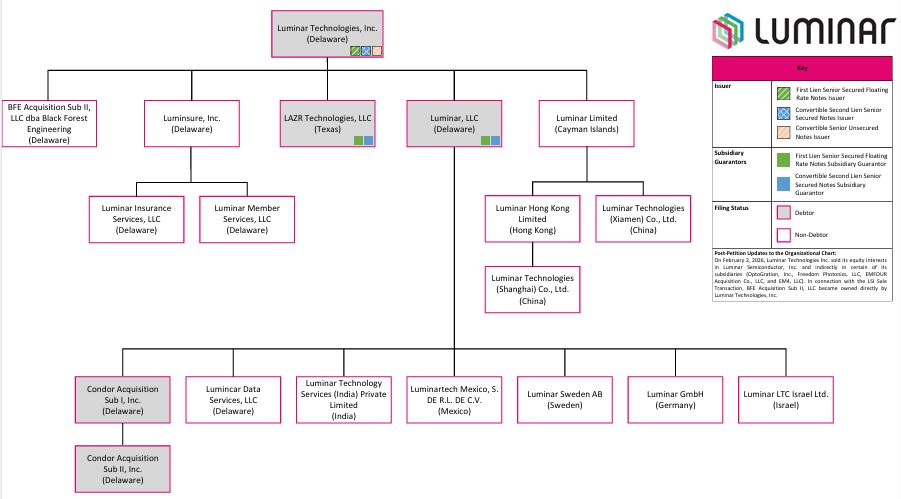

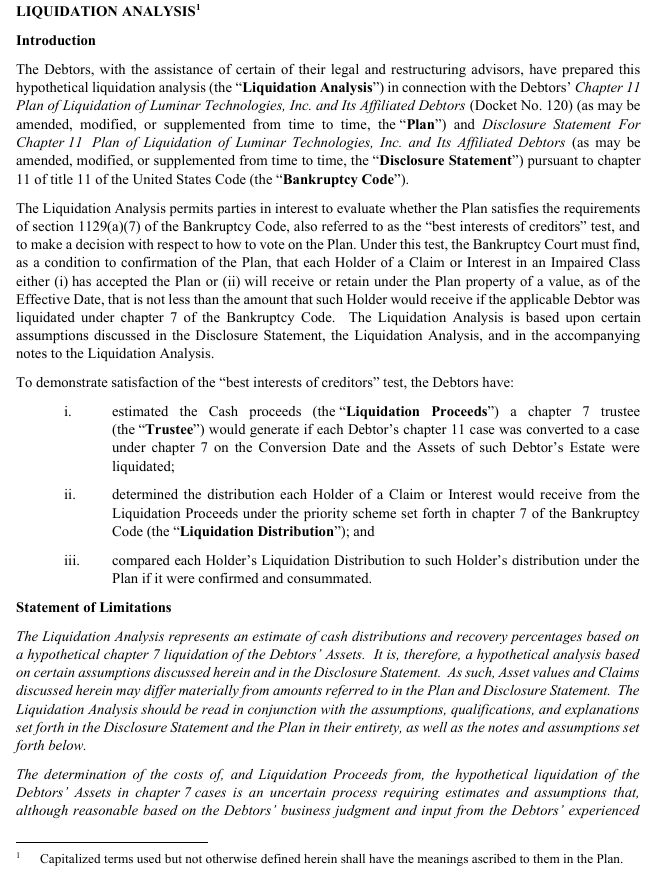
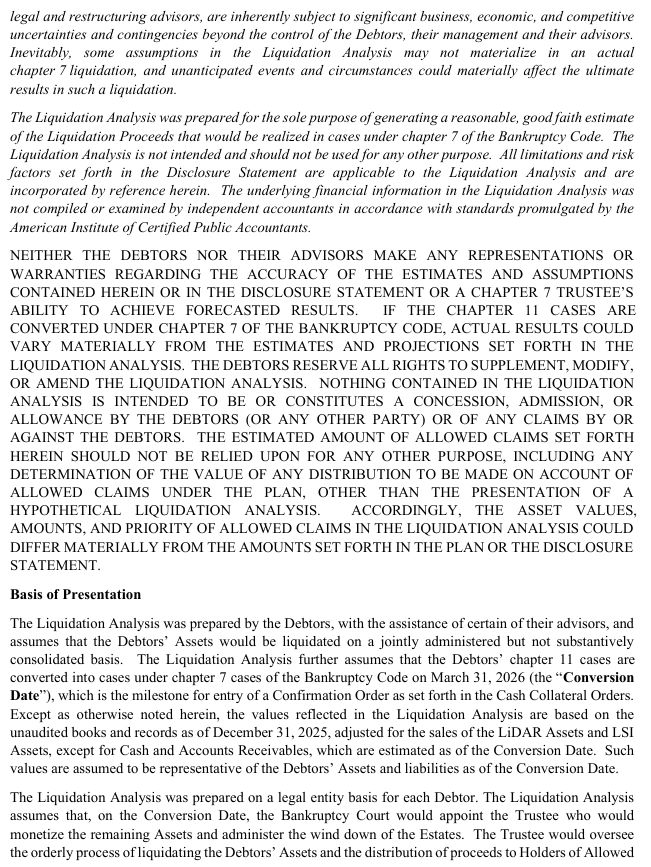
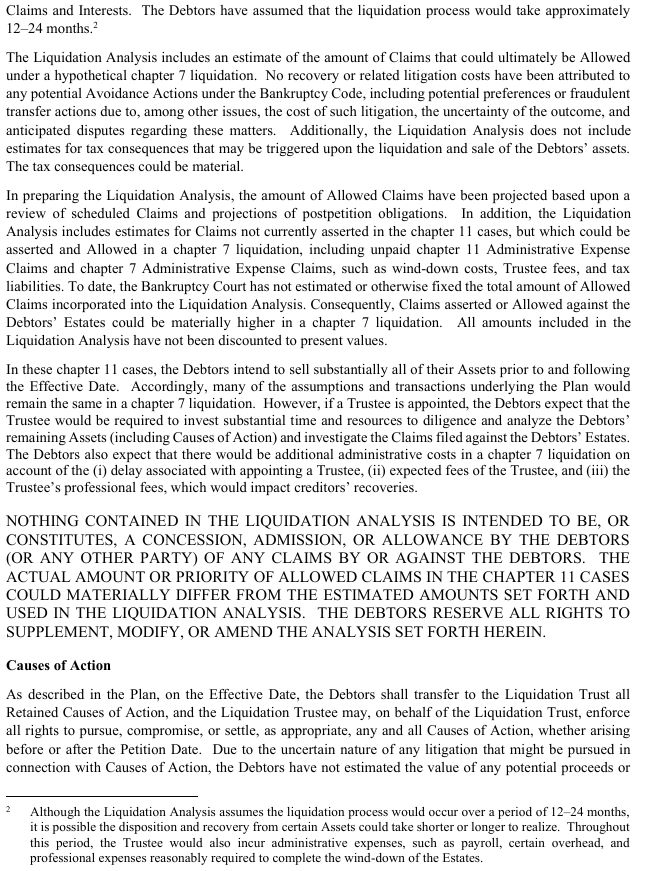
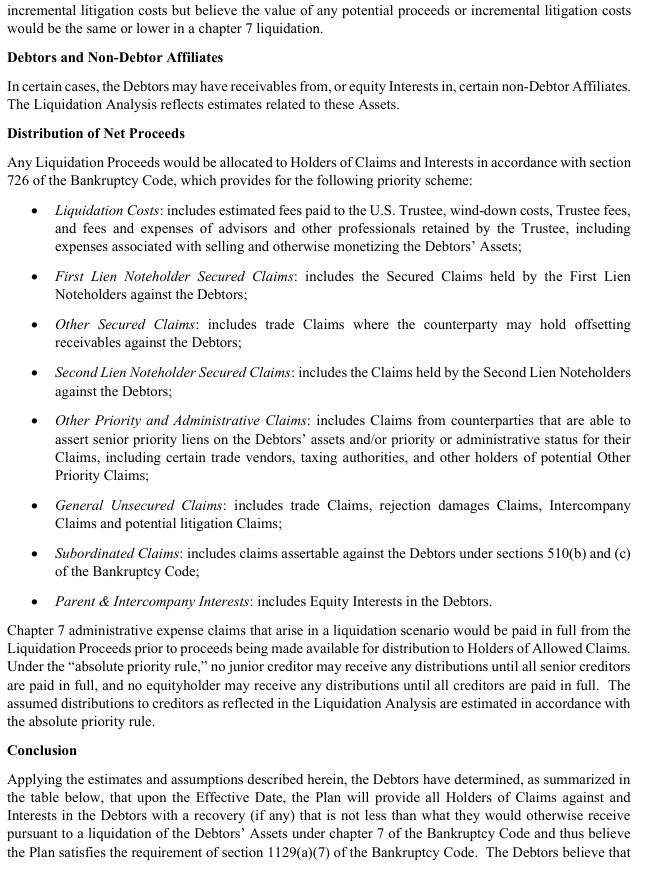
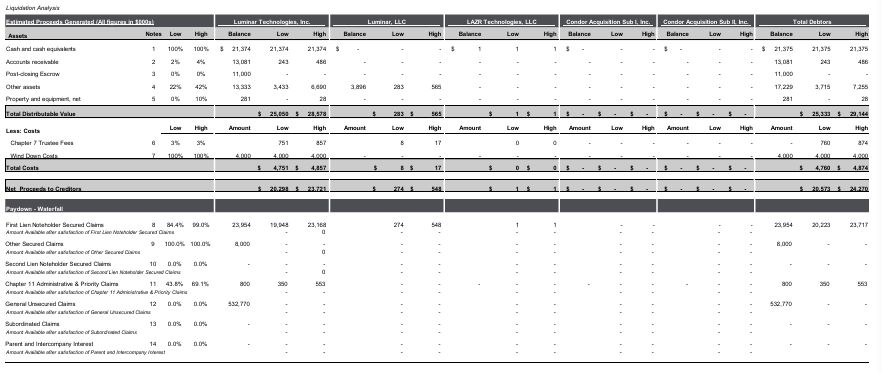
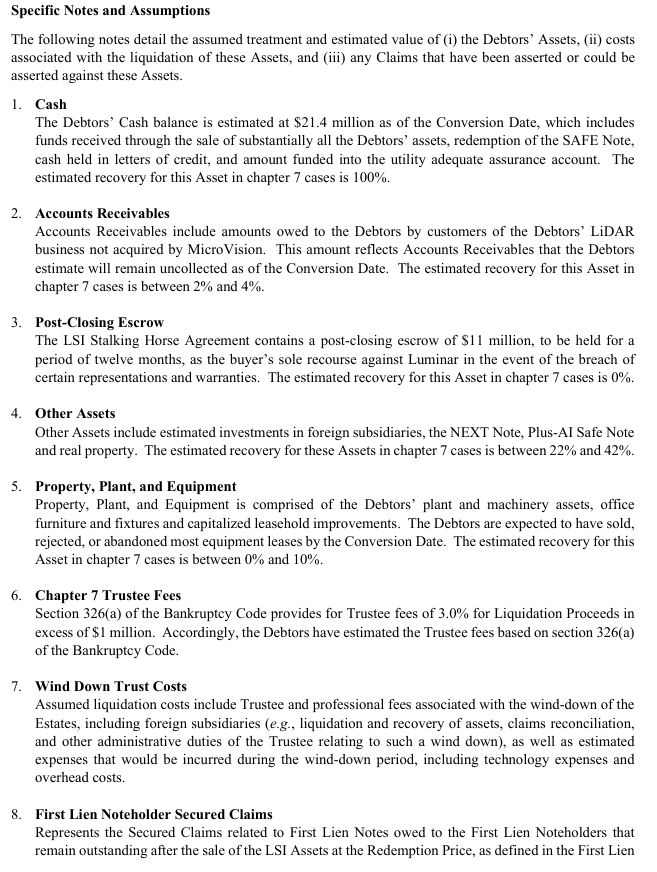


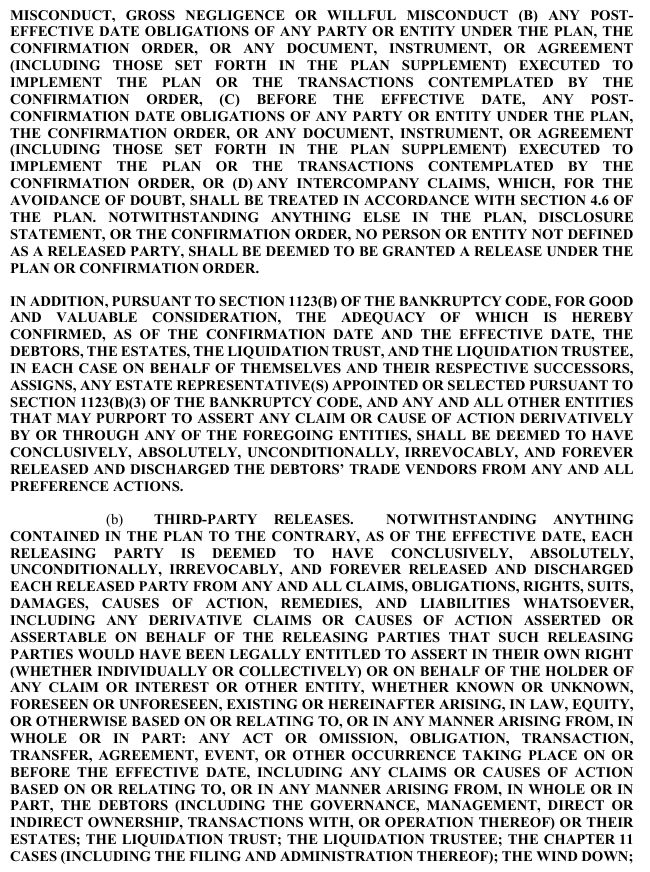
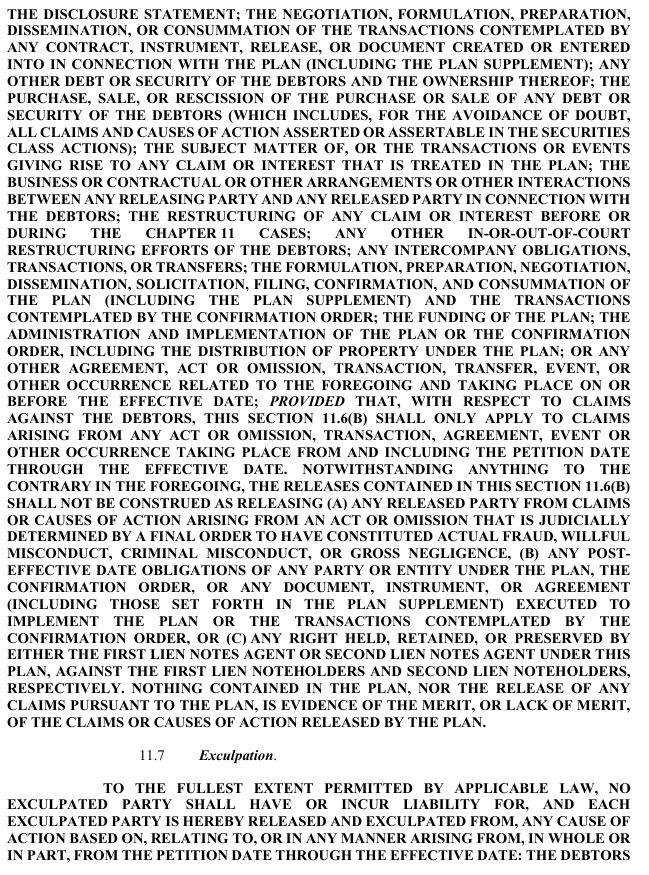
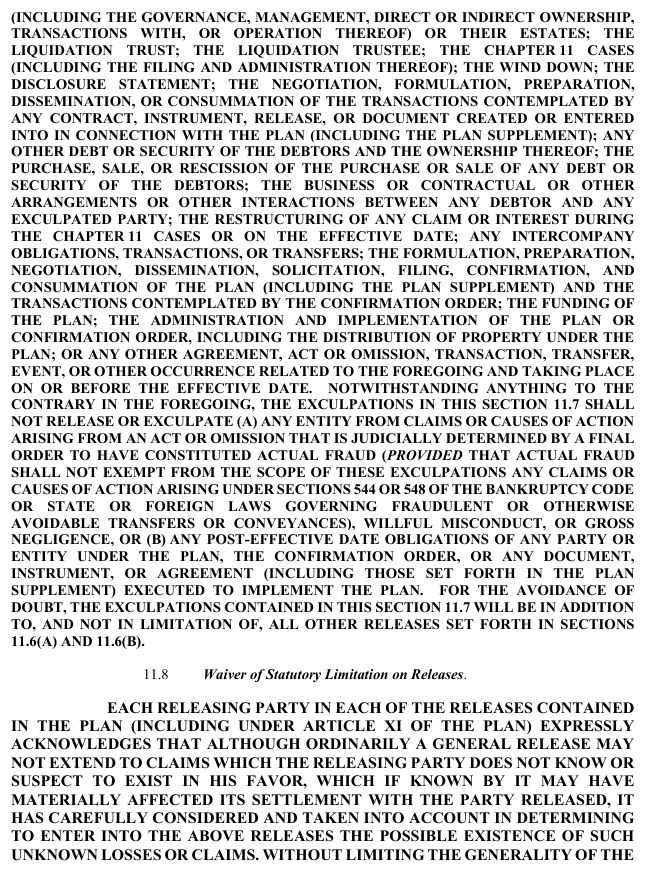
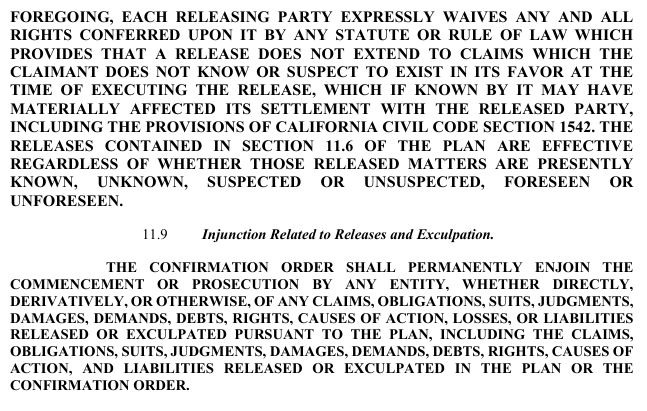

2
3
4
5
6
7
8
9
10
11
12
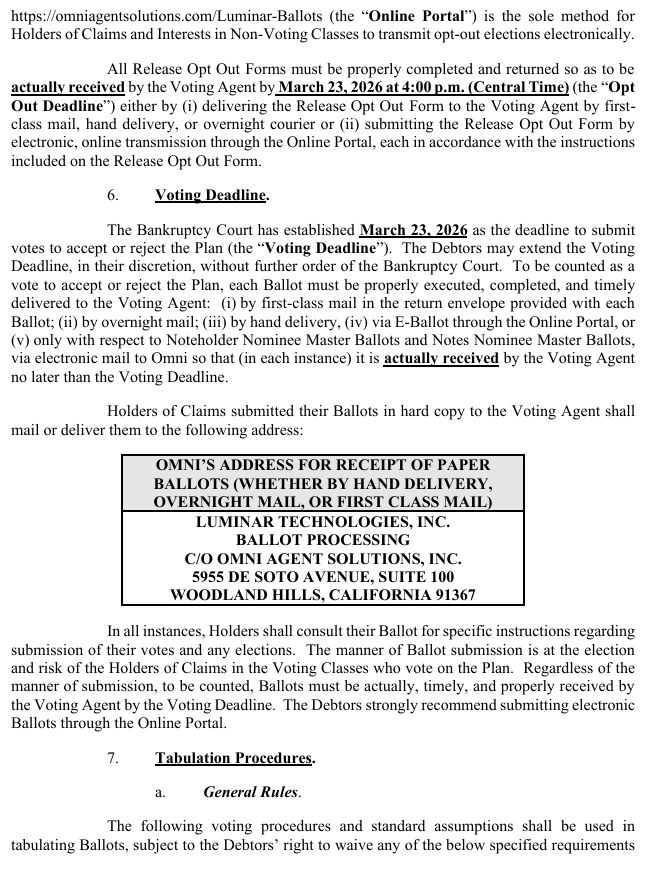
13
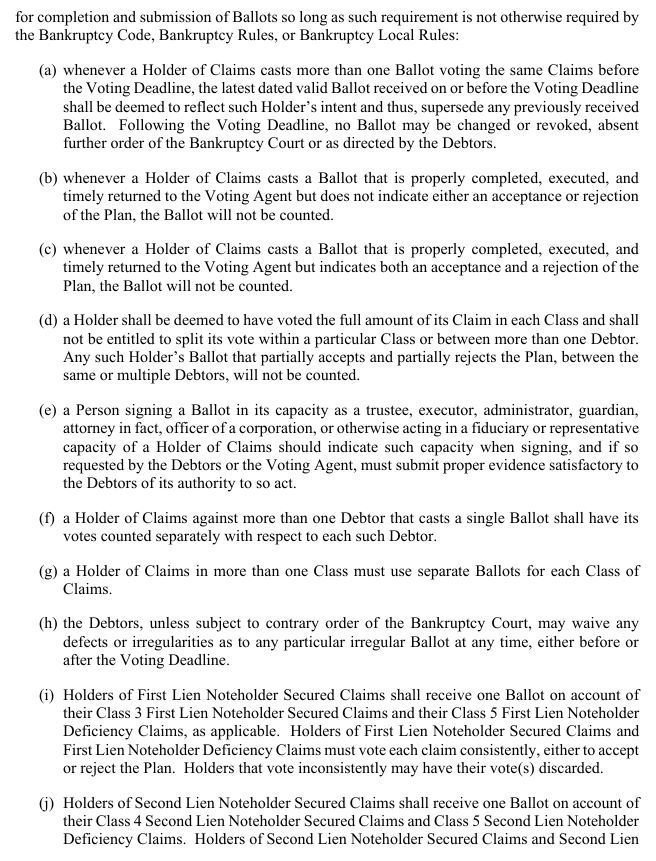
14
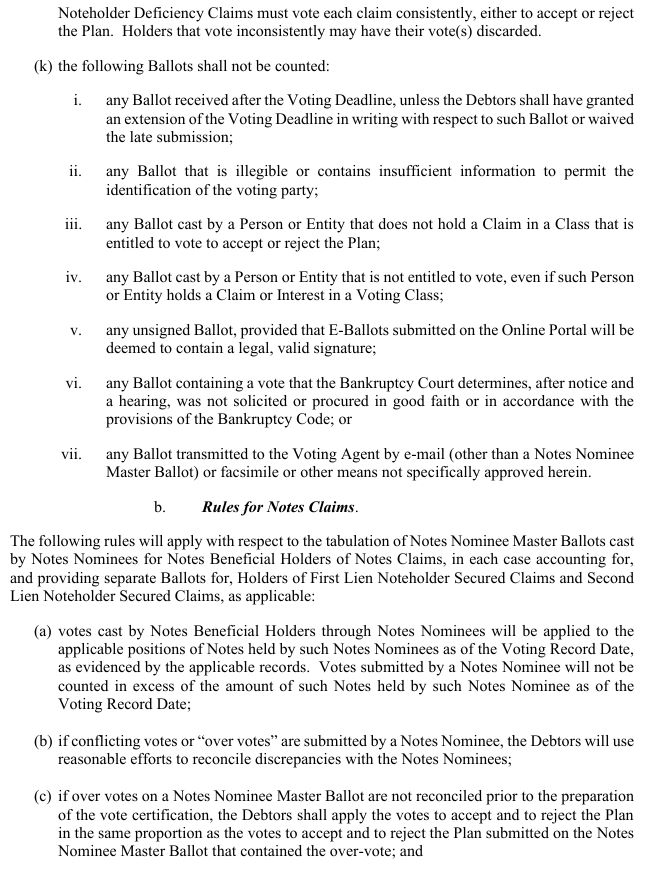
15
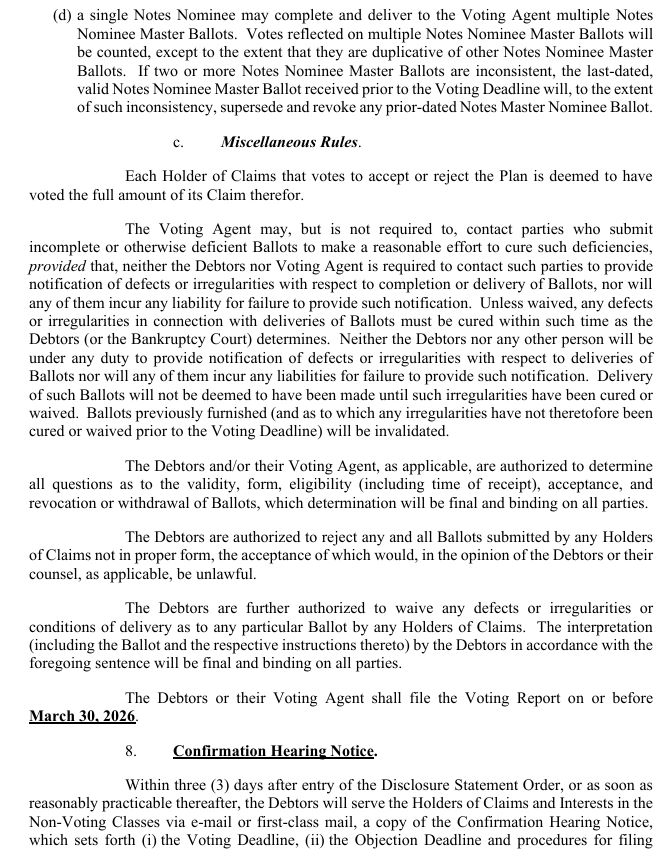
16
17